
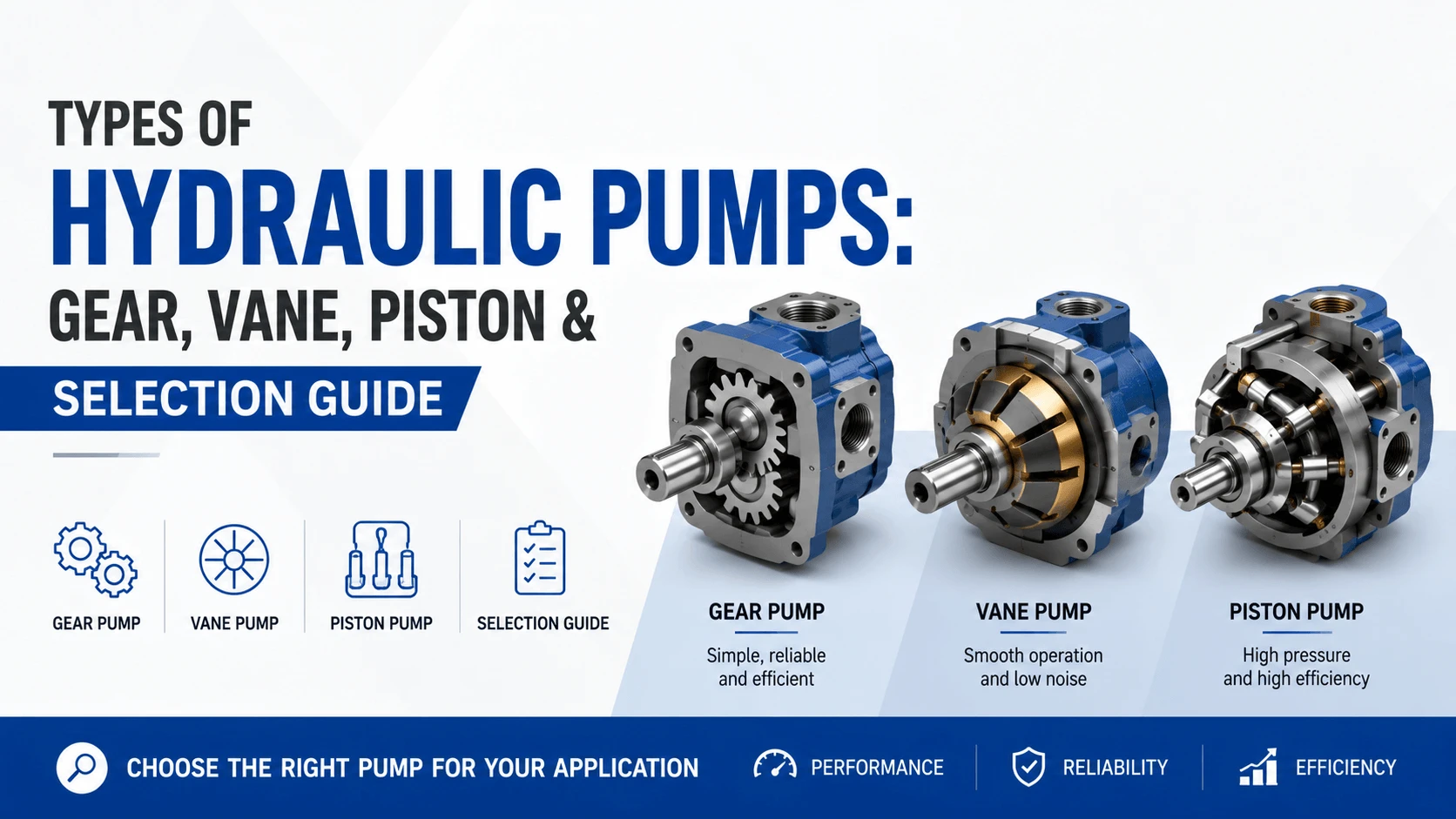
Main Types of Hydraulic Pumps
| Pump Type | Typical Pressure Range | Strengths | Common Applications |
|---|---|---|---|
Gear pump |
Low to medium pressure |
Simple, durable, economical |
Power units, mobile machinery, lubrication |
Vane pump |
Low to medium pressure |
Quiet operation, stable flow |
Machine tools, injection molding, industrial systems |
Piston pump |
Medium to very high pressure |
High efficiency, high pressure capability |
Excavators, presses, marine, mining, closed-loop drives |
1. Gear Pumps
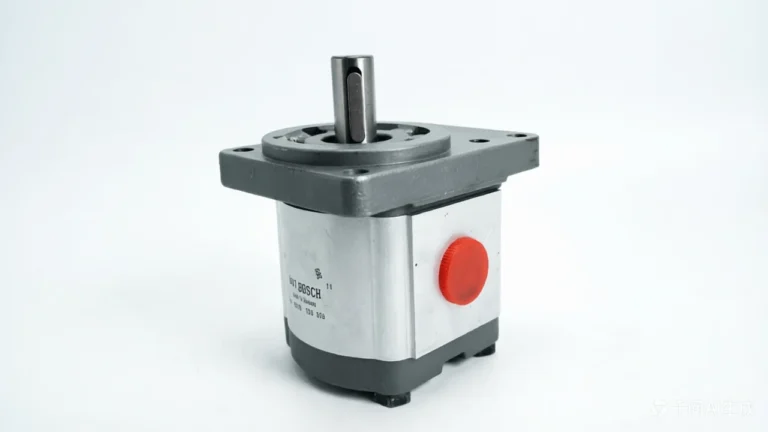
Gear pumps are among the most common hydraulic pump types. They use meshing gears to trap hydraulic oil and move it from the inlet side to the outlet side.
The two main designs are external gear pumps and internal gear pumps. External gear pumps are widely used because they are compact, cost-effective, and tolerant of harsh working environments.
Gear pumps are usually selected for systems that need reliable flow rather than advanced control. Their limitations are higher noise, lower efficiency compared with piston pumps, and limited suitability for very high-pressure systems.
Best for:
- Hydraulic power packs
- Agricultural machinery
- Construction equipment
- Lubrication systems
- Simple industrial circuits
2. Vane Pumps
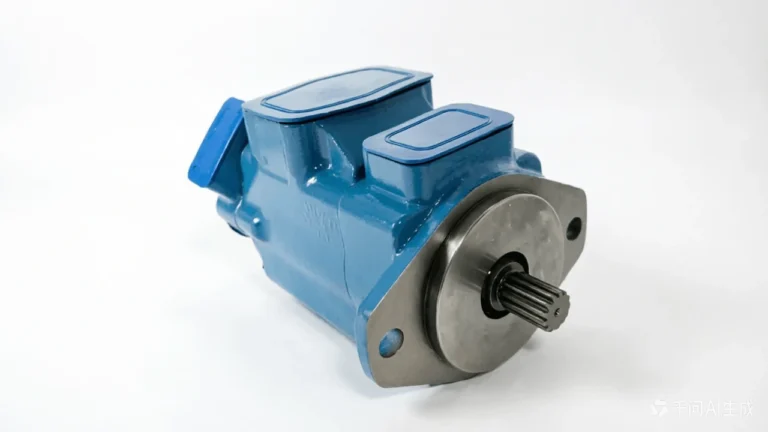
Vane pumps use sliding vanes mounted inside a rotor. As the rotor turns, the vanes follow the cam ring and create expanding and contracting chambers that move oil through the pump.
Compared with gear pumps, vane pumps usually run more quietly and provide smoother flow. They are often used in indoor industrial machinery where noise and flow pulsation matter.
However, vane pumps are more sensitive to oil cleanliness and viscosity. Poor filtration, contaminated oil, or incorrect startup conditions can cause vane wear and reduced efficiency.
Best for:
- Machine tools
- Plastic injection molding machines
- Die casting equipment
- Presses
- Industrial hydraulic power units
3. Piston Pumps
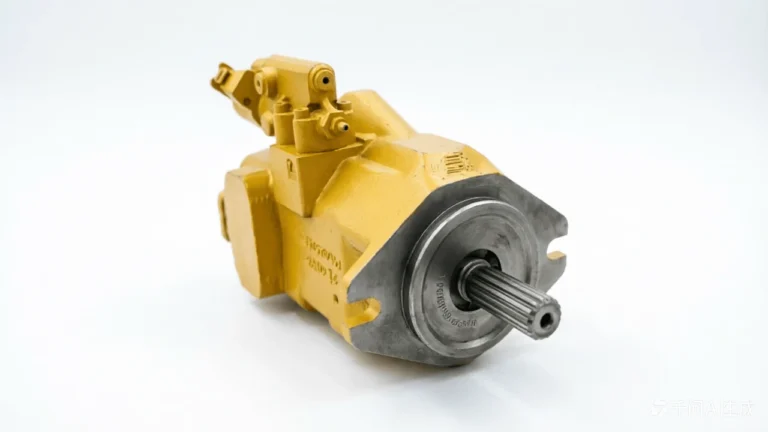
Piston pumps use reciprocating pistons to move hydraulic oil. They are the preferred choice for high-pressure, high-efficiency, and variable-flow hydraulic systems.
The most common designs are axial piston pumps and radial piston pumps. Axial piston pumps are widely used in mobile equipment and industrial systems. Radial piston pumps are often used where very high pressure is required.
Piston pumps are more expensive and require better oil cleanliness, but they deliver strong performance in demanding applications. In excavators, mining equipment, hydraulic presses, and marine systems, piston pumps are often the correct choice because they combine pressure capability with efficiency and controllability.
Best for:
- High-pressure hydraulic systems
- Excavators and mobile machinery
- Hydraulic presses
- Marine and offshore equipment
- Closed-loop hydrostatic drives
Fixed Displacement vs Variable Displacement Pumps
A fixed-displacement pump delivers the same theoretical flow per revolution. Flow changes mainly when pump speed changes.
A variable-displacement pump can adjust its displacement while running. This allows the system to match flow demand, reduce heat generation, and improve energy efficiency.
| Type | Advantages | Limitations |
|---|---|---|
Fixed displacement |
Simple, lower cost, easy maintenance |
Less efficient when demand changes |
Variable displacement |
Better control, lower energy loss, reduced heat |
Higher cost, more complex controls |
For simple lifting, clamping, or transfer systems, fixed-displacement gear or vane pumps may be enough. For load-sensing systems, mobile hydraulics, and high-efficiency industrial equipment, variable-displacement piston pumps are often preferred.
Open Loop vs Closed Loop Hydraulic Pump Systems
In an open-loop system, the pump draws oil from a reservoir and sends it through valves to actuators before the oil returns to tank. This layout is common in presses, cylinders, and general industrial machinery.
In a closed-loop system, oil circulates directly between the pump and hydraulic motor. This design is common in hydrostatic transmissions, travel drives, and winch systems. Closed-loop systems often use variable-displacement piston pumps for precise speed and torque control.
How to Choose the Right Hydraulic Pump
When selecting a hydraulic pump, start with the actual system requirement rather than the pump category.
Key selection factors include:
- Required flow rate
- Maximum working pressure
- Duty cycle
- Fluid viscosity and temperature
- Noise limits
- Efficiency requirements
- Available drive speed and power
- Contamination control level
- Space and mounting requirements
- Total lifecycle cost
A gear pump may be the right choice for a rugged, low-cost power unit. A vane pump may be better for quieter industrial operation. A piston pump is usually the best option when the system requires high pressure, variable flow, and high efficiency.
Common Hydraulic Pump Problems
Common pump failures include:
- Cavitation from poor inlet conditions
- Aeration from air entering the suction line
- Internal leakage from wear
- Bearing failure from misalignment or overload
- Seal failure from heat or pressure spikes
- Low efficiency caused by worn rotating groups
- Excessive noise from contamination, cavitation, or damaged parts
Many pump failures are not caused by the pump alone. Incorrect suction pipe sizing, dirty oil, wrong viscosity, blocked filters, and overheating can destroy even a correctly specified pump.
Maintenance Tips
Good pump maintenance starts with oil condition. Use the correct hydraulic fluid, maintain proper filtration, and monitor temperature, noise, vibration, and pressure changes.
Practical maintenance checks include:
- Inspect suction lines for leaks or restrictions
- Replace filters before bypass conditions occur
- Monitor oil cleanliness and water contamination
- Check coupling alignment
- Confirm relief valve settings
- Avoid dry starts
- Record pressure, flow, temperature, and noise trends
FAQs
What are the three main types of hydraulic pumps?
The three main types are gear pumps, vane pumps, and piston pumps.
Which hydraulic pump is best for high pressure?
Piston pumps are generally best for high-pressure hydraulic systems because they offer higher efficiency and stronger pressure capability.
What is the difference between fixed and variable displacement pumps?
A fixed-displacement pump delivers a constant volume per revolution. A variable-displacement pump can adjust output flow while operating.
Are gear pumps better than piston pumps?
Not always. Gear pumps are simpler and cheaper, while piston pumps are more efficient and suitable for high-pressure or variable-flow systems.
Why do hydraulic pumps fail?
Common causes include contamination, cavitation, overheating, poor lubrication, incorrect fluid viscosity, excessive pressure, and improper installation.
Authority Sources
Need help choosing the right hydraulic pump for your equipment? Contact our engineering team with your pressure, flow rate, duty cycle, fluid type, and application details. We can help you compare gear, vane, and piston pump options and recommend a reliable solution for your hydraulic system.