
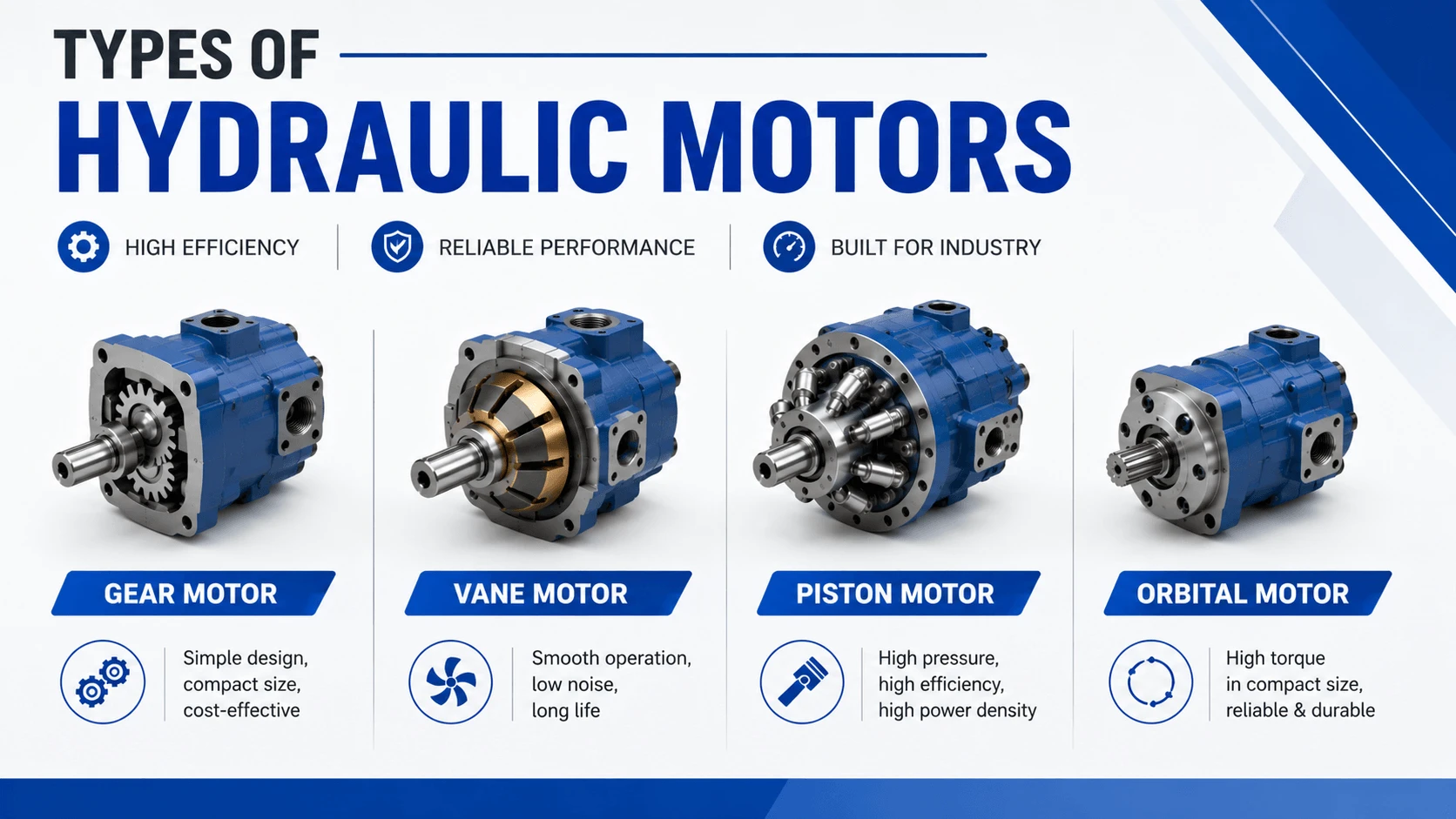
The main types of hydraulic motors are gear motors, vane motors, piston motors, orbital motors, and radial piston motors. Each design has a different performance profile, so the right choice depends on the required torque, speed range, pressure, duty cycle, efficiency, and installation space.
Hydraulic motors convert hydraulic pressure and flow into rotary torque and speed. They are used when electric motors are not ideal because the machine needs high power density, shock-load resistance, compact packaging, or precise force control.
What Is a Hydraulic Motor?
A hydraulic motor is a rotary actuator. Pressurized oil enters the motor, acts on gears, vanes, pistons, or an orbital gear set, and turns an output shaft.
Two basic relationships matter during selection:
- Higher flow generally increases motor speed.
- Higher pressure generally increases motor torque.
In practice, leakage, friction, oil viscosity, temperature, and load conditions reduce actual performance. That is why catalog torque and speed values should be checked against continuous ratings, not only peak ratings.
How Hydraulic Motors Work
A hydraulic pump supplies oil flow to the motor. The motor converts that hydraulic energy into shaft rotation. The motor may be installed in an open-loop circuit, where oil returns to tank after passing through the motor, or in a closed-loop hydrostatic transmission, where pump and motor flow circulate in a loop.
The most important sizing variables are:
| Variable | Why It Matters |
|---|---|
Displacement |
Determines torque per bar and speed per L/min |
Pressure rating |
Determines available torque and durability |
Flow rate |
Determines operating speed |
Efficiency |
Affects heat generation and power loss |
Starting torque |
Critical for winches, conveyors, augers, and wheel drives |
Case drain requirement |
Important for piston motors and some high-pressure designs |
Side-load capacity |
Matters when sprockets, pulleys, or wheels mount directly to the shaft |
Main Types of Hydraulic Motors
1. Gear Hydraulic Motors
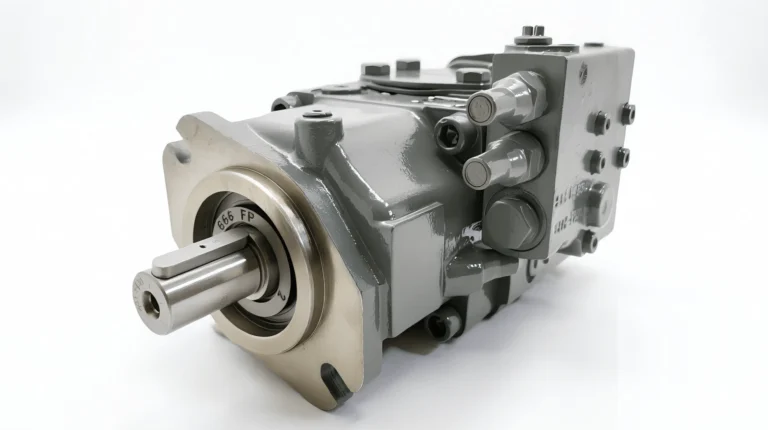
| Feature | Gear Motor Profile |
|---|---|
Cost |
Low to moderate |
Efficiency |
Moderate |
Speed range |
Medium to high |
Low-speed smoothness |
Limited |
Contamination tolerance |
Better than piston motors |
Best use |
Simple rotary drives where cost and durability matter |
2. Vane Hydraulic Motors
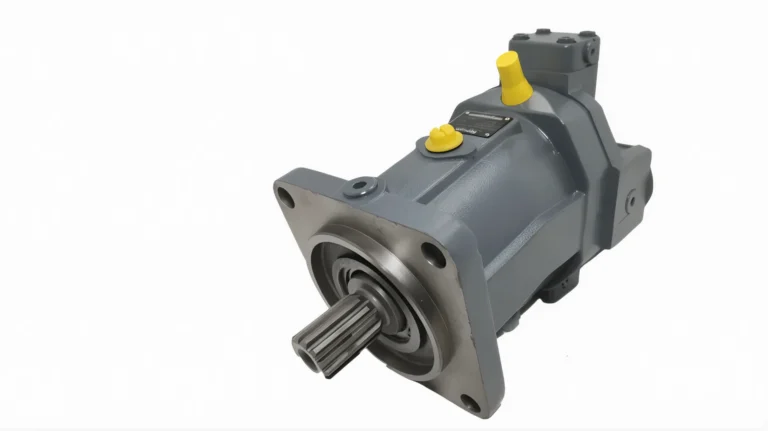
| Feature | Vane Motor Profile |
|---|---|
Cost |
Moderate |
Efficiency |
Moderate to good |
Noise level |
Usually lower than gear motors |
Low-speed behavior |
Better than gear motors |
Contamination sensitivity |
Moderate to high |
Best use |
Smooth medium-duty rotary motion |
3. Orbital Hydraulic Motors
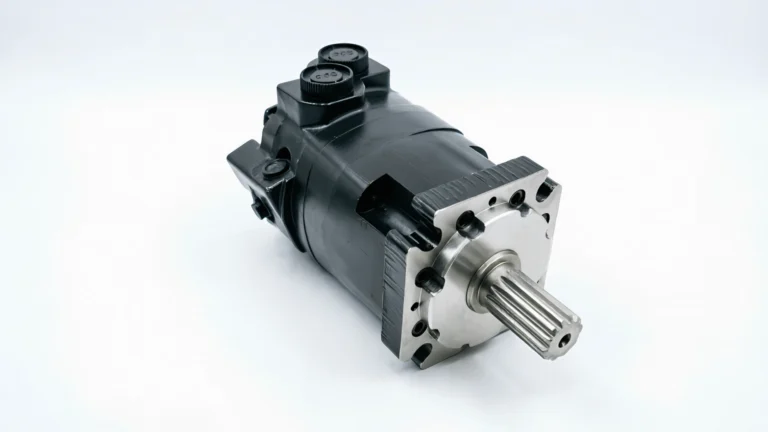
| Feature | Orbital Motor Profile |
|---|---|
Torque |
High for size |
Speed range |
Low to medium |
Low-speed stability |
Good |
Cost |
Moderate |
Efficiency |
Moderate |
Best use |
Low-speed, high-torque mobile machinery |
4. Axial Piston Hydraulic Motors
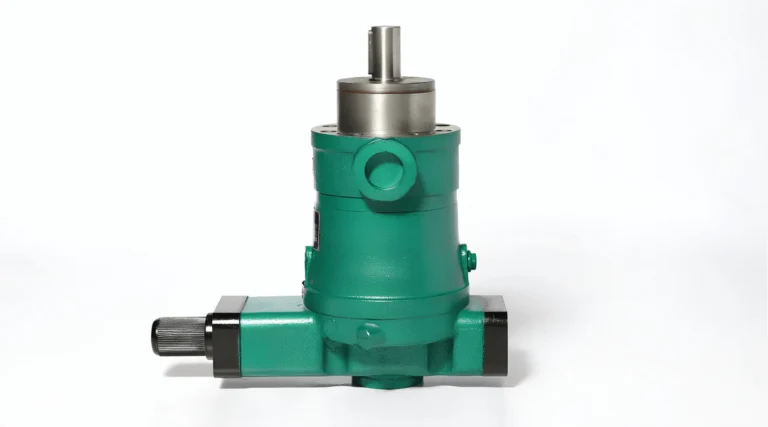
| Feature | Axial Piston Motor Profile |
|---|---|
Pressure capability |
High |
Efficiency |
High |
Speed range |
Wide |
Cost |
High |
Cleanliness requirement |
High |
Best use |
High-performance hydraulic drives |
5. Radial Piston Hydraulic Motors
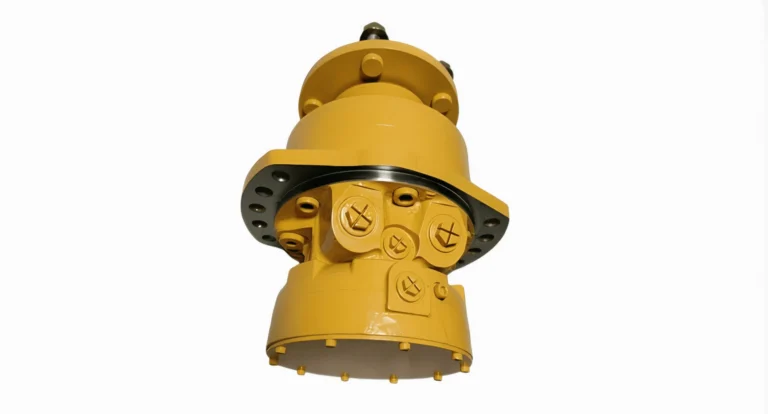
| Feature | Radial Piston Motor Profile |
|---|---|
Starting torque |
Very high |
Low-speed performance |
Excellent |
Pressure capability |
High |
Size |
Larger than many alternatives |
Cost |
High |
Best use |
Heavy-duty low-speed high-torque drives |
Hydraulic Motor Type Comparison
| Motor Type | Best For | Main Advantages | Main Limitations |
|---|---|---|---|
Gear motor |
Simple rotary drives |
Low cost, compact, rugged |
Lower efficiency, rougher at low speed |
Vane motor |
Smooth medium-duty drives |
Quiet, smooth, compact |
Sensitive to contamination |
Orbital motor |
Low-speed high-torque mobile drives |
High starting torque, compact |
Limited high-speed performance |
Axial piston motor |
High-pressure precision drives |
High efficiency, variable displacement options |
Higher cost, clean oil required |
Radial piston motor |
Heavy-duty direct drives |
Very high torque, excellent low-speed control |
Larger, expensive |
How to Select the Right Hydraulic Motor
Start with the load, not the motor catalog.
- Define required output torque.
- Define the required shaft speed range.
- Check available system pressure and flow.
- Decide whether fixed or variable displacement is needed.
- Review duty cycle: continuous, intermittent, or peak.
- Check starting torque, stall torque, and low-speed stability.
- Confirm shaft load, mounting style, and port orientation.
- Verify case drain, flushing, and cooling requirements.
- Match oil viscosity, filtration, and cleanliness to the motor type.
For example, a conveyor drive may work well with a gear or orbital motor. A closed-loop wheel drive on mobile machinery usually points toward a piston motor. A crusher or winch that needs very high torque at low speed may justify a radial piston motor.
Common Problems and Troubleshooting
| Symptom | Possible Cause | Practical Check |
|---|---|---|
Motor runs slowl |
Low flow, internal leakage, worn motor |
Measure flow and pressure under load |
Low torque |
Low pressure, relief valve setting, worn components |
Check pressure at motor inlet |
Excessive heat |
High leakage, wrong viscosity, overloading |
Check oil temperature and case drain flow |
Noise or vibration |
Cavitation, air in oil, misalignment |
Inspect inlet conditions and couplings |
Shaft seal failure |
High case pressure, blocked drain |
Check drain line restriction |
Erratic motion |
Contaminated oil, valve instability, load variation |
Inspect filtration and control valve behavior |
Maintenance Tips
Good hydraulic motor life depends heavily on oil condition and operating temperature. Keep filtration matched to the most sensitive component in the circuit, especially when piston motors are used.
Useful practices include:
- Maintain correct oil viscosity for operating temperature.
- Keep suction restrictions low to avoid cavitation.
- Check case drain flow on piston motors.
- Avoid long operation at relief pressure.
- Inspect couplings and shaft alignment.
- Replace contaminated oil after major component failure.
- Confirm the motor is rated for shock loads and braking loads.
FAQ
What are the main types of hydraulic motors?
The main types are gear motors, vane motors, orbital motors, axial piston motors, and radial piston motors. Gear and vane motors are common in general industrial use, while piston and radial piston motors are used for higher pressure, higher efficiency, or high-torque applications.
Which hydraulic motor is best for low speed and high torque?
Orbital motors and radial piston motors are usually best for low-speed high-torque applications. Orbital motors are common in compact mobile machinery, while radial piston motors are preferred for heavy-duty winches, crushers, and direct drives.
What is the difference between axial piston and radial piston motors?
Axial piston motors arrange pistons parallel to the shaft axis and are often used for high-efficiency, high-speed, high-pressure drives. Radial piston motors arrange pistons around the shaft and are better for very high torque at low speed.
Are hydraulic motors fixed or variable displacement?
Both options exist. Gear, vane, and orbital motors are commonly fixed-displacement. Axial piston motors are available in fixed and variable displacement designs, making them useful for hydrostatic transmissions and adjustable-speed drives.
Why do hydraulic motors fail?
Common causes include contaminated oil, overheating, cavitation, excessive pressure, wrong viscosity, high case pressure, misalignment, and operation beyond continuous-duty ratings.
Authority Sources
- Parker: Selecting the Right Hydraulic Motor
- Mobile Hydraulic Tips: Selecting a Hydraulic Motor
- RoyMech: Hydraulic Motors
Need help selecting a hydraulic motor for your equipment? Share your required torque, speed, pressure, flow rate, duty cycle, and mounting dimensions with our engineering team. We can help compare gear, vane, orbital, axial piston, and radial piston motor options for your application.