
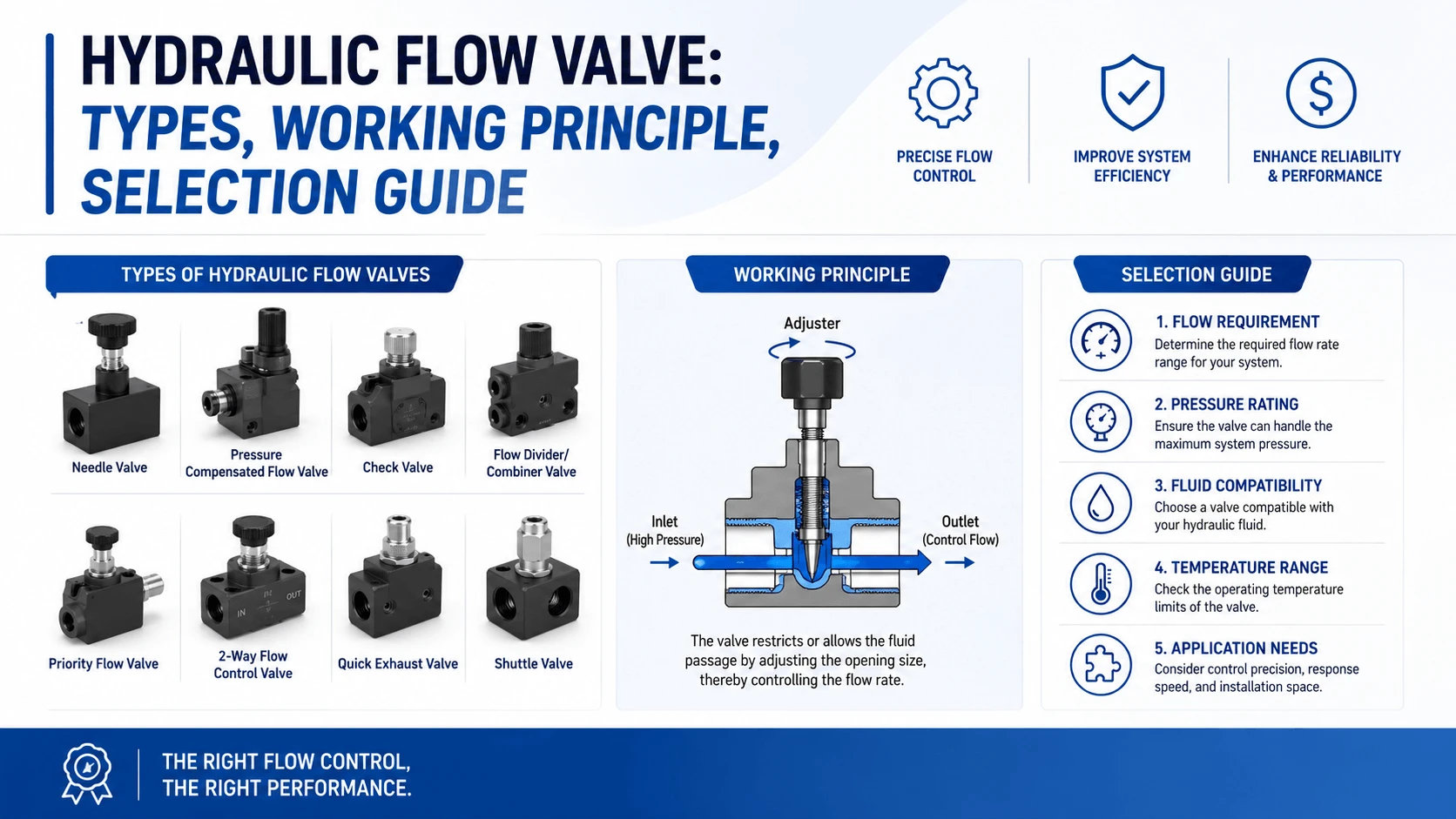
A hydraulic flow valve controls the flow rate of hydraulic oil in a circuit. In practical terms, it controls actuator speed: how fast a cylinder extends, how fast a hydraulic motor rotates, or how quickly a machine function responds.
The important point is that a flow valve is not primarily a pressure-control device. It regulates flow by restricting, diverting, or prioritizing oil flow. If the valve is incorrectly selected, the result can be unstable speed, overheating, wasted energy, or poor machine control.
What Is a Hydraulic Flow Valve?
A hydraulic flow valve, often called a hydraulic flow control valve, is a valve used to regulate oil flow in a hydraulic system. It may be installed in the pressure line, return line, meter-in circuit, meter-out circuit, or bypass line, depending on the application.
Typical uses include:
- Controlling hydraulic cylinder speed
- Regulating hydraulic motor RPM
- Balancing flow between multiple actuators
- Maintaining stable flow despite pressure changes
- Protecting downstream circuits from excessive flow
How It Works
Most hydraulic flow valves work by changing the size of an internal flow passage. A smaller opening increases resistance and reduces flow. A larger opening allows more oil to pass.
In a basic needle valve, the operator adjusts a tapered needle against a seat. This creates a variable orifice. The flow rate depends on the opening size, oil viscosity, inlet pressure, outlet pressure, and load condition.
A pressure-compensated flow valve adds a compensator spool. This spool helps maintain a more constant pressure drop across the metering orifice, so flow remains more stable when load pressure changes.
A simple engineering relationship is:
Cylinder speed = Flow rate / Cylinder area
For example, increasing the flow to a hydraulic cylinder increases extension speed. However, forcing oil through a restriction also creates heat. A useful heat-loss estimate is:
Power loss in kW = Pressure drop in bar x Flow in L/min / 600
This is why excessive throttling is a common cause of high oil temperature.
Main Types of Hydraulic Flow Valves
| Valve Type | Main Function | Best Use Case |
|---|---|---|
Needle valve |
Manual fine flow adjustment |
Simple speed control |
Flow control valve with check |
Controlled flow one way, free flow reverse |
Cylinder speed control |
Pressure-compensated flow valve |
Stable flow under changing load |
Variable-load equipment |
Priority flow valve |
Supplies priority circuit first |
Steering, braking, auxiliary circuits |
Flow divider/combiner |
Splits or combines flow |
Synchronized cylinders or motors |
Proportional flow valve |
Electrically controlled variable flow |
Automation and closed-loop control |
Key Components
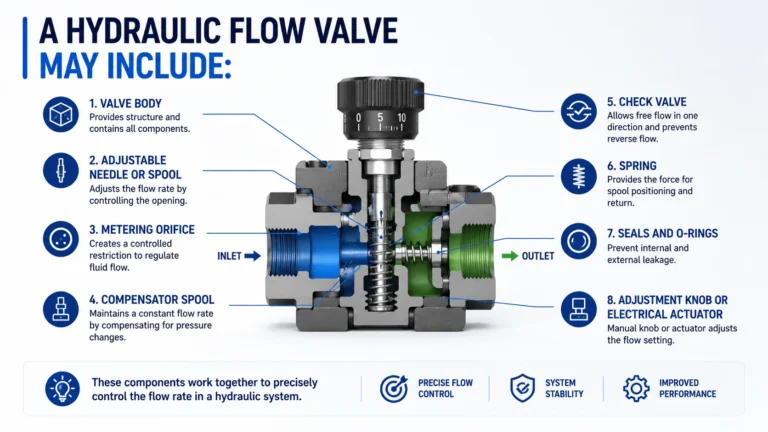
A hydraulic flow valve may include:
- Valve body
- Adjustable needle or spool
- Metering orifice
- Compensator spool
- Check valve
- Spring
- Seals and O-rings
- Adjustment knob or electrical actuator
In cartridge-style valves, these parts are often integrated into a compact cavity-mounted design. In inline valves, the valve body is installed directly into the hydraulic line.
Advantages
Hydraulic flow valves offer several practical benefits:
- Simple actuator speed control
- Compact circuit design
- Better machine repeatability
- Protection against excessive actuator speed
- Easy manual or electronic adjustment
- Suitable for mobile, industrial, and agricultural systems
Limitations
Flow valves also have limitations:
- Throttling creates heat
- Non-compensated valves may vary with load pressure
- Incorrect sizing can cause poor control resolution
- Contamination can block small metering passages
- Flow control cannot replace proper pressure relief protection
A common mistake is using a basic needle valve where a pressure-compensated valve is required. If the load changes frequently, actuator speed may change even when the valve setting remains the same.
Industrial Applications
Hydraulic flow valves are widely used in:
- Injection molding machines
- Press brakes and hydraulic presses
- CNC clamping systems
- Agricultural implements
- Construction machinery
- Material handling equipment
- Marine hydraulic systems
- Hydraulic power units
- Test benches and industrial automation
For example, a press machine may use a flow control valve to slow the cylinder during the working stroke while allowing faster return flow through an integrated check valve.
Common Problems
| Problem | Likely Cause | Practical Check |
|---|---|---|
Actuator too slow |
Valve over-restricted, blocked filter, low pump flow |
Check valve setting and pump output |
Speed changes under load |
Non-compensated valve used in variable-load circuit |
Use pressure-compensated valve |
Oil overheating |
Excessive pressure drop across valve |
Measure pressure before and after valve |
No flow |
Blocked orifice, wrong installation direction |
Inspect valve and flow arrow |
Cylinder jerks |
Air in system, contamination, unstable load |
Bleed system and check oil cleanliness |
Adjustment has little effect |
Valve oversized or bypass leakage |
Confirm rated flow range |
Troubleshooting Guide
- Confirm the valve type. Check whether the valve is a needle valve, compensated flow control valve, priority valve, or proportional valve.
- Check installation direction. Many flow control valves with reverse-flow check functions are directional.
- Measure flow and pressure. Do not troubleshoot by feel only. Measure inlet pressure, outlet pressure, and actual flow where possible.
- Inspect oil condition. Contamination can damage spools and block small orifices. Poor cleanliness is one of the most common causes of unstable flow control.
- Check oil temperature and viscosity. Cold oil increases resistance. Hot oil can reduce viscosity and increase internal leakage.
- Verify valve sizing. A valve rated for much higher flow than the application may be difficult to adjust accurately at low flow.
How to Select a Hydraulic Flow Valve
| Selection Factor | What to Check |
|---|---|
Required flow rate |
Minimum, normal, and maximum L/min or GPM |
Pressure rating |
Must exceed system working pressure with margin |
Compensation |
Needed if load pressure changes |
Flow direction |
Otne-way, two-way, or reverse free-flow requiremen |
Adjustment method |
Manual knob, screw, lever, hydraulic, or electric |
Mounting style |
Inline, subplate, cartridge, manifold |
Fluid compatibility |
Mineral oil, biodegradable oil, fire-resistant fluid |
Environment |
Temperature, vibration, contamination risk |
Control accuracy |
Manual adjustment vs proportional control |
Typical industrial hydraulic systems often operate around 100-250 bar, while mobile or heavy-duty systems may operate around 250-350 bar or higher depending on design. Always select the valve according to the actual machine pressure, flow, safety requirements, and manufacturer rating.
Maintenance Tips
- Keep hydraulic oil clean and properly filtered.
- Check valve adjustment locks after commissioning.
- Inspect seals for leakage during scheduled maintenance.
- Avoid using flow valves as a substitute for pressure relief valves.
- Record final valve settings after machine tuning.
- Replace damaged knobs, springs, and cartridges rather than forcing adjustment.
- Flush the circuit after pump, hose, or cylinder failure.
Conclusion
A hydraulic flow valve is a key component for controlling actuator speed and machine motion. The correct valve depends on flow rate, pressure, load variation, control accuracy, installation style, and heat management.
For simple applications, a needle valve or flow control valve with a check may be sufficient. For variable-load systems, a pressure-compensated flow control valve is usually the better choice. For automation, proportional flow control provides more flexible and repeatable performance.
FAQs
What does a hydraulic flow valve do?
A hydraulic flow valve controls the flow rate of hydraulic oil. This controls actuator speed, such as cylinder movement or hydraulic motor rotation.
Is a flow valve the same as a pressure valve?
No. A flow valve controls oil flow. A pressure valve controls or limits pressure. Restricting flow can increase pressure drop, but that does not make a flow valve a proper pressure-control device.
What is the difference between a needle valve and a flow control valve?
A needle valve is a simple, adjustable restriction. A flow control valve may include additional features such as pressure compensation, reverse-flow check, or priority flow control.
When should I use a pressure-compensated flow valve?
Use a pressure-compensated flow valve when the actuator speed must remain stable even when the load pressure changes.
Why does a hydraulic flow valve cause heat?
Heat is generated when oil is forced through a restriction, and pressure energy is converted into thermal energy. Excessive throttling can raise oil temperature and reduce system efficiency.
Authority Sources
- ISO fluid power standards overview
- NFPA fluid power standards
- Parker hydraulic flow control valve technical information
- EN ISO 4413 hydraulic safety reference
Need help selecting a hydraulic flow valve for your equipment? Contact our hydraulic engineering team with your required flow rate, working pressure, oil type, actuator size, and circuit diagram. We can help recommend the correct valve type, pressure rating, and configuration for your application.