
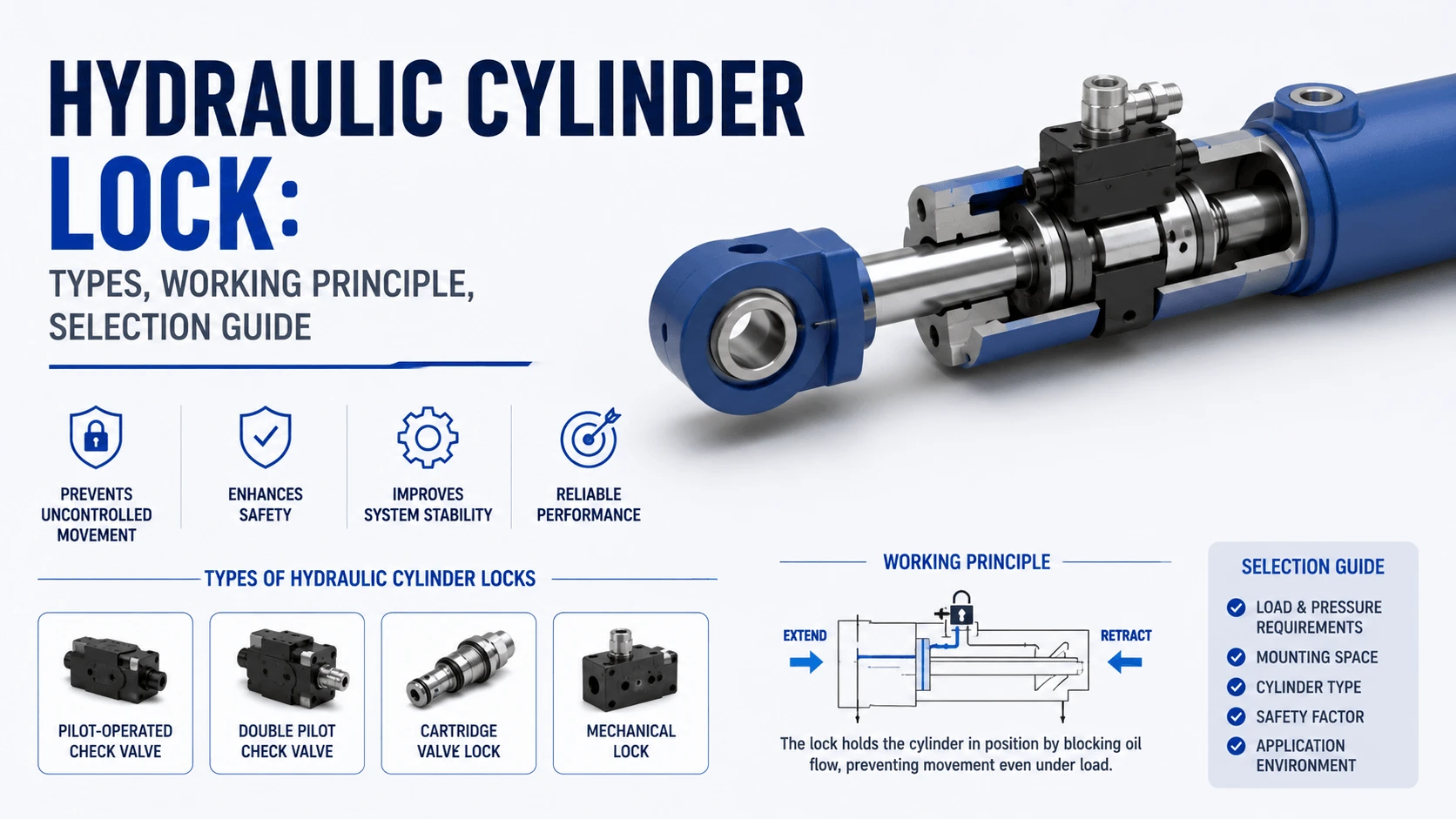
What Is a Hydraulic Cylinder Lock?
Main Types of Hydraulic Cylinder Locks
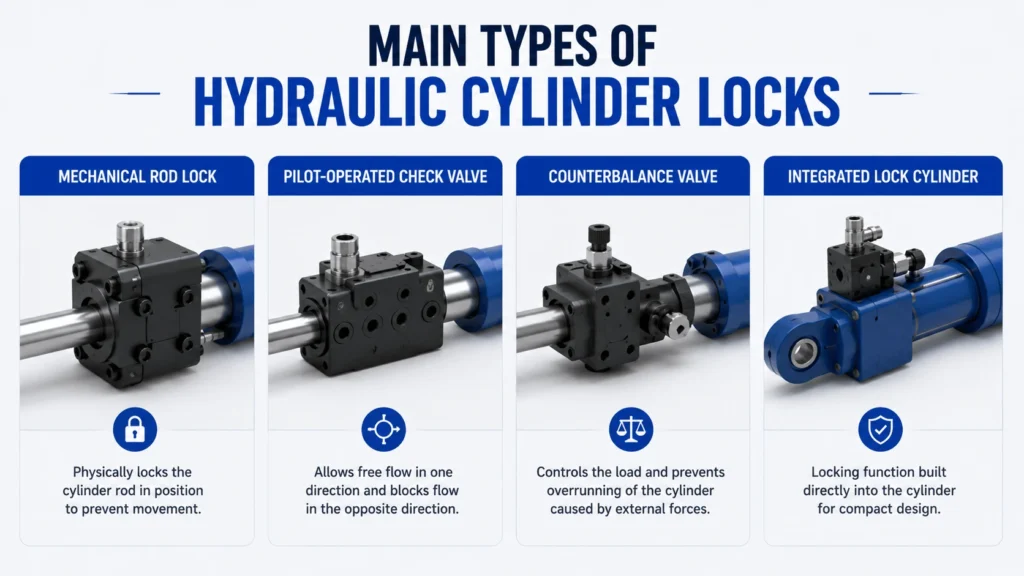
| Type | How It Holds Position | Best For | Limitation |
|---|---|---|---|
Mechanical rod lock |
Clamps or locks the piston rod |
Fail-safe holding, vertical loads, safety-critical axes |
Must be sized by holding force and rod condition |
Pilot-operated check valve |
Traps fluid in the cylinder port until pilot pressure opens it |
Static load holding, preventing drift |
Poor choice for overrunning loads |
Counterbalance valve |
Holds load and meters flow during lowering |
Booms, lifts, winches, gravity-loaded cylinders |
Requires correct setting and pilot ratio |
Integrated lock cylinder |
Locking function built into cylinder assembly |
Compact OEM designs |
Higher customization cost |
How Does a Hydraulic Cylinder Lock Work?
A mechanical hydraulic cylinder rod lock usually uses a spring-applied, hydraulically released design. When hydraulic release pressure is available, the locking element releases the rod and allows normal cylinder movement. When pressure is removed, springs engage the lock and clamp the rod to prevent motion.
A pilot-operated check valve works differently. It allows oil to flow into the cylinder but blocks reverse flow until pilot pressure opens the check. This traps oil in the cylinder chamber and prevents movement caused by valve leakage.
A counterbalance valve combines load holding with motion control. It resists load-induced movement until pilot pressure and load pressure overcome the valve setting. This makes it more suitable for lowering heavy loads without runaway motion.
Advantages
Hydraulic cylinder locks improve machine safety and positional stability. They reduce cylinder drift, help protect workers near suspended loads, and improve repeatability in equipment where position matters.
They are especially valuable in systems where a standard directional valve cannot be trusted to hold a load. Spool valves often have internal leakage, and even small leakage can allow a heavy cylinder to creep over time.
Disadvantages
A cylinder lock is not a universal fix. Mechanical rod locks require clean, undamaged rods and proper alignment. Pilot-operated check valves can create pressure trapping issues and may cause jerky motion with overrunning loads. Counterbalance valves require accurate adjustment and can generate heat if incorrectly specified.
A locking device also does not replace proper cylinder sizing, structural design, or machine guarding. For safety-related applications, the system should be reviewed against applicable hydraulic safety standards such as ISO 4413.
Industrial Applications
Hydraulic cylinder locks are commonly used in:
- Mobile cranes and stabilizer outriggers
- Aerial work platforms and scissor lifts
- Excavator booms and attachments
- Agricultural loaders and folding implements
- Injection molding machines and hydraulic presses
- Marine doors, ramps, and hatch systems
- Mining and construction machinery
- Industrial lift tables and positioning fixtures
In mobile equipment, a lock valve is often mounted close to the cylinder port to reduce the risk of load drop after hose failure. In safety-critical vertical axes, a mechanical rod lock may be preferred because it does not rely only on trapped hydraulic oil.
Common Problems
| Problem | Likely Cause | Practical Check |
|---|---|---|
Cylinder drifts down |
Internal cylinder leakage, valve leakage, wrong lock type |
Test cylinder seals and valve leakage separately |
Lock will not release |
Low pilot pressure, blocked line, mechanical wear |
Check release pressure at the lock port |
Jerky lowering |
Pilot check used on overrunning load |
Consider counterbalance valve |
Rod damage |
Misalignment or contaminated rod surface |
Inspect rod finish and mounting geometry |
Pressure spikes |
Thermal expansion or trapped oil |
Add relief strategy where required |
Load creeps after shutdown |
Lock valve leakage or poor cylinder sealing |
Isolate cylinder chambers and monitor pressure |
Selection Guide
When selecting a hydraulic cylinder lock, start with the load case rather than the component name.
- Determine maximum load force, including dynamic loads and shock.
- Identify whether the load is static, overrunning, vertical, or bidirectional.
- Confirm cylinder bore, rod diameter, stroke, mounting style, and operating pressure.
- Decide whether the system needs hydraulic holding, mechanical fail-safe holding, or both.
- Check pilot pressure availability for releasing the lock.
- Mount lock valves as close to the cylinder as practical.
- For mechanical rod locks, verify holding force, rod finish, rod hardness, and alignment.
- Review the safety category and applicable standards before final design approval.
As a rule of thumb, pilot-operated check valves are suitable for simple load holding, counterbalance valves are better for controlled lowering, and mechanical rod locks are preferred when loss of pressure must not allow movement.
Maintenance Tips
Keep cylinder rods clean and free from scoring. Contamination on the rod can reduce the performance of a mechanical lock and damage seals. Inspect fittings, hoses, and lock valve mounts for vibration fatigue, especially on mobile equipment.
Do not loosen cartridge valves or lock valves on a loaded cylinder without a controlled pressure-release procedure. Trapped pressure can be dangerous, and a suspended load can move unexpectedly. Follow the machine manufacturer’s procedure and use qualified hydraulic technicians for service work.
FAQs
What is a hydraulic cylinder lock?
A hydraulic cylinder lock is a device or valve arrangement that holds a cylinder in position and prevents unwanted movement. It may be a mechanical rod lock, a pilot-operated check valve, or a counterbalance valve.
What is the difference between a rod lock and a lock valve?
A rod lock holds the cylinder rod mechanically. A lock valve holds position hydraulically by trapping oil in the cylinder. A rod lock is usually better for fail-safe holding, while a lock valve is often used for drift prevention and load holding.
Can a hydraulic cylinder lock prevent drift?
Yes, if correctly selected and installed. However, drift can also come from worn piston seals, valve leakage, thermal expansion, or external load changes.
Is a pilot-operated check valve the same as a counterbalance valve?
No. A pilot-operated check valve opens or closes flow but does not meter overrunning loads well. A counterbalance valve holds the load and controls lowering speed.
Where should a hydraulic lock valve be installed?
It is usually installed as close to the cylinder port as practical, so a hose failure upstream of the valve does not allow uncontrolled cylinder movement.