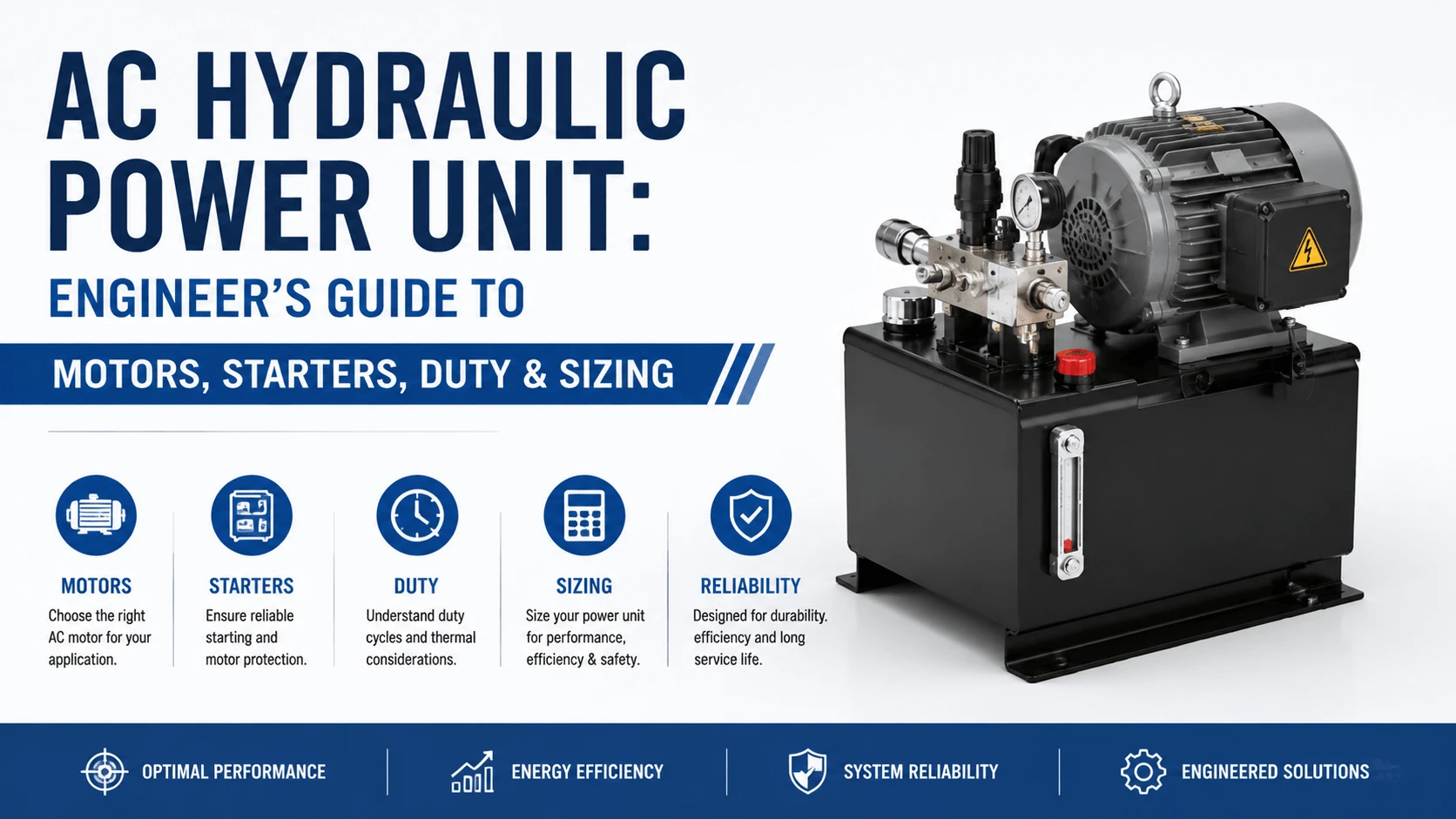
AC Hydraulic Power Unit: Engineer’s Guide to Motors, Starters, Duty & Sizing

AC Hydraulic Power Unit- Engineer's Guide to Motors, Starters, Duty & Sizing

Table of Contents

Introduction

An AC hydraulic power unit drives a hydraulic pump with an AC electric motor instead of a battery or engine. The motor turns at a fixed speed set by the supply frequency, so the pump delivers near-constant flow whenever the unit runs. You find these units on presses, machine tools, lifts, and any stationary machine that needs pressurized oil for hours at a stretch.
 
Most buyers pick one by flow and pressure, then call it done. That shortcut hides the choices that decide whether the unit runs ten years or trips every Monday. Motor type, starter, protection, and duty rating matter more than the nameplate. This guide walks through the AC-specific engineering you need to specify a unit that survives real production work.

What is an AC Hydraulic Power Unit?

An AC hydraulic power unit is a self-contained package that generates and controls pressurized oil using an AC electric motor. The motor drives a pump, the pump pulls oil from a reservoir, and a manifold routes that oil to the machine’s cylinders or hydraulic motors. A relief valve caps maximum pressure, and a directional valve directs flow.
 
The “AC” part matters. Unlike the 12V and 24V DC units on trailers and lift gates, an AC unit plugs into plant power. That means three-phase or single-phase induction motors, starters, overload protection, and wiring that meets electrical code. The hydraulic side looks similar, but the power side changes the whole selection and installation process.
 
You will hear “AC power pack,” “AC power unit,” and “AC HPU” used interchangeably. They all mean the same thing: a stationary, electrically driven hydraulic source built for continuous or semi-continuous plant service.

How an AC Hydraulic Power Unit Works

Power up the motor, and it spins the pump at a fixed speed. On a 50 Hz supply, the motor runs close to 1,500 rpm. At 60 Hz, it runs near 1,800 rpm. That speed sets pump flow, since a fixed-displacement pump moves a set volume every revolution.
 
The pump draws oil through a suction strainer from the reservoir. Oil flows to the manifold, where a relief valve limits maximum pressure. When a directional valve shifts, pump flow routes to the actuator. Oil pushes the cylinder rod out or turns the hydraulic motor.
 
Return oil flows back through a return line filter into the reservoir. A heat exchanger pulls heat from the oil when the temperature climbs above the setpoint. When the valve returns to center, pump flow dumps to tank at low pressure, and the load holds.

AC Motor: Single-Phase vs Three-Phase

 
AC Motor- Single-Phase vs Three-Phase
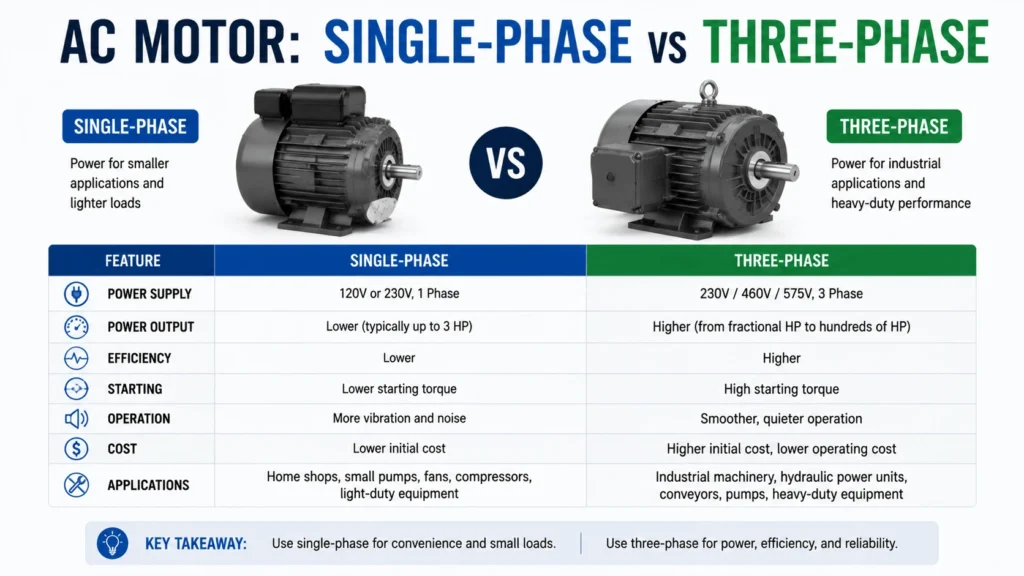
The first real decision is phase count, and it depends on what your building can supply. Three-phase power runs almost every industrial unit above 1.5 kW. Single-phase power serves small shop units, remote installations, and equipment plugged into a standard wall outlet.

Single-phase AC motors

Single-phase induction motors top out around 2.2 to 3 kW in practice. Above that, the starting current gets ugly, and the supply cannot deliver clean torque. They suit small presses, bench-top testing, and auxiliary clamping circuits. Most use a capacitor for starting torque, which adds a wear item you must replace every few years.
 
Run a single-phase unit only when three-phase service is unavailable. The motor costs more per kilowatt, starts harder, and trips more often on a weak supply.

Three-phase AC motors

Three-phase induction motors run from 1.5 kW up to 100 kW and beyond. They start smoother, run quieter, and cost less per kilowatt than single-phase. Every serious industrial HPU uses a three-phase motor. The squirrel-cage design needs no brushes, so the motor runs 20,000 hours or more with only bearing wear.
 
Pick three-phase for any unit above 3 kW, any continuous-duty application, and any machine that starts under load. If your site lacks three-phase service, a rotary phase converter or a single-phase-input VFD can bridge the gap. Both add cost and complexity, so weigh that against running a new supply.

Motor Efficiency Classes (IE2, IE3, IE4)

AC induction motors carry an International Efficiency (IE) class. The class sets how much input electrical power turns into shaft power, and how much becomes heat. Higher classes cost more up front and pay back in energy over the motor’s life.
IE class Efficiency (11 kW, 4-pole) Status
IE1
~89%
largely phased out
IE2
~91%
minimum in many regions
IE3
~93%
required for new sales in EU and parts of Asia
IE4
~95%
premium, growing adoption
The payback math is real. An 11 kW IE3 motor drawing 93 percent efficiency uses about 11.8 kW of electrical power at full load. An older IE1 unit at 89 percent draws 12.4 kW. That 0.6 kW difference, running 6,000 hours a year at 0.15 USD per kWh, costs you 540 USD a year. Over a 15-year life, the IE3 unit saves over 8,000 USD.
 
For continuous-duty HPUs, buy IE3 or IE4. The energy savings dominate the purchase price. For intermittent S2 service, IE2 may pencil out, since the motor runs too few hours to recover the premium.

Starting Methods: DOL, Star-Delta, Soft Starter, VFD
 
Starting Methods: DOL, Star-Delta, Soft Starter, VFD
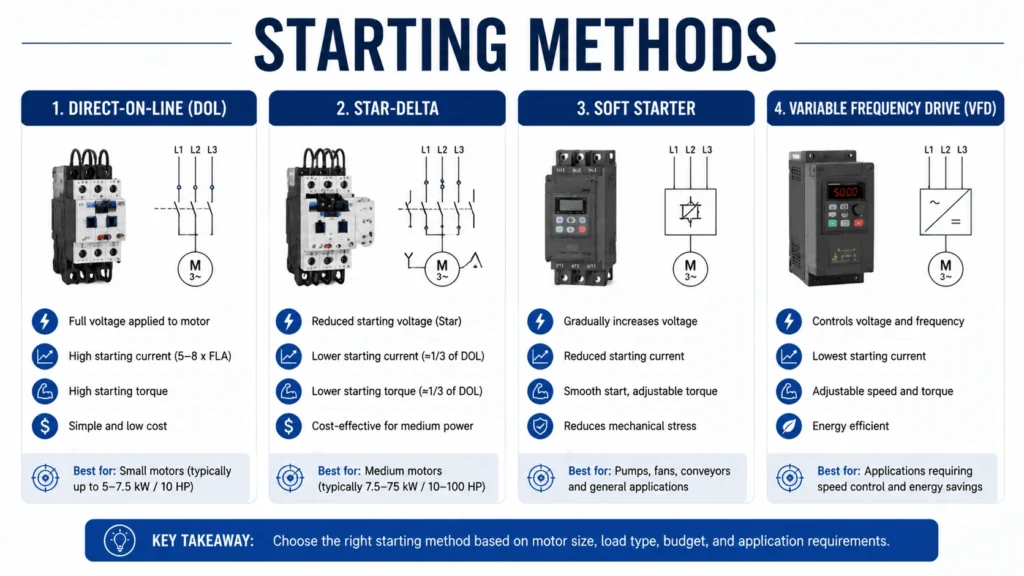
The starter decides what happens in the first half-second after you hit start. Get it wrong and the unit trips, the lights flicker, or the main breaker opens. Match the starter to motor size and supply stiffness.

Direct-on-line (DOL)

A DOL starter connects the motor straight across the line. The motor pulls 6 to 8 times rated current for a moment, then settles. DOL works fine for small motors up to about 5.5 kW on a stiff supply. Above that, inrush trips breakers and sag the line.

Star-delta

A star-delta starter starts the motor in star connection at reduced voltage, then switches to delta for full running. Inrush drops to about 2 to 3 times rated current. The catch: starting torque also drops to a third, so the motor must spin the pump unloaded or the start fails.
 
Use star-delta on motors from 7.5 to 30 kW where the supply is soft, and the pump can start unloaded. You must unload the pump, usually by opening a dump valve or de-energizing the directional valve, before the motor starts.

Soft starter

A soft starter ramps the voltage up over a few seconds. Inrush stays around 3 to 4 times rated current, and torque rises smoothly. It costs more than star-delta but handles loaded starts and avoids the switching transient.
 
Pick a soft starter for motors from 7.5 to 75 kW on soft supplies. It also fits any time the pump must start under residual load. It also extends mechanical life by removing the shock of a full-voltage start.

Variable frequency drive (VFD)

A VFD controls motor speed by varying supply frequency. It ramps speed from zero, so inrush stays near rated current. It also lets you slow the motor when the circuit needs less flow, which saves energy on variable-demand circuits.
 
Use a VFD when you want soft starting plus speed control, or when you pair it with a fixed-displacement pump to fake variable flow. VFDs cost the most, need clean cooling, and add harmonic filtering on large units. They shine on presses and injection molders with wide demand swings.

Motor Protection

A contactor alone does not protect a motor. You need overload, short-circuit, and phase protection at a minimum, plus thermal sensors for continuous-duty units.
A thermal overload relay trips when motor current stays above the set point long enough to heat its bimetal elements. Set it to the motor nameplate full-load current. It protects against sustained overload but not against a single-phase loss on a three-phase motor, which is where phase-failure protection comes in.
 
A motor protection circuit breaker combines short-circuit and overload protection in one device. Some models add phase-loss detection. For any three-phase HPU above 5.5 kW, spend the extra money on phase-loss protection. A lost phase cooks a three-phase motor in minutes, and the overload relay catches it too late.
 
For continuous-duty units, embed PTC thermistors in the motor windings. They trip the starter before the insulation melts. This protection catches overload conditions that the current relay misses, like a blocked cooling fan or high ambient temperature.

Voltage and Frequency Considerations

AC HPUs ship for a specific voltage and frequency, and getting it wrong burns out motors. The common industrial supplies are 230/400V at 50 Hz, 480V at 60 Hz, and 230V single-phase at 50 or 60 Hz. North America also uses 208V and 240V three-phase.
 
A motor wound for 400V at 50 Hz runs fine on 460V at 60 Hz. The 20 percent voltage rise matches the 20 percent frequency rise, so the V/Hz ratio stays constant. The motor spins 20 percent faster, so pump flow rises about 20 percent. This works for motors with dual-voltage nameplates.
 
The reverse does not hold. A 60 Hz motor on a 50 Hz supply runs slower and draws more current per kilowatt. If the motor is not rated for it, it overheats. Exporters shipping 60 Hz equipment to 50 Hz regions must specify 50/60 Hz motors and derate pump flow accordingly.
 
Check the nameplate before you wire anything. A 230/400V motor connected in delta on a 400V supply pulls excess current and trips. The same motor in a star connection runs correctly. Wiring errors cause more motor failures than bad bearings.

Main Components

The components mirror any hydraulic power pack, so I will keep this brief. The AC-specific parts get the details here.
 
The AC motor sets the pump speed and therefore the flow. The pump sets the pressure capability and flow at that speed. The reservoir holds oil and gives it dwell time to shed air and heat. The manifold bolts the control valves into one block. The filtration cleans the oil. The heat exchanger removes heat that the reservoir cannot shed.
 
What changes on an AC unit are the electrical package. You add a motor starter, overload relay, motor protection breaker, control transformer, and a terminal box. You also add an enclosure rated for the environment, typically IP54 for indoor industrial service or IP66 for washdown and outdoor duty.

Key Specifications

Spec Typical range Notes
Motor power
1.5–100 kW
3-phase AC induction, IE3 or IE4
Supply voltage
230/400/460/480V
single or three-phase
Supply frequency
50 or 60 Hz
sets pump speed
Motor speed
1,450 or 1,750 rpm
4-pole, most common
Pump type
gear / vane / piston
fixed or variable
Max pressure
70–450 bar
relief or pump limit
Flow at pressure
5–400 L/min
falls as pressure rises
Reservoir volume
20–1,000 L
2–3× pump flow per minute
Duty cycle
S1 continuous
industrial AC units favor S1
Starter type
DOL / star-delta / soft / VFD
matched to motor size
Motor protection
MPCB + overload + PTC
phase-loss on 3-phase
Oil grade
ISO VG 32 / 46 / 68
VG 46 most common
Enclosure rating
IP54 / IP66
indoor or washdown
Noise
62–78 dB(A)
enclosure cuts 5–10 dB
Read the flow at the pressure your circuit needs, not at zero pressure. Fixed pumps lose flow as pressure climbs because internal leakage grows with pressure.

Sizing an AC Hydraulic Power Unit

Three numbers drive selection: force, speed, and runtime.
Force sets pressure. Say you need 250 kN from a 100 mm bore cylinder. Area is 0.00785 m². Pressure equals force over area, so 250,000 N / 0.00785 m² = 31,800 kPa, or about 318 bar. That points to a piston pump, not a gear pump.
 
Speed sets flow. To extend that cylinder at 100 mm/s, you need a flow equal to area times speed. That gives 0.00785 m² × 0.1 m/s × 60 = 47 L/min. Pick a pump that delivers 47 L/min at 318 bar, plus margin.
 
Runtime sets motor power. Hydraulic power equals pressure times flow, divided by 600 for bar and L/min. Here, 318 × 47 / 600 = 24.9 kW. At 92 percent pump efficiency and 93 percent motor efficiency, the electrical input reaches about 29 kW. Add a 15 percent margin, and you pick a 30 kW IE3 motor.

Continuous Duty and Heat Rejection

Industrial AC units often run S1 continuous duty, which means the motor runs at rated load until you shut it off. That changes the heat equation. A 30 kW unit running hard rejects roughly 15 to 25 percent of input power as heat. You must move that heat, or the oil cooks.
 
Calculate the heat load first. A 30 kW input at 20 percent heat rejection generates about 6 kW of heat that the cooler must remove. A bare steel tank sheds about 0.5 kW per 100 L of surface at a 40 °C rise. If a 200 L tank handles 1 kW, the cooler must remove the remaining 5 kW.
 
Pick an air cooler for indoor service where water is scarce or dirty. Pick a water cooler when clean process water exists, and heat loads run high. Size the cooler for the worst-case duty, not the average. A unit sized for average duty overheats on the days it works hardest.
 
Oil temperature should stay between 45 and 55 °C. Above 65 °C, viscosity drops, internal leakage rises, and seal life falls fast. Wire the cooler fan to a thermostat set around 50 °C so it runs only when needed.

AC vs DC Hydraulic Power Units

The choice between AC and DC comes down to where the unit lives and how long it runs. AC units dominate stationary plant service. DC units (12V and 24V) dominate mobile and battery-powered service.
 
AC units run continuous duty without draining a battery. They deliver higher flow and pressure because a three-phase motor produces more power per kilogram than a PMDC motor. They start instantly and run for hours. The trade-off is that they need fixed wiring, an enclosure, and a starter.
 
DC units run anywhere a battery sits. They suit dump trailers, lift gates, snow plows, and marine winches. They run short cycles, rest between moves, and draw from a battery charged by the vehicle. The trade-off is low flow, short duty, and voltage sag under load.
 
If your machine sits still and plugs into a wall, pick AC. If your machine moves and runs off a battery, pick DC. The crossover point sits around 1.5 kW for a fixed installation. Below that, a 12V or 24V DC unit may serve. Above it, AC wins on every metric that matters for stationary service.

Common Applications of the AC Hydraulic Power Unit
Common Applications of AC Hydraulic Power Unit
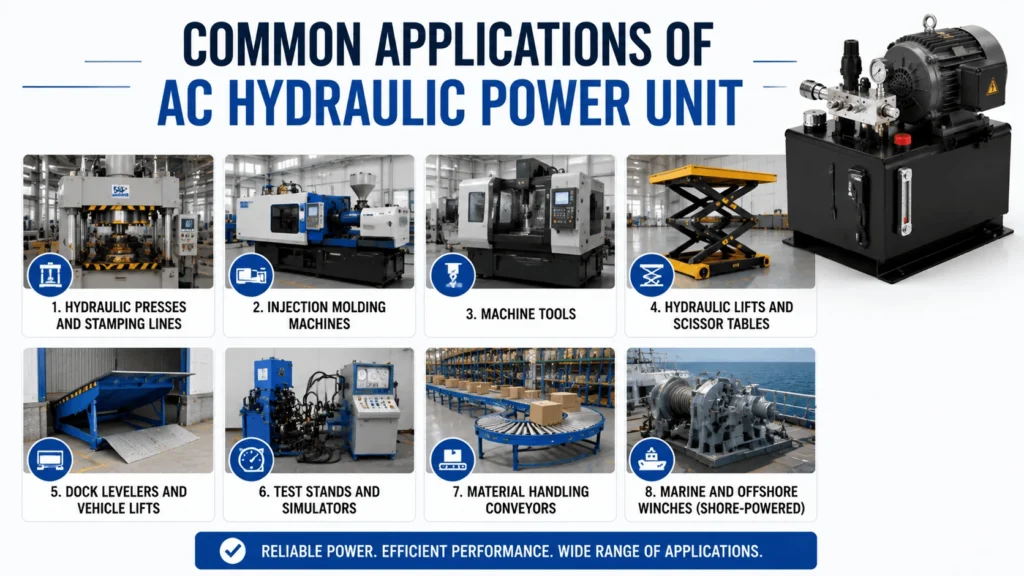
  • Hydraulic presses and stamping lines: high-pressure, three-phase piston pumps, S1 duty, soft starters
  • Injection molding machines: variable displacement, VFD or servo-proportional control, IE4 motors
  • Machine tools: clamping and feeding, vane pumps for low noise, IE3 motors
  • Hydraulic lifts and scissor tables: intermittent S2, gear pumps, DOL starters
  • Dock levelers and vehicle lifts: compact three-phase packs, single-acting cylinders
  • Test stands and simulators: variable pumps, accumulator circuits, closed-loop control
  • Material handling conveyors: low-pressure gear pumps, continuous duty
  • Marine and offshore winches (shore-powered): stainless hardware, IP66 enclosures

Common Failures

Motor trips on startup rank first. The cause is almost always inrush current on a DOL starter that exceeds the breaker’s magnetic trip. Fix it by switching to a soft starter or star-delta, or by upsizing the supply breaker if the supply can handle the real current.

Overheating ranks second. Causes include an undersized cooler, a relief valve stuck open, a clogged filter, or running the motor above its duty rating. Check oil temperature first. If it climbs past 65 °C, shut down and find the heat source before seals fail.

Pump failure usually traces to contamination. Dirt scores the gear teeth or piston bores, internal leakage rises, and flow falls. A pump that ran fine for years then loses pressure in a week, almost always ingested dirt. The dirt gets in through a failed breather or a torn filter seal.

Phase loss on a three-phase motor cooks the windings in minutes. The motor runs on two phases, draws excess current, and overheats before the thermal overload reacts. A phase-failure relay or a motor protection breaker with phase-loss detection catches it in seconds.

Slow cycle time often comes from a worn pump or a relief valve cracking low, not from low motor power. Gauge pump flow at pressure. If flow at full pressure drops more than 15 percent from the nameplate, the pump needs a rebuild or replacement.

Troubleshooting Guide

Symptom Likely cause First check
Motor trips on startup
inrush on DOL, weak supply, wrong starter
starter type and supply capacity
Motor trips while running
overload, phase loss, bearing failure
motor current and phase balance
Oil overheats
undersized cooler, relief stuck open, wrong duty
oil temperature and cooler operation
Pump noisy or cavitating
clogged suction strainer, cold oil, low level
suction strainer and oil level
Flow drops at pressure
worn pump, contaminated oil, relief cracking low
pump flow test at pressure
Won’t hold load
check valve leak, cylinder seal bypass, relief drift
lower loaded cylinder, watch drift
Motor runs hot but does not trip
blocked cooling fan, high ambient, undersized motor
fan, ambient temp, motor frame size

Selection Checklist

  1. Available supply sets single-phase or three-phase.
  2. Required actuator force sets pressure.
  3. Required speed sets the flow at that pressure.
  4. Pressure and flow band set pump type.
  5. Runtime and demand profile set fixed or variable displacement.
  6. Runtime sets S1 continuous or S2 intermittent duty.
  7. Motor power comes from pressure, flow, and efficiency.
  8. Motor size and supply stiffness set the starter type.
  9. Motor size sets protection: overload, phase-loss, and PTC.
  10. Heat load sets the cooler type and size.
  11. The environment sets the enclosure rating, tank material, and oil grade.
  12. Frequency and voltage set the motor nameplate and pump speed.

Installation Best Practices

  • Wire the motor to the nameplate voltage and connection (star or delta).
  • Size the supply cable for full-load current plus margin, not for breaker size.
  • Ground the motor frame and the reservoir to the building ground.
  • Mount the starter and protection in an enclosure rated for the environment.
  • Route the motor leads in conduit or sealed cable glands to keep oil out.
  • Install a control transformer for 24V or 110V control circuits on large units.
  • Verify phase rotation before the first start, so the pump runs the right way.
  • Add a drip leg and an isolation valve on the supply so you can service the starter.
  • Keep the reservoir breather clean; a failed breather ingests dirt.
  • Log motor current and oil temperature weekly for the first month of service.

FAQ

What is an AC hydraulic power unit?

An AC hydraulic power unit is a self-contained package that generates and controls pressurized oil using an AC electric motor. It combines a motor, pump, reservoir, control valves, filtration, and often a cooler in one housing. You connect the plant power and the work ports, and the machine has hydraulic power on demand.

How does an AC hydraulic power unit work?

An AC motor drives a pump that draws oil from the reservoir through a suction strainer. The pump pushes oil to a manifold, where a relief valve limits pressure and a directional valve routes flow to the actuators. Return oil passes through a return filter back to the tank, and a heat exchanger removes excess heat.

Single-phase or three-phase AC hydraulic power unit?

Pick three-phase for any unit above 3 kW, any continuous-duty application, and any machine that starts under load. Single-phase suits small shop units and remote installations where three-phase service is unavailable. Three-phase motors start more smoothly, cost less per kilowatt, and run longer between failures.

What starter does an AC hydraulic power unit need?

Match the starter to motor size and supply stiffness. DOL works up to about 5.5 kW on a stiff supply. Star-delta fits 7.5 to 30 kW on soft supplies when the pump starts unloaded. A soft starter handles loaded starts from 7.5 to 75 kW. A VFD adds speed control and near-rated inrush for variable-demand circuits.

Why does my AC hydraulic motor trip on startup?

The most common cause is inrush current on a DOL starter exceeding the breaker’s magnetic trip. Other causes include a weak supply, a pump starting under load, or a star-delta starter that switches too early. Fix it by switching to a soft starter, unloading the pump before start, or upsizing the supply if it can handle the real current.

Can I run a hydraulic power unit on a VFD?

Yes. A VFD ramps motor speed from zero, which keeps inrush near rated current and removes starting shock. It also lets you slow the motor when the circuit needs less flow, which saves energy on variable-demand circuits. VFDs suit presses, injection molders, and any application with wide demand swings. They cost more and need clean cooling.

How long does an AC hydraulic power unit last?

A well-specified industrial AC unit runs 15 to 20 years with routine maintenance. The AC induction motor itself often outlasts the rest of the unit, with bearing replacement around 20,000 to 40,000 hours. Pump life reaches 15,000 to 20,000 hours with clean oil. Oil and filter changes, cleanliness control, and correct duty-cycle matching decide the actual service life.

Conclusion

An AC hydraulic power unit trades the flexibility of a DC pack for the durability of plant power. Get the spec right, and the unit runs for two decades with bearing swaps. Get it wrong, and you rebuild pumps, swap starters, and chase motor trips every quarter.

The spec that decides service life is not flow and pressure alone. It is motor type matched to the supply, starter matched to motor size, protection matched to phase count, and cooling matched to heat load. Get those four right, and almost everything else follows.

Whether you are specifying a press power unit, replacing a burned-out motor on a machine tool, or diagnosing a unit that trips every Monday morning, the math above takes you from “which AC power unit?” to a fully specified installation. The components, ratings, and sizing steps give you a duty-matched unit without guesswork.

Related Articles

Scroll to Top
Shoot Us An Email

Professional Manufacturer