
Introduction
Mid-pressure industrial hydraulics has a go-to pump: the hydraulic vane pump. It fills the gap between cheap gear pumps and high-pressure piston pumps. If you design machine tools, injection molders, or die-casting presses, you have probably specified one.
This guide covers vane pump working principles, the balanced vs unbalanced distinction, variable displacement control, and selection criteria. We wrote it for engineers who size, install, and troubleshoot these pumps. Real numbers follow: pressure bands, flow ranges, efficiency targets, and cleanliness limits.
What is a Hydraulic Vane Pump
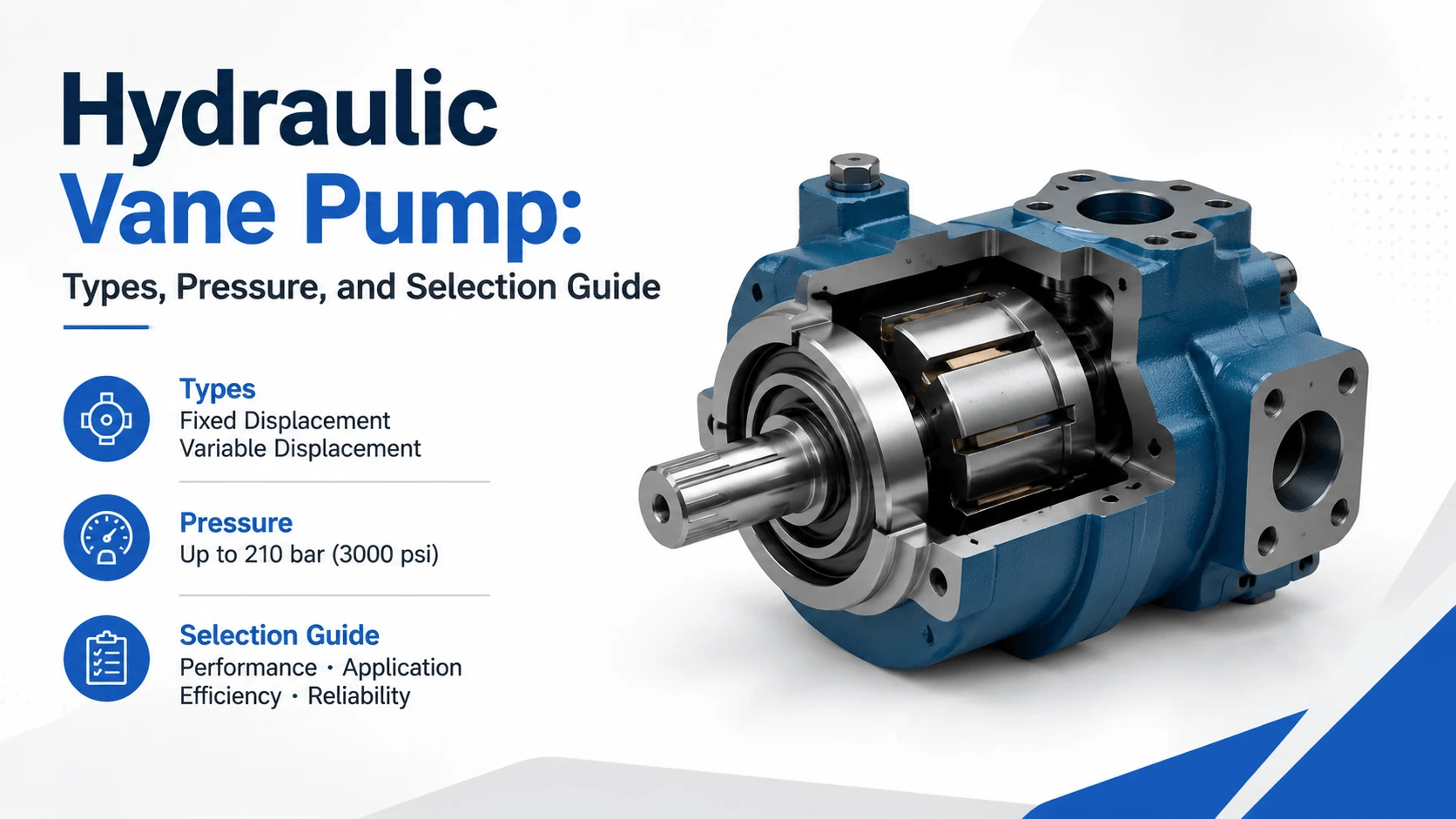
A hydraulic vane pump is a positive-displacement pump. It moves fluid with a rotor that carries sliding vanes inside a cam ring. As the rotor turns, the vanes slide out and trap fluid between them.
That trapped fluid travels from the inlet to the outlet. The offset between the rotor and the cam ring creates the pumping chambers. Output stays nearly constant per revolution.
Vane pumps sit in the middle of the pressure range. They handle 70 to 210 bar continuous duty in most designs. Two-stage high-pressure versions reach 250 to 320 bar.
How a Hydraulic Vane Pump Works
The drive shaft spins the rotor inside the cam ring. Centrifugal force throws the vanes outward against the ring. System pressure also feeds behind the vanes to hold contact.
On the inlet side, the chamber volume grows and fluid fills the space. On the outlet side, the chamber shrinks and pushes fluid out. The cycle repeats each revolution.
Flow stays smooth because several chambers fill and empty at once. Pulsation runs lower than gear or piston pumps. That low pulsation is why vane pumps run quieter.
Types of Hydraulic Vane Pumps
Balanced Vane Pump
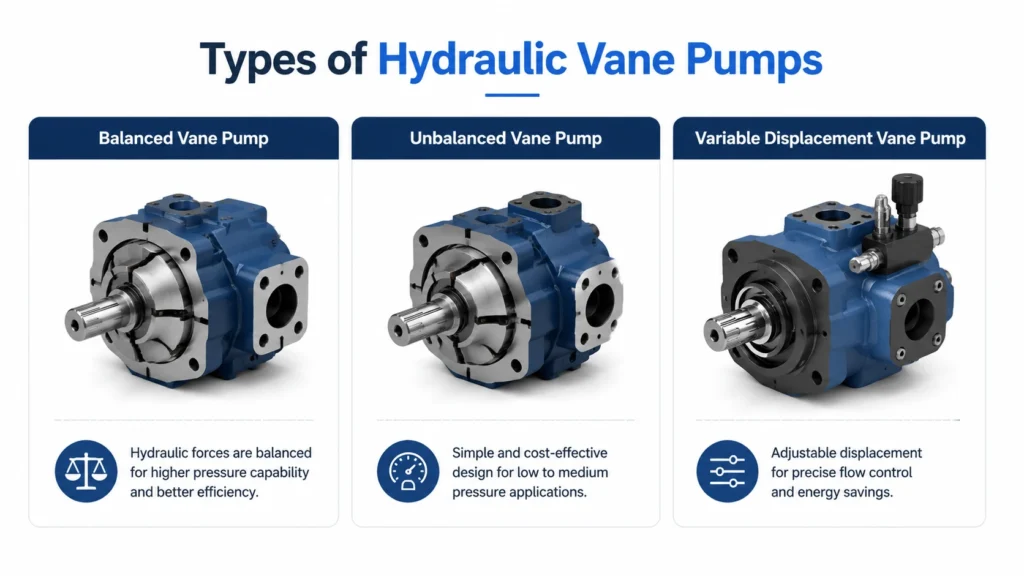
The balanced type uses an elliptical cam ring. It has two intake ports and two discharge ports set 180 degrees apart. This layout cancels the radial load on the shaft.
Balanced pumps deliver fixed displacement only. They suit continuous-duty industrial circuits. Bearing life runs long because the shaft sees no net side load.
Unbalanced Vane Pump
The unbalanced type uses a circular cam ring offset from the rotor. One intake and one discharge port create a net radial force on the shaft. That side load limits bearing life at high pressure.
The offset also enables variable displacement. Move the cam ring to change the eccentricity. Flow drops to near zero when the centers align.
Variable Displacement Vane Pump
Most variable vane pumps work on the pressure-compensated principle. The cam ring shifts against a spring as system pressure rises. At the cutoff pressure, flow falls to zero and holds pressure with little power draw.
This makes them ideal for holding clamps or presses at pressure. They save energy and run cool. Eaton Vickers and Parker Denison built their industrial lines on this concept.
Key Specifications of Hydraulic Vane Pump
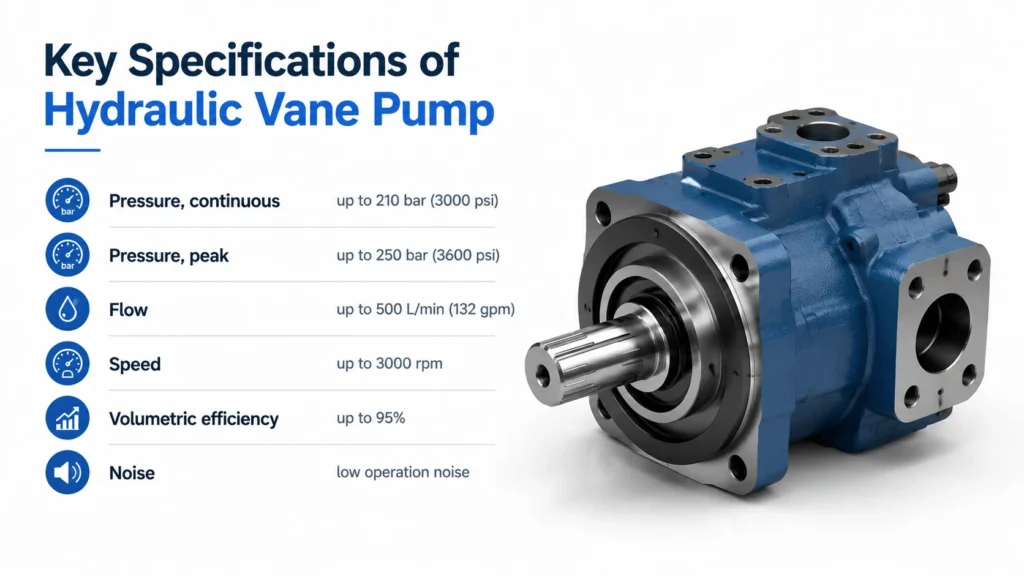
Match the pump to your circuit pressure and flow first. Then check the speed range against your motor. Volumetric efficiency above 90 percent signals a healthy pump.
| Specification | Typical range | Notes |
|---|---|---|
Pressure, continuous |
70 to 210 bar |
Single-stage designs |
Pressure, peak |
250 to 320 bar |
Two-stage high-pressure types |
Flow |
5 to 400 L/min |
Size-dependent |
Speed |
600 to 3,000 rpm |
1,200 to 1,800 rpm common |
Volumetric efficiency |
90 to 95 percent |
Drops as vanes wear |
Noise |
60 to 75 dB(A) |
Quieter than gear pumps |
Vane Pump vs Gear Pump vs Piston Pump
The three pump families split the pressure spectrum. Gear pumps own the low-cost, low-pressure end. Piston pumps own high pressure and high efficiency. Vane pumps own the quiet mid-range.
| Feature | Gear pump | Vane pump | Piston pump |
|---|---|---|---|
Pressure range |
up to 250 bar |
70 to 250 bar |
250 to 700 bar |
Noise level |
High |
Low |
Medium |
Cost |
Lowest |
Medium |
Highest |
Variable displacement |
No |
Yes |
Yes |
Contamination tolerance |
High |
Medium |
Low |
Efficiency at rated pressure |
85 to 90 percent |
90 to 95 percent |
92 to 98 percent |
Pick gear pumps for budget mobile circuits. Pick piston pumps for 350 bar and up. Pick vane pumps when you need quiet, smooth flow at mid pressure.
Advantages and Disadvantages
Advantages
- Quiet operation, often below 70 dB(A)
- Smooth flow with low pulsation
- Good efficiency at mid-pressure
- Variable displacement option saves energy
- Long bearing life in balanced designs
- Reasonable cost below piston pumps
Disadvantages
- Sensitive to dirty oil and varnish
- Limited to about 250 bars in most designs
- Vane sticking in cold or contaminated oil
- Not ideal for water-glycol fluids without special vanes
- Higher cost than gear pumps
Industrial Applications
Vane pumps shine where noise and smoothness matter. Machine tools were their classic home. The pressure-compensated vane pump held hydraulic clamps steady on milling and grinding machines.
Injection molding machines use them for clamp and injection circuits. Die-casting presses run them for hold pressure. Many industrial power units fit a vane pump when the shop floor demands low noise.
Mobile use is rarer but real. Some aerial lifts and refuse trucks run vane pumps for auxiliary circuits. Automotive power steering ran vane pumps for decades before electric assist took over.
Common Problems and Troubleshooting
| Symptom | Likely cause | Action |
|---|---|---|
No flow or low flow |
Vane sticking |
Check oil cleanliness and temperature |
Loud whining noise |
Cavitation |
Inspect suction line and filter |
Pressure drop under load |
Cam ring wear |
Measure case drain flow, replace ring |
External oil leak |
Shaft seal failure |
Replace seal, check shaft surface |
Erratic pressure |
Air in oil |
Bleed air, check suction fittings |
Overheating |
Bypass at relief too long |
Switch to pressure-compensated type |
Selection Guide
Start with your required pressure and flow. Below 210 bar, a vane pump fits well. Above 250 bar, switch to a piston pump.
Choose fixed displacement for simple circuits with steady flow demand. Choose variable displacement when you hold pressure for long periods. The energy savings pay back the higher price.
Pick a balanced design for continuous duty. Pick a variable design for clamp-and-hold duty. Match the port standard to your manifold: SAE J744 flanges, ISO 3019-2 mounts, or BSPP ports.
Installation and Maintenance Tips
Mount the pump close to the reservoir. Keep the suction line short and large to prevent cavitation. A flooded inlet helps cold starts.
Fill the case with clean oil before startup. Dry starts score the vanes within seconds. Run the pump unloaded for the first few minutes.
Hold the oil clean. ISO 4406 19/17/14 keeps the vanes sliding freely. Replace the filter before the bypass indicator trips. Trend the case drain flow and noise level. A rising drain flow signals internal wear.
FAQ
What is a hydraulic vane pump used for?
Engineers use vane pumps for mid-pressure industrial circuits. They run machine tools, injection molders, and presses where quiet, smooth flow matters. Variable types hold pressure with low energy use.
How does a hydraulic vane pump work?
A rotor spins inside a cam ring with sliding vanes. The vanes trap fluid and carry it from the inlet to the outlet. The rotor offset creates the expanding and shrinking chambers.
What pressure can a vane pump handle?
Most single-stage vane pumps run 70 to 210 bar continuously. Two-stage high-pressure designs reach 250 to 320 bar. Above that, piston pumps take over.
Vane pump or gear pump?
Pick a gear pump for low cost and dirty environments. Pick a vane pump for quiet, smooth flow at mid-pressure. Vane pumps cost more but run quieter and cleaner.
Can a vane pump be variable displacement?
Yes. Unbalanced vane pumps shift the cam ring to vary flow. Pressure-compensated types cut flow to zero at the set pressure. They save energy in hold-pressure circuits.
Why is my vane pump noisy?
Cavitation causes most vane pump noise. Check the suction filter, line size, and reservoir level. Cold, thick oil also starves the inlet. Vane sticking makes a rattling sound.
Conclusion
The hydraulic vane pump has a quiet mid-pressure band. It costs more than a gear pump and tops out below a piston pump. But for noise-sensitive industrial circuits, nothing else fits as well.
Size it for your pressure and flow. Choose variable displacement when you hold pressure. Keep the oil clean and the inlet flooded. Done right, a vane pump runs quietly and reliably for years.