
A maintenance team usually meets a hydraulic accumulator during a pressure problem. The pump sounds fine. The valve bank looks normal. Yet the cylinder jumps, the clamp loses force, or the machine hammers at each stroke.
That small pressure vessel can decide how smooth the system feels. It can also hide trouble for months. When a hydraulic accumulator loses precharge, the rest of the circuit often takes the blame first.
What is a Hydraulic Accumulator
A hydraulic accumulator stores energy in a hydraulic system by compressing nitrogen gas. The pump pushes oil into the accumulator. The gas compresses, holds pressure, and then pushes oil back into the circuit when demand rises.
Think of it as a short-term pressure reserve. It does not replace the pump. It helps the pump handle sudden flow demand, pressure spikes, leakage, and emergency movement.
Most industrial units use nitrogen, not air. Oxygen and oil can create a fire risk under pressure. That detail matters, and good maintenance teams treat it seriously.
How a Hydraulic Accumulator Works
The pump sends oil into the accumulator port. Inside the shell, a bladder, piston, or diaphragm keeps oil and nitrogen apart. As oil volume increases, nitrogen volume shrinks, and gas pressure rises.
When the machine needs extra flow, the compressed nitrogen expands. It pushes oil back into the line. The circuit gets a fast burst of flow without asking the pump to react instantly.
Precharge controls the starting point. If the precharge sits too high, the accumulator may accept little oil. If it sits too low, the bladder or piston can slam against the end cap.
Main Components of Hydraulic Accumulator
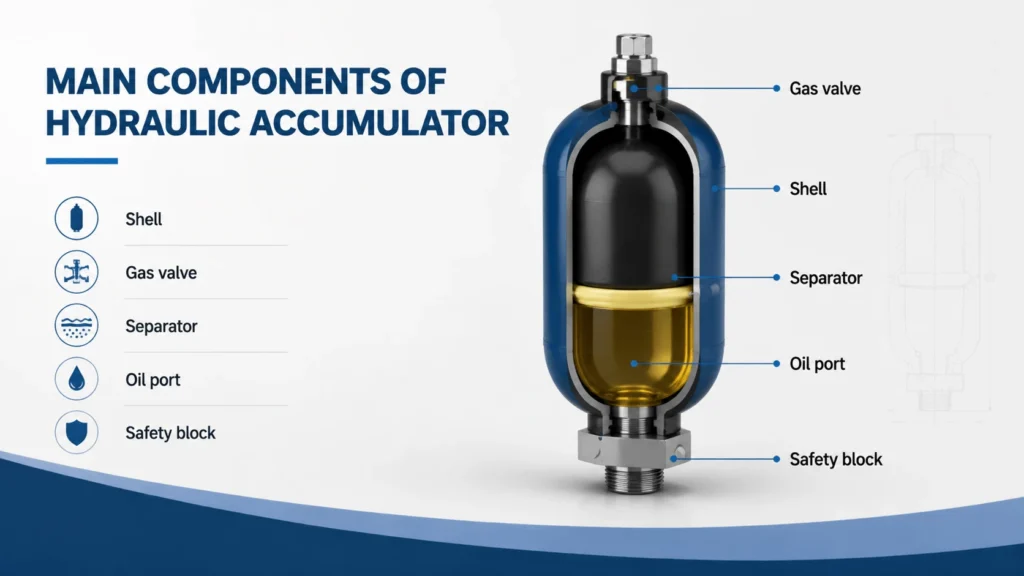
| Component | What It Does | Field Note |
|---|---|---|
Shell |
Holds pressure and fluid volume |
Check the rated pressure before any replacement |
Gas valve |
Allows nitrogen charging |
Never charge with shop air |
Separator |
Keeps gas away from oil |
Bladder, piston, or diaphragm design changes behavior |
Oil port |
Connects to the hydraulic line |
Port size affects response speed |
Safety block |
Isolates and drains the unit |
Good systems make service hard to do wrong |
Common Types of Hydraulic Accumulator
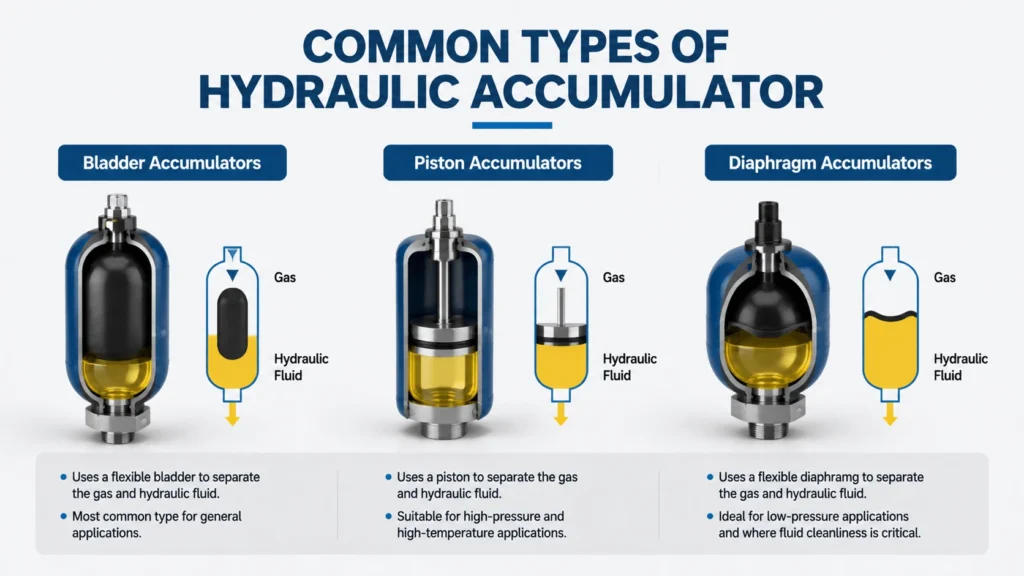
Bladder accumulators respond fast. Many press and mobile circuits use them for shock absorption and short flow bursts. They suit systems with quick pressure changes.
Piston accumulators handle larger volumes and higher compression ratios. They also tolerate a wide range of sizes. They need clean oil because seal friction can hurt response.
Diaphragm accumulators fit compact systems. They work well in pilot circuits, braking systems, and small mobile equipment. Their volume range stays limited.
| Type | Best Use | Watch Point |
|---|---|---|
Bladder |
Fast response and pulsation control |
Bladder damage from low precharge |
Piston |
Large volume and high pressure service |
Seal wear and oil cleanliness |
Diaphragm |
Compact circuits |
Limited gas and oil volume |
Why Hydraulic Systems Use Accumulators
A hydraulic accumulator can supply flow during short peak demand. That helps engineers choose a smaller pump in some circuits. The machine gets speed when it needs speed, while the pump runs at a steadier load.
Accumulators also reduce shock. A valve shift can send a sharp pressure wave through hoses and fittings. The accumulator absorbs part of that wave before it reaches weaker parts of the circuit.
Some systems use accumulators for emergency movement. A brake release circuit may need stored pressure after pump failure. A clamp may need to hold force during a short power loss.
Limits and Tradeoffs
An accumulator adds stored energy to the machine. That helps performance, but it raises service risk. A technician must drain hydraulic pressure and release gas pressure in the right order.
Precharge drift also causes trouble. Nitrogen can leak through valves, seals, or damaged bladders over time. A system that ran well in January may cycle badly in June.
Temperature changes affect gas pressure. A cold morning can make the precharge look low. A hot machine can make it look high. Test conditions matter.
Industrial Applications of Hydraulic Accumulator
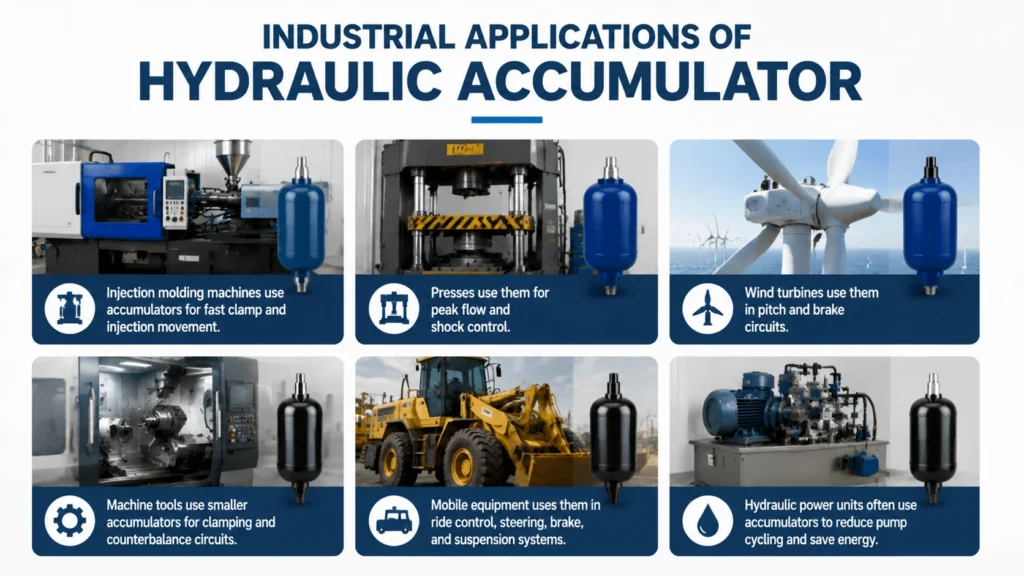
Injection molding machines use accumulators for fast clamp and injection movement. Presses use them for peak flow and shock control. Wind turbines use them in pitch and brake circuits.
Machine tools use smaller accumulators for clamping and counterbalance circuits. Mobile equipment uses them in ride control, steering, brake, and suspension systems.
Hydraulic power units often use accumulators to reduce pump cycling. This works well when the circuit needs small amounts of oil between longer idle periods.
Common Problems
Low precharge causes many accumulator complaints. The pump cycles often. The oil gets hot. The machine may lose its smooth motion.
High precharge creates a different problem. The accumulator accepts too little oil, so it cannot deliver enough flow. The system then acts as if no accumulator exists.
A ruptured bladder can send nitrogen into the oil. The reservoir may foam, and actuators may feel soft. At that point, the team should stop guessing and inspect the unit.
Troubleshooting Guide
| Symptom | Likely Cause | Practical Check |
|---|---|---|
Pump cycles too often |
Low precharge or small accumulator |
Check nitrogen pressure with oil side drained |
Harsh valve shock |
Wrong location or undersized unit |
Check mounting point near the shock source |
Slow response |
Restricted port or piston seal friction |
Check port size, oil cleanliness, and seals |
Foamy oil |
Bladder failure or gas leakage |
Inspect accumulator and reservoir condition |
No stored pressure |
Failed gas valve or separator |
Isolate, drain, and test precharge |
Selection Guide
Start with the job the accumulator must do. Shock control, energy storage, leakage makeup, and emergency backup need different sizing methods.
Match the pressure rating to the system relief setting, with a suitable margin. A 3000 psi circuit needs more than a nameplate guess. Check the accumulator code, shell rating, port rating, and safety block rating.
Choose a volume from the oil the circuit needs between the maximum and minimum working pressure. Then set the precharge for the duty. Many energy storage circuits use a precharge near 80 to 90 percent of the minimum operating pressure.
For shock control, location matters as much as size. Put the accumulator close to the event. Long hose runs add delay and reduce the damping effect.
Maintenance Tips
Check precharge on a schedule. Many plants inspect critical units every three to six months. Harsh cycles, heat, and old gas valves call for shorter intervals.
Use dry nitrogen and the correct charging kit. Open the gas valve slowly. Record ambient temperature, oil temperature, precharge, and operating pressure.
Inspect mounting brackets, clamps, and safety blocks. A heavy accumulator with poor support can fatigue pipework. That failure usually costs more than a planned bracket repair.
Replace bladders, seals, or diaphragms when inspection shows damage. Do not keep adding nitrogen to a unit that loses pressure every week. Find the leak.
Conclusion
A hydraulic accumulator earns its place when it has a clear job. It can smooth pressure, supply peak flow, protect components, and support emergency movement.
The same part can cause heat, shock, and downtime when teams ignore precharge or choose the wrong type. Treat it as a pressure device, not an accessory. The system will usually tell you when it needs attention.
FAQ
What does a hydraulic accumulator do?
A hydraulic accumulator stores pressurized hydraulic energy and releases oil when the system needs extra flow, pressure support, or shock absorption.
What gas should a hydraulic accumulator use?
Use dry nitrogen. Do not use compressed air because oxygen can create a fire hazard when mixed with hydraulic oil under pressure.
How often should precharge be checked?
Many industrial plants check critical accumulators every three to six months. High-cycle or hot systems may need shorter intervals.
Which type is better, bladder or piston?
Bladder accumulators respond faster and suit shock control. Piston accumulators suit larger volumes and higher pressure duties.
Need help selecting a hydraulic accumulator for an OEM machine, press, mobile system, or hydraulic power unit? Send your working pressure, flow demand, fluid type, duty cycle, and installation space to our engineering team. We can help review the circuit and recommend a suitable accumulator type, volume, and precharge range.