
Introduction
A solenoid valve turns an electrical signal into fluid flow control. Send current to the coil, and the valve opens, closes, or redirects a line. Cut the current, and a spring returns the valve to its rest state. That simplicity explains why these valves run everything from coffee machines to steel mills.
The hard part is picking the right one. Engineers face dozens of solenoid valve types, and the wrong choice can lead to leaks, jams, or burnout within weeks. This guide sorts the field by what actually differs: port count, actuation principle, default state, media, and material.
What a solenoid valve does
A solenoid valve controls fluid on an electrical command. The coil pulls a plunger. The plunger moves a seat or spool, and that seat or spool opens or blocks a flow path. Most models switch in 10 to 50 milliseconds.
Different valve types handle these duties at different pressures, flows, and media. A 2 mm direct-acting valve handles a 40 bar gas line. A 50 mm pilot valve moves water at 0.3 bar. The type sets the limits.
How solenoid valves work
A coil of copper wire wraps around a bobbin. Apply voltage, and the coil builds a magnetic field. The field pulls a ferromagnetic plunger into the bobbin against a spring. The plunger lifts a seat or shifts a spool.
When you cut the power, the spring pushes everything back. The stroke is short, often 1 to 5 mm, but the force reaches tens of newtons. For a deeper look at coil behavior, see our hydraulic solenoid valve guide.
Types by port and position count
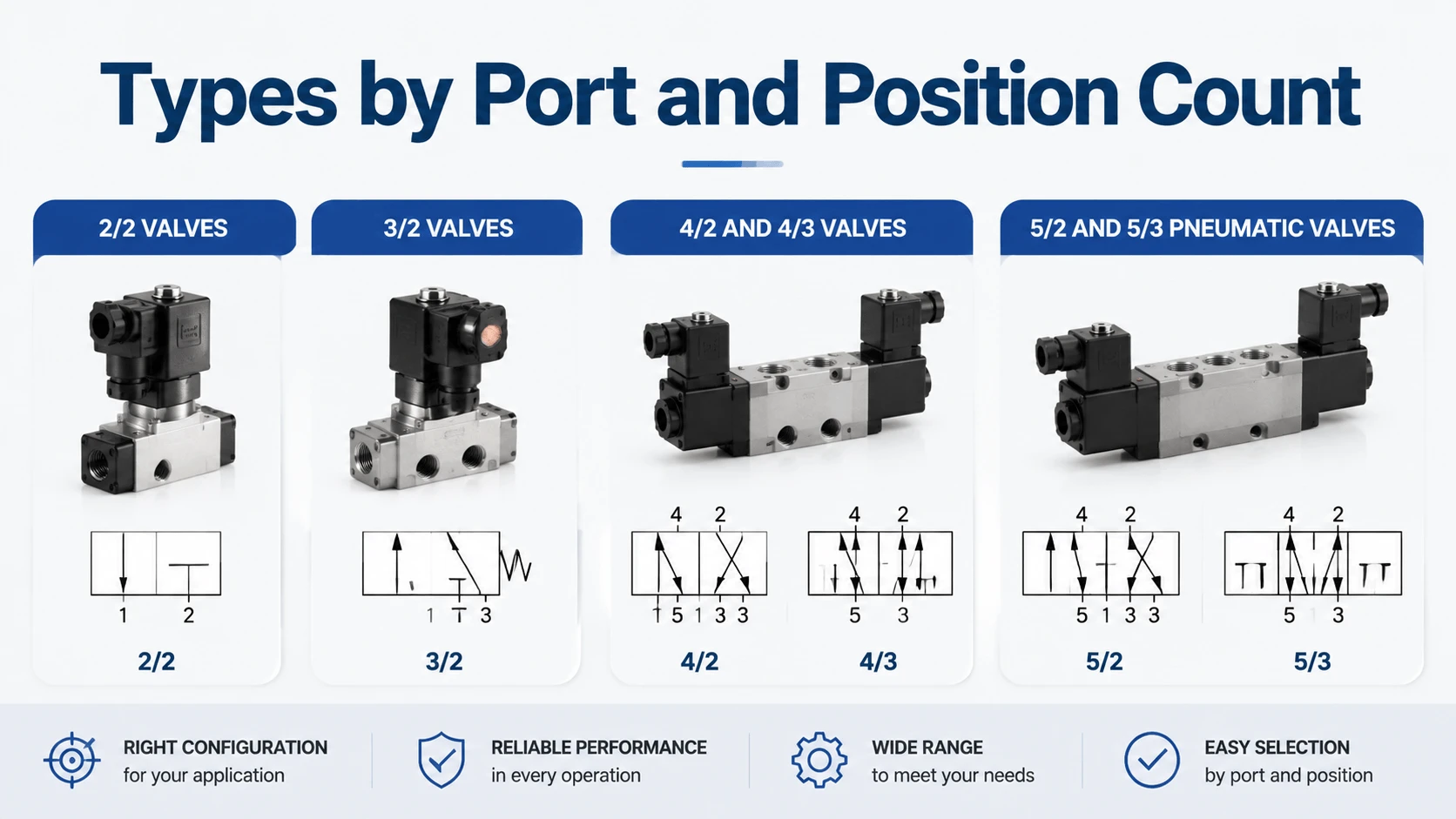
The most common way to sort solenoid valve types is by port and position count. The first number counts ports. The second counts positions. A 2/2 valve has two ports and two positions, for example.
2/2 valves
A 2/2 valve is an on/off switch for one line. It has an inlet and an outlet, and it either passes flow or blocks it. Most shutoff duties in gas, water, and low-flow pneumatic lines use this type.
These valves come normally closed or normally open. A normally closed 2/2 block flow until you energize the coil. A normally open version passes flow until you cut the power.
3/2 valves
A 3/2 valve adds a third port, usually a vent or return. Energize the coil and pressure routes to the work port. De-energize, and the spring vents the work port to the atmosphere or tank.
The classic use is a single-acting pneumatic cylinder. Air extends the rod on one signal, and a spring retracts it when the signal drops. 3/2 valves also run pilot circuits for larger valves.
4/2 and 4/3 valves
A 4/2 valve has four ports (P, T, A, B) and two positions. It routes pressure to one work port while venting the other. There is no neutral, so the actuator always drives one way or the other.
A 4/3 valve adds a center position. That center can hold the load, unload the pump, or let the actuator float. These valves suit press and clamp circuits.
5/2 and 5/3 pneumatic valves
Pneumatic systems favor 5/2 and 5/3 valves. A 5/2 valve has five ports (one supply, two outlets, two exhausts) and two positions. It drives a double-acting air cylinder without extra exhaust routing.
A 5/3 valve adds a center position for hold, float, or pressure-release duties. ISO 5599 defines the mounting interface for these sizes, so brands swap on a common subplate.
Direct-acting vs pilot-operated solenoid valves
Direct-acting valves
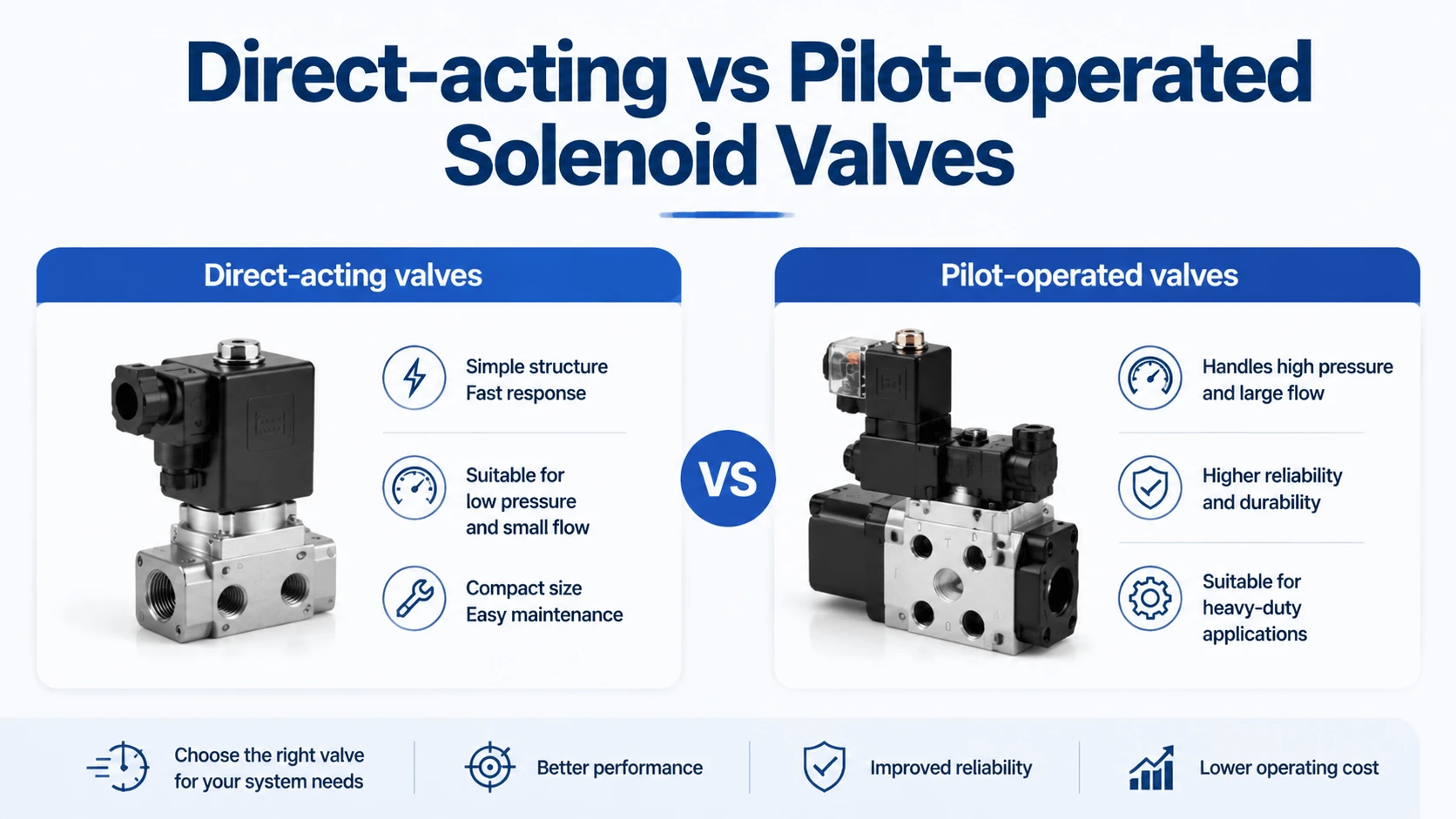
A direct-acting valve lifts the seat with the plunger alone. It needs no pressure differential. The coil force does all the work against the line pressure and the return spring.
These valves work from a vacuum up to 40 bar. Orifice size stays small, usually 0.1 to 3 mm. Small orifice means low flow. Response is fast, typically 10 to 30 ms, because nothing but the plunger moves.
Pilot-operated valves
A pilot-operated valve uses line pressure to help the seat lift. A small pilot orifice, often 0.5 to 1 mm, lets pressure build on a diaphragm or piston. The diaphragm then lifts the main seat.
This design handles large flows at a fraction of the coil force. The catch is a minimum pressure differential, usually 0.2 to 0.5 bar. Below that, the valve never fully opens, and the seat chatters.
Pilot valves suit water, air, and steam lines where pressure is stable and flow is high. Both direct-acting and pilot-operated solenoid valve types appear in 2/2 and 3/2 configurations.
Normally open vs normally closed
Among solenoid valve types, the default state decides what happens on power loss. A normally closed (NC) valve blocks flow at rest and opens on energization. A normally open (NO) valve passes flow at rest and closes on energization.
Pick NC when a power failure should stop the flow. Safety shutoffs on gas lines, fuel lines, and steam feeds use NC valves almost exclusively. Pick NO when a power failure should keep flow running. Think of a cooling loop that must not starve on a breaker trip.
Universal valves offer both, with a coil that can sit on either port. They add flexibility but cost more and complicate spare stocking.
Types by media
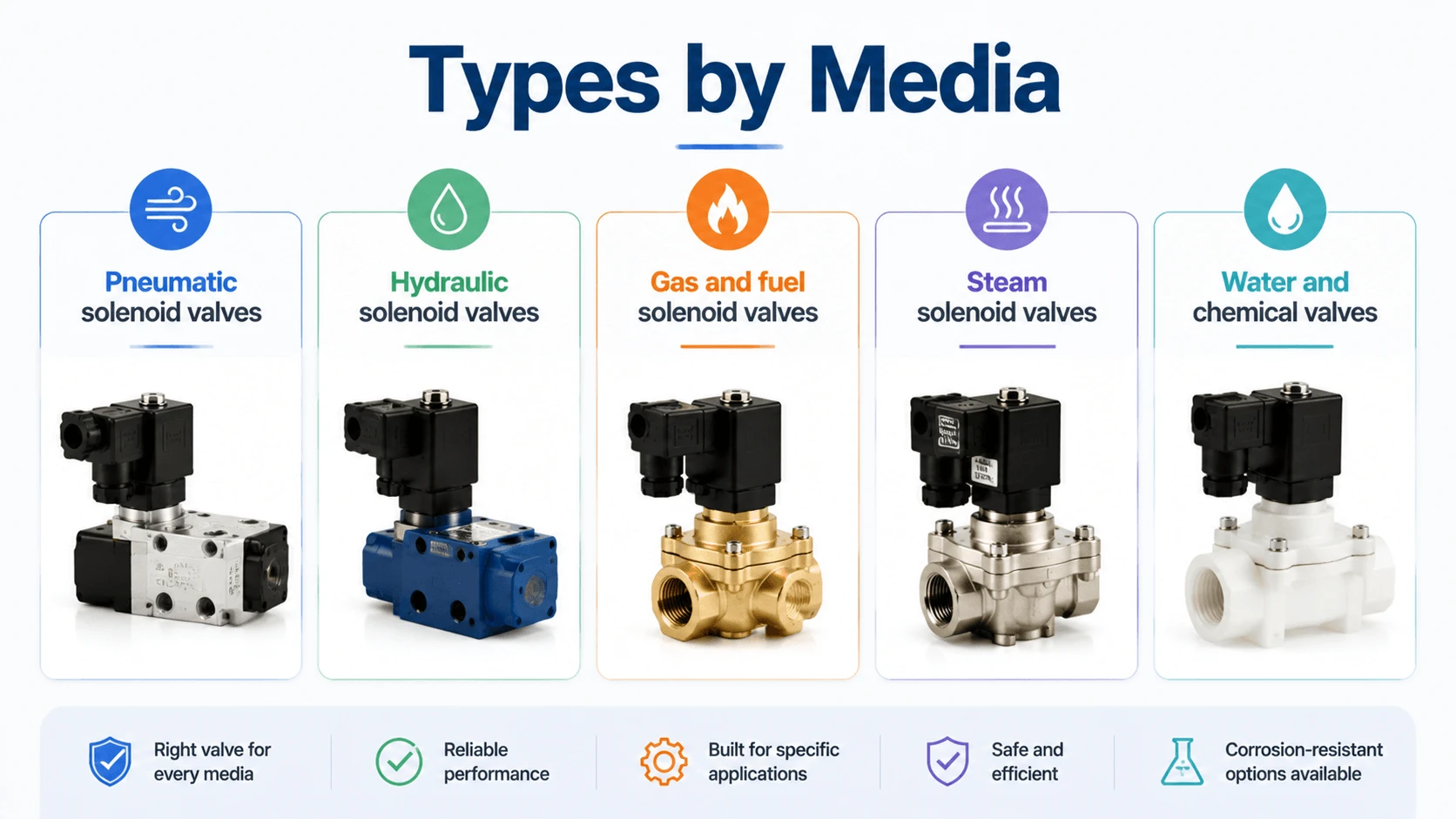
Solenoid valve types are also split by the fluid they handle. The media sets the seal, the body, and the pressure rating. A valve built for compressed air fails fast on steam. A gas valve leaks if you put it on a hydraulic line.
Pneumatic solenoid valves
Air valves run compressors, cylinders, and air preparation units. Pressure is modest, usually 5 to 10 bar. Flow matters more than pressure. Brass or aluminum bodies, NBR or PU seals, and 5/2 or 5/3 spool designs dominate.
Hydraulic solenoid valves
Oil valves run at 210 to 420 bar. The oil itself lubricates the spool, so wet-pin coils run cooler and quieter. ISO 4401 (CETOP) mounting patterns let you swap brands. Our hydraulic solenoid valve guide covers coil and spool detail.
Gas and fuel solenoid valves
Gas valves shut off natural gas, propane, and fuel oil. They need a tight shutoff, low leakage, and often a certified safety rating. Brass or stainless bodies pair with FKM seals for fuel oil and NBR for natural gas.
Steam solenoid valves
Steam runs hot, 130 to 180 °C common. Metal or high-temp PTFE seals handle the heat. The coil often sits on a heat barrier to protect the winding. Pilot operation suits the high pressure, but you need the minimum differential.
Water and chemical valves
Water valves use brass, stainless, or plastic bodies. EPDM seals resist water and mild chemicals. Aggressive acids and solvents need PTFE or PVDF bodies with PTFE or FFKM seals. Always cross-check the chemical chart before you commit.
Body and seal materials
Body material sets the pressure and corrosion limits across valve families. Brass handles water and air up to 16 to 50 bar. Stainless steel reaches 100 to 200 bar and resists corrosion. Plastic suits low-pressure chemical and water lines.
| Body | Pressure | Media | Temp range |
|---|---|---|---|
Brass |
16 to 50 bar |
Air, water, fuel |
-10 to +90 °C |
Stainless 304 / 316 |
100 to 200 bar |
Steam, chemicals, food |
-20 to +180 °C |
Aluminum |
10 to 25 bar |
Pneumatic air |
-10 to +80 °C |
PVC / PVDF |
6 to 10 bar |
Water, acids |
0 to +60 °C |
Seal material matters as much as the body. NBR works for air, water, and oil from -10 to +80 °C. FKM handles fuel, steam, and oil to +150 °C. EPDM suits hot water and alkalis but fails on oils. PTFE covers aggressive chemicals to +200 °C.
Specialized valve types
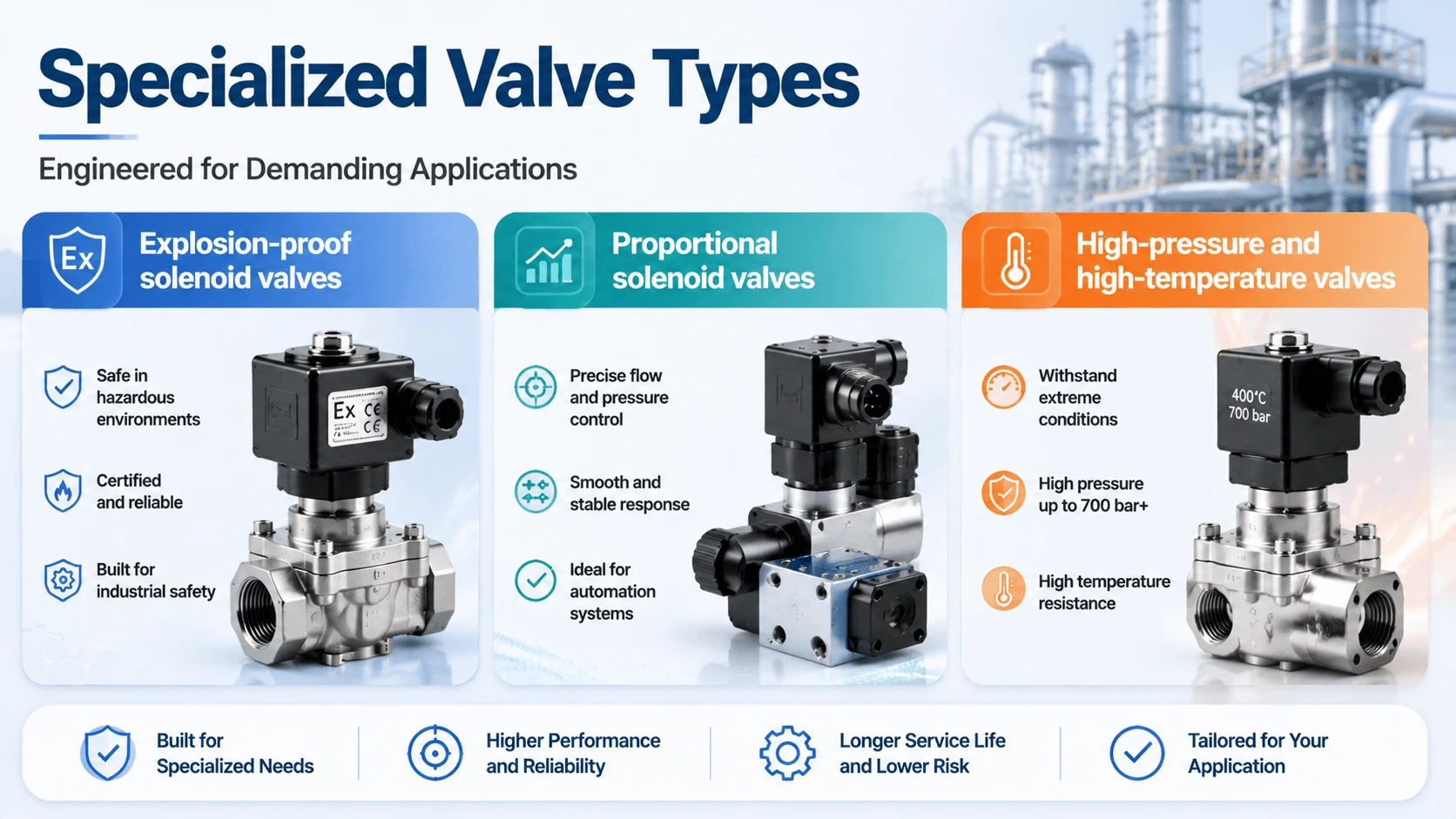
Explosion-proof solenoid valves
ATEX and IECEx zones demand explosion-proof coils. The coil housing contains any arc and limits surface temperature. Oil and gas, grain handling, and chemical plants use these wherever vapor or dust can ignite.
Proportional solenoid valves
A standard valve shifts fully on or off. A proportional valve holds any position between, so it meters flow instead of just blocking it. These valves run closed-loop pressure and flow control in packaging, testing, and process equipment.
High-pressure and high-temperature valves
Hydraulic and steam circuits push the limits. High-pressure types reach 350 to 700 bar with hardened seats and robust coils. High-temperature types use metal seals and heat-barrier coils for service above 180 °C.
Comparison table
Use this table to compare solenoid valve types side by side. Match the column to your circuit and the right family shows up fast.
| Type | Ports / positions | Actuation | Best media | Typical pressure |
|---|---|---|---|---|
2/2 NC |
2 / 2 |
Direct or pilot |
Air, water, gas |
0 to 40 bar |
2/2 NO |
2 / 2 |
Direct or pilot |
Air, water, gas |
0 to 40 bar |
3/2 |
3 / 2 |
Direct |
Air, pilot gas |
0 to 16 bar |
4/2 |
4 / 2 |
Direct |
Hydraulic oil |
210 to 350 bar |
4/3 |
4 / 3 |
Direct |
Hydraulic oil |
210 to 420 bar |
5/2 |
5 / 2 |
Direct |
Compressed air |
5 to 10 bar |
5/3 |
5 / 3 |
Direct |
Compressed air |
5 to 10 bar |
How to choose the right solenoid valve type
Picking among solenoid valve types starts with the fluid and the circuit. Define the media, the pressure range, and the flow you need. Those three answers rule out most options.
Then pick the configuration. A single line that opens or closes needs a 2/2. A single-acting cylinder needs a 3/2. A double-acting air cylinder needs a 5/2 or 5/3. A hydraulic cylinder needs a 4/3.
Pick actuation next. High flow with stable pressure favors a pilot valve. Vacuum, low pressure, or dirty fluid favors a direct-acting valve. Then pick the default state for the failure mode you want.
Finally, match body, seal, and voltage to the plant. Check the chemical chart for the seal. Check the temperature for the body. Confirm the coil voltage against your control panel, and add a surge suppressor on DC coils.
Common selection mistakes
Engineers often oversize the orifice. A bigger valve moves more flow but needs more coil force and costs more. Size to the real flow plus 20 percent margin, not to a round number.
Skipping the pressure differential on a pilot valve is another common error. A 0.3 bar differential on a water line that runs at 0.2 bar means the valve never opens. Go direct-acting when the head is low.
Wrong seal material fails fast. EPDM in an oil line swells and tears within days. FKM in a steam line above 150 °C hardens and leaks. Always cross-check media against the seal chart before ordering.
Industrial applications by valve type
Construction equipment runs 4/3 hydraulic valves for boom and bucket control. Packaging lines run 5/2 pneumatic valves for pick-and-place cylinders. Boiler feeds run brass 2/2 pilot valves on steam and condensate.
Gas trains on burners run NC brass valves with safety certifications. Chemical dosing runs PTFE-bodied 2/2 valves on metered flows. HVAC systems run 3/2 valves on damper actuators and 2/2 valves on chilled-water loops.
Anywhere a fluid needs to start, stop, or redirect on an electrical command, a solenoid valve does the work. The type decides whether it does the job for ten years or ten weeks.
FAQ
What are the main solenoid valve types?
The main types sort by port and position count: 2/2, 3/2, 4/2, 4/3, 5/2, and 5/3. They also split by actuation, default state, and media. Actuation covers direct-acting or pilot-operated. Default state covers normally open or normally closed. Media covers pneumatic, hydraulic, gas, steam, water, and chemical service.
What is the difference between direct-acting and pilot-operated solenoid valves?
A direct-acting valve lifts the seat with coil force alone. It works from vacuum to high pressure but flow stays low. A pilot-operated valve uses line pressure to help lift the seat. It handles large flows but needs a minimum 0.2 to 0.5 bar pressure differential.
Which solenoid valve type do I need for a pneumatic cylinder?
A single-acting cylinder needs a 3/2 valve. A double-acting cylinder needs a 5/2 valve. Add a 5/3 if you need a hold or float center on power loss. ISO 5599 mounting lets you swap brands on a common subplate.
What is the difference between 2/2 and 3/2 solenoid valves?
A 2/2 valve has two ports and two positions. It acts as a simple on/off switch for one line. A 3/2 valve adds a third port for vent or return. That lets it drive a single-acting cylinder or pilot a larger valve.
What pressure can a solenoid valve handle?
Direct-acting brass valves reach 40 bar. Pilot-operated valves reach 50 bar or more on water and air. Hydraulic solenoid valves reach 210 to 420 bar, and high-pressure hydraulic types reach 700 bar. Always check the rated and burst pressure on the spec sheet.
What seal material should I choose?
Pick NBR for air, water, and oil to 80 °C. Pick FKM for fuel, steam, and oil to 150 °C. Pick EPDM for hot water and alkalis, but never for oils. Pick PTFE for aggressive chemicals and temperatures to 200 °C. Cross-check the media against the seal chart every time.
15. Conclusion
The right choice among solenoid valve types comes down to fluid, pressure, flow, and failure mode. Define those four, and most of the catalog falls away. Get the configuration, the actuation, and the seal right, and the valve runs for years.
The wrong choice leaks, jams, or burns out fast. An undersized pilot valve chatters. An oversized orifice wastes coil force. The wrong seal swells or hardens. None of those failures is random. They trace back to a mismatch between the valve type and the circuit.
Need help matching a valve to a real load? Our engineering team can review the schematic, calculate flow and pressure drop, and recommend a configuration before you buy.