
A single morning with hydraulic fluid freezing can shut down an entire fleet. Excavators will not dig. Crane booms will not lift. Trailer tippers will not raise. The cost is not just delayed work.
It includes damaged pumps, blown hoses, and operators forcing systems that should never have been started cold. This guide explains what happens when hydraulic oil gets too cold, how to prevent it, and what to do when prevention fails.
What Hydraulic Fluid Freezing Really Means
“Freezing” means different things at different temperatures. Hydraulic fluid does not turn into a solid ice block like water at 0C. Instead, it goes through two stages that both stop your equipment.
Cloud point is the first threshold. Wax crystals begin forming in the oil. The fluid turns cloudy. This typically happens between -10C and -25C for standard mineral hydraulic oils, depending on the base stock and additive package. Cloud point matters because those wax particles can clog filter elements and narrow valve clearances before the oil actually stops flowing.
Pour point comes next. This equals the lowest temperature at which the oil still flows under its own weight. Standard ISO VG 46 mineral oil usually has a pour point around -30 °C to -33 °C. Below that temperature, the oil behaves like soft wax. It will not pour. It will not circulate through a pump.
But your system fails long before the pour point. Pumpability limit is the number that actually matters. Most axial piston pumps cannot pull oil much thicker than 1000 to 2000 cSt. Gear pumps handle a bit more, maybe 2000 to 4000 cSt. That viscosity threshold often arrives at -15C to -25C with conventional mineral oil. These cold-weather problems start well above the rated pour point.
Temperature Thresholds by Fluid Type
Not all hydraulic fluids fail at the same temperature. Base stock type determines cold-weather performance more than any other factor. Here is how common fluid types compare:
| Fluid Type | Typical Pour Point | Usable Limit (Pump) | Approx. Cost Index |
|---|---|---|---|
Conventional Mineral Oil (ISO VG 46) |
-30C to -33C |
-15C to -20C |
1.0x (baseline) |
Mineral + Pour Point Depressant |
-39C to -45C |
-25C to -30C |
1.2x |
Synthetic PAO (ISO VG 46) |
-50C to -57C |
-35C to -40C |
3.0x to 4.0x |
Synthetic Ester (Bio-based) |
-30C to -36C |
-20C to -25C |
2.5x to 3.5x |
Water-Glycol Fire Resistant |
-28C (freezes) |
-15C |
2.0x |
These are typical ranges. Always check the datasheet for your specific product. Two oils, both labeled ISO VG 46 can have pour points that differ by 15 degrees or more, depending on refining method and additive treatment.
Synthetic PAO fluids dominate extreme cold applications. A good PAO ISO VG 46 still flows at -40 °C where mineral oil has turned to sludge. The price gap has narrowed over the past decade as production scaled up. For operations below -25 °C ambient, synthetics often pay for themselves in avoided downtime and pump repairs.
What Happens Inside a System During Hydraulic Fluid Freezing
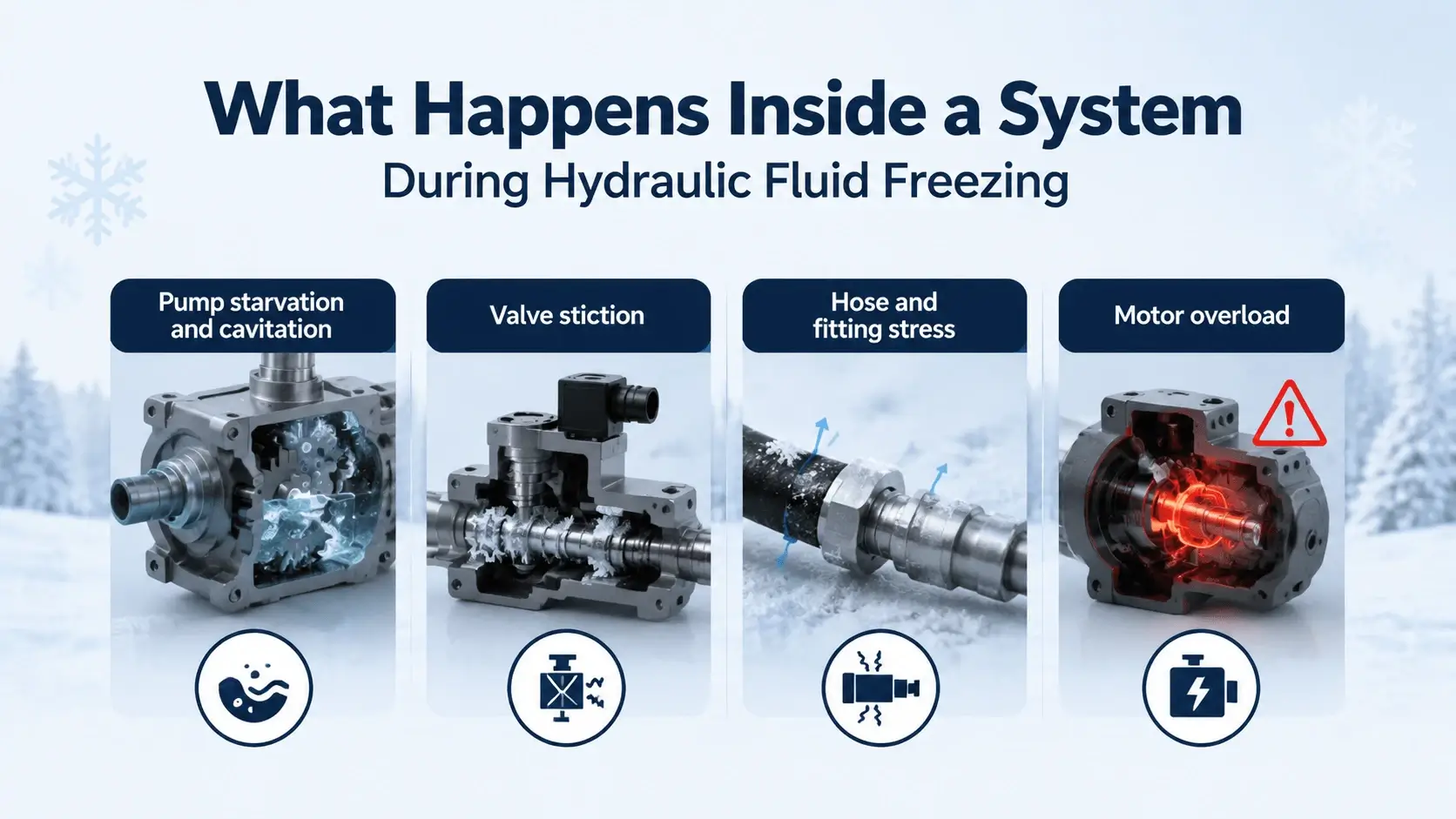
Thick oil creates problems throughout the hydraulic circuit. Understanding where and why helps you diagnose the failure mode correctly.
Pump starvation and cavitation
The pump inlet cannot draw sufficiently thick oil. Inlet pressure drops below atmospheric. Vapor bubbles form in the pumping chambers. When those bubbles collapse under discharge pressure, the shock wave erodes metal surfaces. Cavitation destroys pump gears, vanes, and piston slippers in hours if unchecked. Loud knocking noise from the pump during cold starts almost always indicates cavitation from these cold-weather conditions.
Valve stiction
Spool valves rely on close sliding fits. Thick oil increases viscous drag between spool and bore. The solenoid or pilot force cannot overcome that drag. Valves stick in position. Cylinders do not move when commanded. Operators push harder on the lever, building pilot pressure against a stuck spool. Eventually something gives. The spool snaps across, causing uncontrolled cylinder movement. This whiplash action loads cylinders, mounts, and tooling beyond design limits.
Hose and fitting stress
Pressure spikes from cavitation and valve stiction travel through the system as shock waves. Hoses see transient pressures two to three times normal operating levels. Old hoses with degraded reinforcement layers burst at these spikes. Fittings crack. O-ring extrusion increases at low temperatures because the elastomer stiffens and loses sealing force.
Motor overload
The electric motor or engine driving the pump sees shaft resistance rise sharply as oil thickness increases. A motor sized for normal-viscosity operation may trip its overload relay or blow a fuse on a cold start. Diesel engines lug down, produce black smoke, and sometimes stall. Repeated cold-cranking abuse shortens starter motor and battery life significantly.
Preventing Hydraulic Fluid Freezing Problems
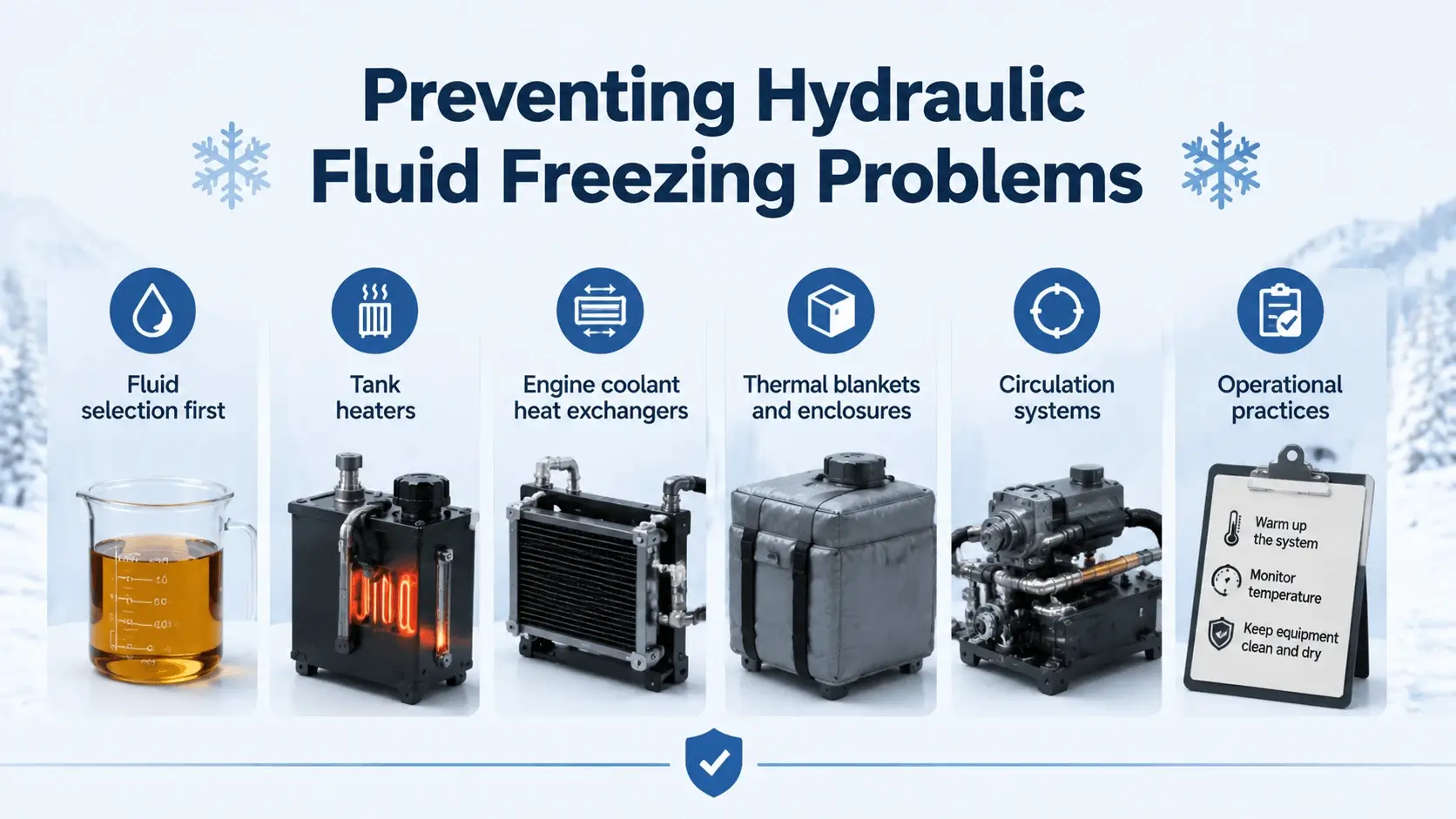
Prevention costs less than repair every time. These methods range from cheap operational changes to capital investments in heating equipment.
Fluid selection first
Match your fluid to your coldest expected startup temperature, not your average operating temperature. If your equipment sees -20C mornings, specify a fluid with a pour point at least 10C below that. Synthetic PAO or heavily depressant-treated mineral oil becomes mandatory below -25C. The fluid cost increase per liter is small compared to one pump rebuild.
Tank heaters
Immersion heaters mounted in the reservoir maintain oil temperature above the pumpability threshold overnight. Typical sizing runs 1 to 2 kW per 100 liters of reservoir capacity for insulated tanks. Uninsulated tanks may need double that wattage. Thermostatic control set to 10C to 15C ensures the oil stays pumpable without overheating. Install heaters with low-level cutout switches. A heater running in an empty tank creates a fire hazard.
Engine coolant heat exchangers
Mobile equipment with diesel engines can route coolant through a heat exchanger in the hydraulic tank. Engine block heaters (common in northern fleets) then warm both the engine oil and the hydraulic fluid simultaneously. This approach uses waste heat and requires no extra electrical circuit.
Thermal blankets and enclosures
Insulating the hydraulic tank and exposed lines retains heat generated during the previous shift. A quilted fiberglass blanket wrapped around a 200-liter tank can keep oil 10C to 15C warmer than ambient after an 8-hour overnight soak in moderate cold. Full machine enclosures work better but cost more and require space.
Circulation systems
Some installations use a small auxiliary pump to circulate tank oil through the system at low flow during idle periods. Circulating oil picks up heat from the pump case, motor, and valve bodies, distributing it through the tank. This method works well for stationary systems with continuous electrical power available.
Operational practices
Simple habits reduce hydraulic fluid freezing risk without spending money. Park equipment indoors or under shelter when possible. Run the hydraulic system at low idle for five to ten minutes before loading. This warms the oil gradually and brings all components up to temperature evenly. Avoid full-stroke, full-speed movements until the oil reaches at least 20C to 30C.
Emergency Thawing Procedure
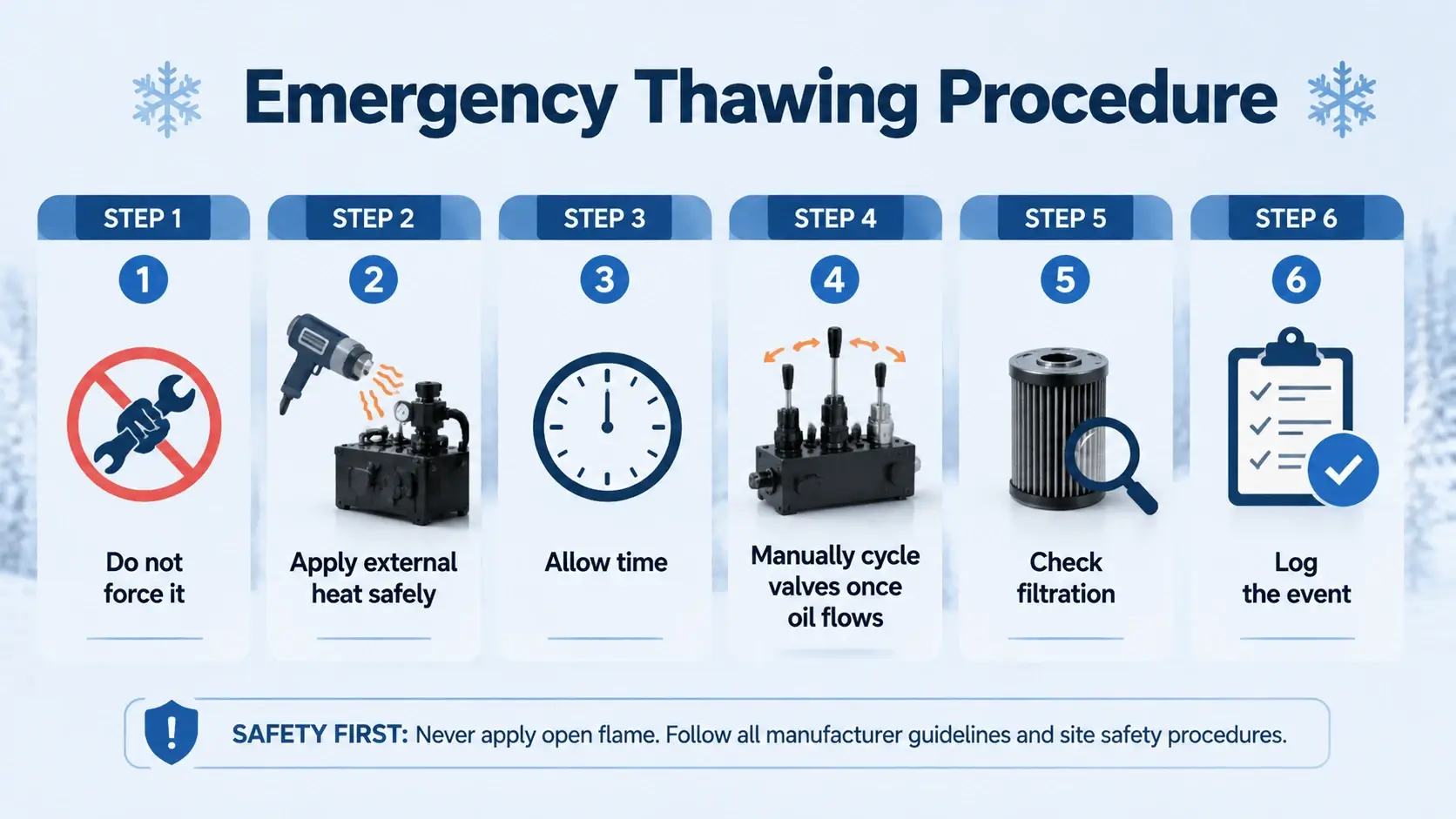
Sometimes prevention fails and you face a frozen system. Follow this procedure to minimize damage while recovering operation.
Step 1: Do not force it
If the pump makes loud cavitation noise or the engine labors hard on startup, shut down immediately. Forcing a frozen-oil condition accelerates wear by orders of magnitude. Ten minutes of patience saves thousands in repairs.
Step 2: Apply external heat safely
Use forced-air heaters (salamander heaters) directed at the hydraulic tank, pump housing, and filter housing. Maintain at least one meter distance to avoid hot spots that can damage paint, seals, or electrical components. Never use open flame torches on hydraulic components. Localized overheating distorts housings, burns seals, and can ignite residual oil film.
Step 3: Allow time
A 200-liter tank of cold oil takes one to three hours to reach pumpable temperature with external air heating, depending on starting temperature and heater output. Smaller systems thaw faster. Do not rush this step.
Step 4: Manually cycle valves once oil flows
After the pump runs quietly at low idle, slowly cycle each directional valve through its positions. Listen for stiction or erratic movement. Warm oil flushes cold pockets out of valve bodies, cylinder lines, and remote-mounted components.
Step 5: Check filtration
Cold operation may have pushed wax particles or thickened oil through the filter element. If system response remains sluggish after thawing, inspect and possibly replace the filter element before resuming full operation.
Step 6: Log the event
Record the date, ambient temperature, fluid type, and time required to recover. This data builds the case for investing in prevention equipment if events recur.
Selecting the Right Cold-Weather Approach
Use this decision framework to match solutions to your climate and budget:
| Climate Zone | Typical Min Temp | Minimum Fluid Spec | Recommended Add-ons |
|---|---|---|---|
Mild Winter (Southern US, Southern Europe) |
-5C to 0C |
Standard mineral oil OK |
Tank insulation optional |
Moderate Winter (Northern US, Central Europe) |
-15C to -10C |
Mineral + PPD or light synthetic |
Tank heater recommended |
Severe Winter (Northern Canada, Scandinavia) |
-30C to -25C |
Full synthetic PAO |
Heater + enclosure + coolant loop |
Arctic / High Altitude |
Below -40C |
Specialized arctic-grade PAO |
Complete thermal management system |
FAQ
At what temperature does hydraulic fluid freeze?
It depends on the fluid. Standard mineral hydraulic oil stops flowing (reaches pour point) around -30C to -33C. But your pump cannot operate with it long before that, typically above -20C due to excessive viscosity. Synthetic PAO fluids remain pumpable down to -40C or lower. Check your fluid datasheet for exact pour point and low-temperature viscosity specifications.
Can I add antifreeze to hydraulic fluid like automotive coolant?
No. Automotive antifreeze (ethylene glycol or propylene glycol) is not compatible with hydraulic oil additives, seals, or pump materials. It causes seal swelling, reduced lubricity, and accelerated wear. Use proper pour point depressant additives designed for hydraulic oil, or switch to a cold-weather formulated fluid.
Will a tank heater alone solve hydraulic fluid freezing problems?
A properly sized tank heater prevents most hydraulic fluid freezing issues by keeping oil above the pumpability threshold. However, heaters only protect the oil in the tank. Long lines, remote valves, and external cylinders can still contain cold oil that causes stiction or high pressure drop. Combine tank heating with a warm-up circulation period before loading the system.
How do I know if my hydraulic fluid has frozen or something else is wrong?
Cold hydraulic fluid freezing produces distinctive symptoms: extremely slow or no cylinder movement, loud pump cavitation noise (knocking or rattling), motor or engine laboring heavily at low load, and oil visible in the sight glass that looks opaque or sludgy. If the pump runs quiet but nothing moves, check for a failed solenoid, broken mechanical linkage, or closed manual cutoff instead.
Can thawed hydraulic fluid be reused?
If the fluid did not overheat during thawing and no contamination entered the system, the fluid itself is usually fine. Cold thickening does not permanently degrade oil. However, the freeze-thaw cycle may have pushed wax precipitate into the filter or allowed condensation to form in the headspace. Change the filter, run a quick oil analysis if you have a program, and monitor the system closely for the next few operating hours.
What is the best hydraulic fluid for freezing temperatures?
Full synthetic PAO hydraulic fluid in the correct ISO VG grade offers the best overall cold-weather performance. Look for pour points below -50C and viscosity index above 140. For extreme arctic conditions, some suppliers offer specialized formulations with ester blends that extend the low end further. Expect to pay three to four times the price of mineral oil, but count the cost against unplanned downtime and pump replacement.
Conclusion
Hydraulic fluid freezing is predictable and preventable. Know your fluid’s pour point and your pump’s cold-start viscosity limit. Match fluid type to your minimum expected temperature. Install heating where the climate demands it. Train operators to warm up systems before loading. When cold catches you unprepared, thaw gently and never force a cavitating pump. Cold-weather hydraulics adds cost, but far less than the alternative.