
A barrel of base oil does about half the work in a hydraulic system. The other half comes from the hydraulic fluid additive package blended into that oil. Without additives, mineral oil would oxidize, foam, corrode steel, and let pumps wear out in weeks. This guide covers what each additive does, how to read an additive package, and where most selection mistakes happen.
What is a Hydraulic Fluid Additive?
A hydraulic fluid additive is a chemical compound that formulators blend into base oil. It improves one or more properties of the finished fluid. Base oil provides the hydrodynamic film and carries the load. Additives protect that film, extend oil life, and defend metal surfaces from the conditions that base oil alone cannot handle.
Most finished hydraulic oils contain 0.5 to 5 percent additives by volume. Anti-wear fluids sit near 1 to 2 percent. High-VI and severe-duty formulations run higher. The additive package is not random. Each component targets a specific failure mode, and the components must work together without fighting each other.
Main Additive Categories
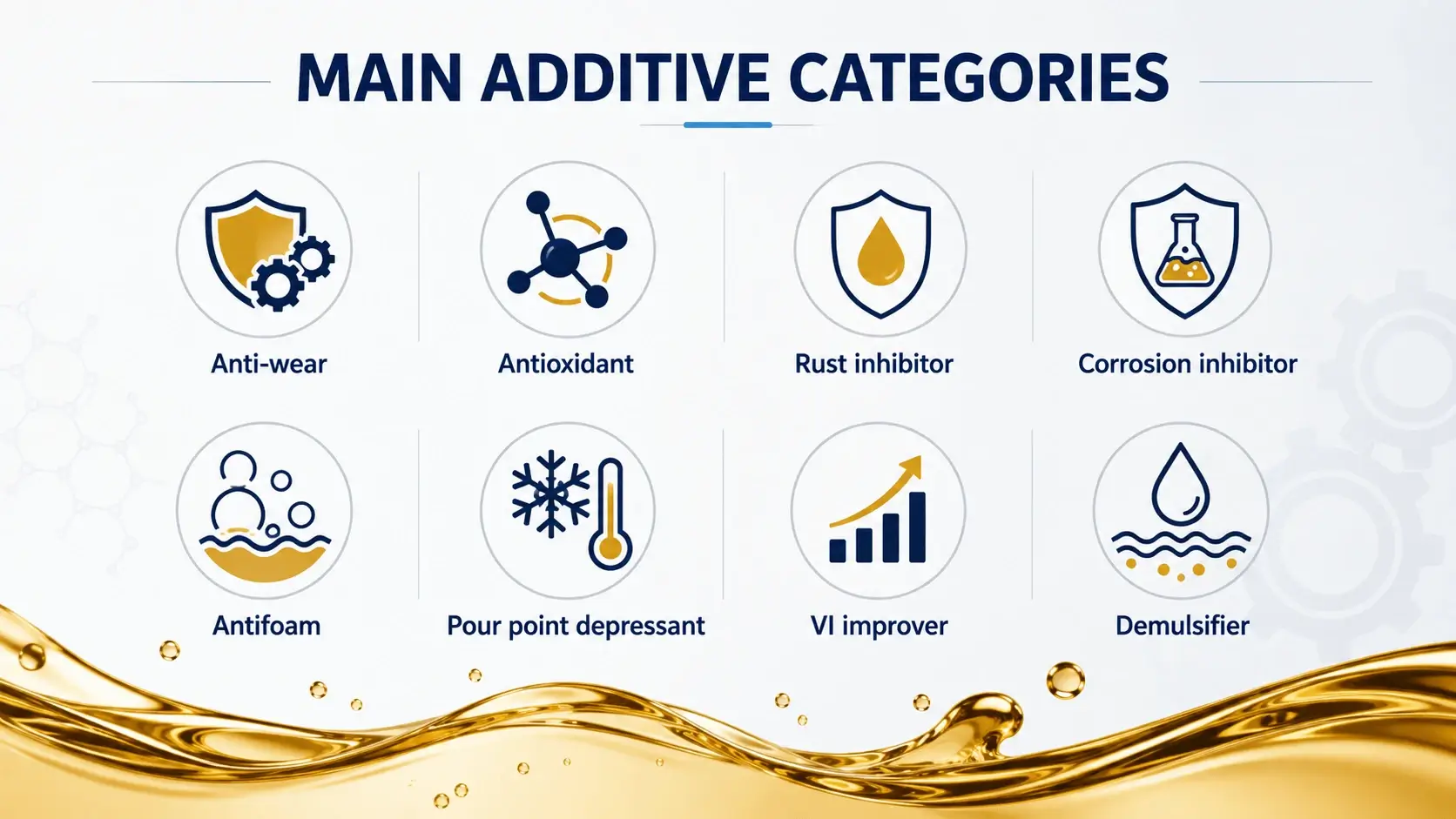
Hydraulic oil formulators group additives by function. Each category solves a distinct problem inside the system.
| Additive Type | Function | Typical Chemistry |
|---|---|---|
Anti-wear |
Boundary film on loaded steel |
ZDDP, ashless phosphorus-sulfur |
Antioxidant |
Slows oil oxidation at heat |
Hindered phenols, aromatic amines |
Rust inhibitor |
Protects ferrous surfaces from water |
Carboxylates, sulfonates |
Corrosion inhibitor |
Protects yellow metals |
Triazoles |
Antifoam |
Breaks entrained air bubbles |
Silicone, polyacrylate |
Pour point depressant |
Prevents wax gelation in cold |
Polymethacrylate |
VI improver |
Flattens viscosity-temperature curve |
PMA, olefin copolymer |
Demulsifier |
Separates water from oil |
PEO copolymers |
Anti-Wear Additives
Zinc dialkyldithiophosphate, or ZDDP, dominates this category. The molecule decomposes under boundary contact and lays down a sacrificial film on steel surfaces. That film shears instead of the metal beneath it. Vane and piston pumps depend on this protection at pressures above 210 bar.
Some modern fluids run ashless anti-wear chemistry using phosphorus and sulfur compounds without zinc. These suit silver-bearing components and applications where zinc residue causes problems.
Oxidation Inhibitors
Hot oil reacts with oxygen. The reaction produces sludge, varnish, and acids. Antioxidants interrupt this chain reaction at the molecular level. Hindered phenols and aromatic amines do most of the work. A good hydraulic fluid additive package for high-temperature service will stack two or three antioxidant chemistries together.
Rust and Corrosion Inhibitors
Water finds its way into every system eventually. Condensation, cooler leaks, and washdown spray all introduce moisture. Rust inhibitors form a polar film on ferrous surfaces that water cannot displace. Yellow metal corrosion inhibitors protect bronze and brass bushings, often using triazoles.
Foam Inhibitors
Air bubbles in oil cause spongy response, cavitation-like damage, and pump noise. Silicone antifoam agents break bubble walls at the surface. Dose rates run in parts per million. Too much silicone actually stabilizes foam instead of killing it, so formulators measure carefully.
Pour Point Depressants
Cold oil thickens. Below the pour point, it stops flowing. Pour point depressants interfere with wax crystal growth in paraffinic base oils. They do not thin the oil. They stop wax from forming a solid network. This additive matters most for outdoor equipment in winter service.
Viscosity Index Improvers
Long-chain polymer molecules uncoil at high temperature and contract at low temperature. That behavior flattens the viscosity-temperature curve. VI improvers let one oil cover a wider ambient range. The tradeoff is shear stability. Polymers break down in high-shear pump zones, and viscosity drifts downward over time.
Demulsifiers and Emulsifiers
Demulsifiers separate water from oil so the water drops to the reservoir bottom for draining. Emulsifiers do the opposite, dispersing water as tiny droplets. Most industrial hydraulic fluids use demulsifier chemistry. Paper mill and steel mill fluids sometimes use emulsifiers because water ingress is constant and removal is impractical.
How Additive Packages Come Together
Formulating a finished oil means balancing competing additives. Two examples show how this works.
A high-pressure anti-wear fluid for piston pumps needs ZDDP, antioxidants, rust inhibitors, and a demulsifier. The ZDDP and the demulsifier can clash. Formulators run compatibility tests to confirm the package stays stable in storage and in service.
An outdoor mobile fluid needs pour point depressant, VI improver, antifoam, and anti-wear. The VI improver choice affects shear life. A polymethacrylate gives a good low-temperature response but poorer shear stability than an olefin copolymer. Every choice costs something elsewhere.
Reading the supplier datasheet tells you which tradeoffs the formulator accepted. If the sheet lists only “contains anti-wear agents” with no chemistry named, ask. A proper hydraulic fluid additive disclosure identifies the active species and their treat rates.
Compatibility and Mixing Problems
Mixing fluids with incompatible additive systems causes real failures. The classic case is mixing a zinc-containing anti-wear oil with a silver-compatible ashless fluid. The zinc attacks silver slipper pads in some old piston pump designs. Result is rapid pad loss and pump seizure.
Other mixing problems include additive dropout, where two chemistries react and form a sludge that clogs filters. Foaming can spike when two antifoam systems interact. Demulsibility can fail when surfactant chemistry conflicts.
The safe rule is simple. Drain, flush, and refill when switching between additive families. Top up only with the same product. If you must mix brands, send a sample to a lab for a compatibility check first. A wrong hydraulic fluid additive combination costs more than the flush would have.
Testing Additive Performance
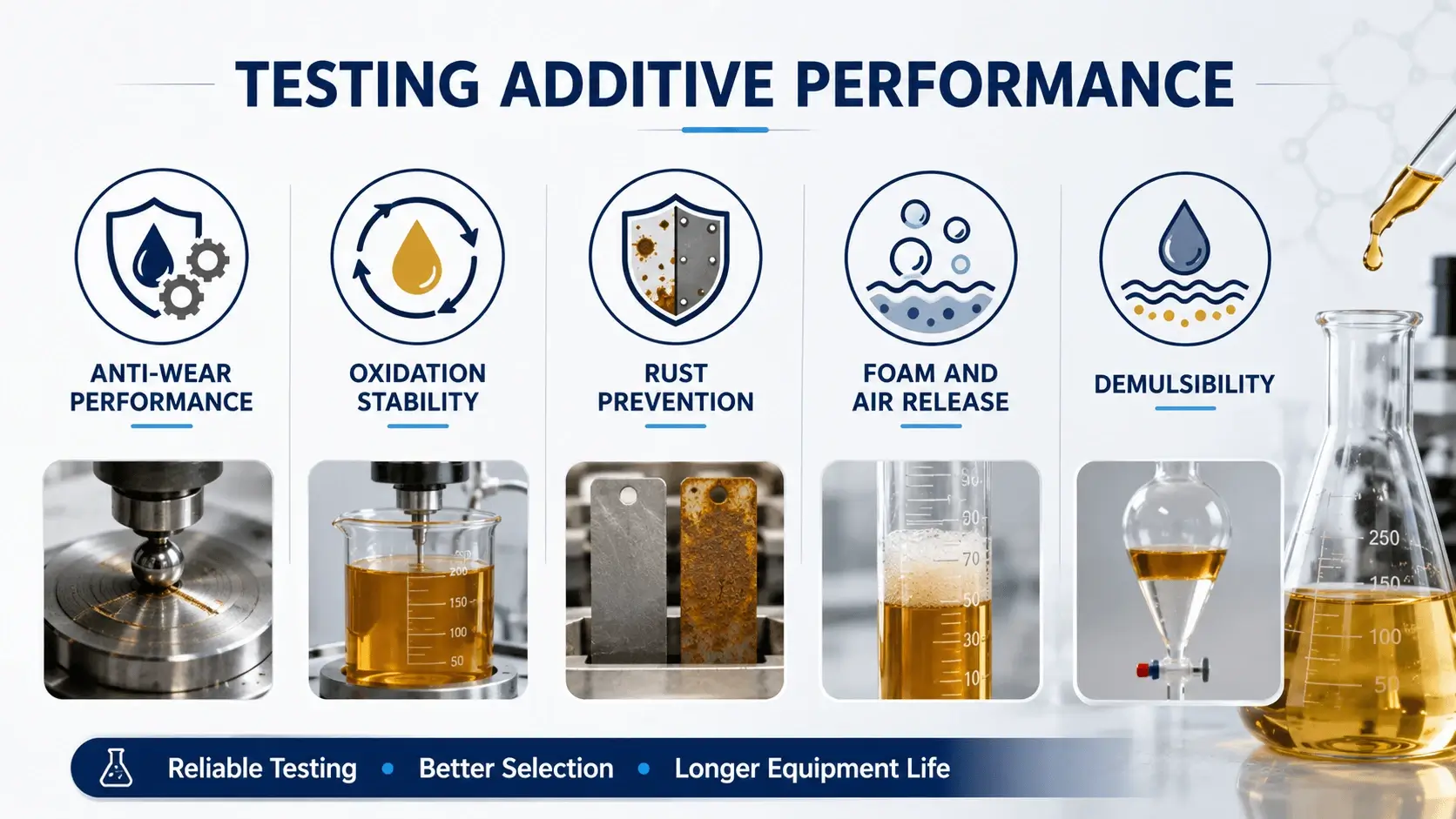
Several standardized tests measure how well additives do their job.
Anti-Wear Performance
The FZG gear test rig (DIN 51354) loads a gear pair in the test oil. It steps up the load until scuffing occurs. A higher failure load stage means better anti-wear protection. The vane pump test (ASTM D2882) runs a real pump on the candidate fluid. Technicians weigh the cam ring and vanes afterward.
Oxidation Stability
The TOST test (ASTM D943) runs oil at 95 °C with water and a copper catalyst. It measures time to reach a neutralization number of 2.0. Good oils exceed 2000 hours. The Rotary Pressure Vessel Oxidation Test (ASTM D2272) gives faster results using oxygen pressure drop as the signal.
Rust Prevention
ASTM D665 runs a steel pin in a stirred oil and water mixture at 60 °C. Pass or fail, with the pass requiring no visible rust. Synthetic seawater tests saltwater environments. A hydraulic fluid additive package that fails D665 has no place in a system that sees condensation.
Foam and Air Release
ASTM D892 measures foam tendency and stability after blowing air through the oil. ASTM D3427 measures air release time, how long entrained air takes to drop to 0.2 percent. Slow air release causes a spongy actuator response. Antifoam dose directly affects both numbers.
Demulsibility
ASTM D1401 stirs oil and water together, then measures how fast they separate. Good separation can be completed in 30 minutes or less for most industrial fluids. Slow separation means water circulates through the pump and bearings instead of settling out.
Additive Depletion and Oil Life
Additives deplete as they do their job. ZDDP depletes as it lays down protective films. Antioxidants deplete as they scavenge radicals. Rust inhibitors can wash out with water drains.
Oil analysis tracks additive health through several signals. The elemental panel reports zinc, phosphorus, calcium, and magnesium levels. A dropping zinc trend means the anti-wear additive is depleting. Rising acid number means oxidation is winning. Dropping pH confirms the same trend.
A healthy additive system depends on catching depletion before it crosses the condemnation limit. Most labs flag additives at 50 percent of new-oil concentration. By that point, schedule a changeout.
Common Additive-Related Failures
Varnish
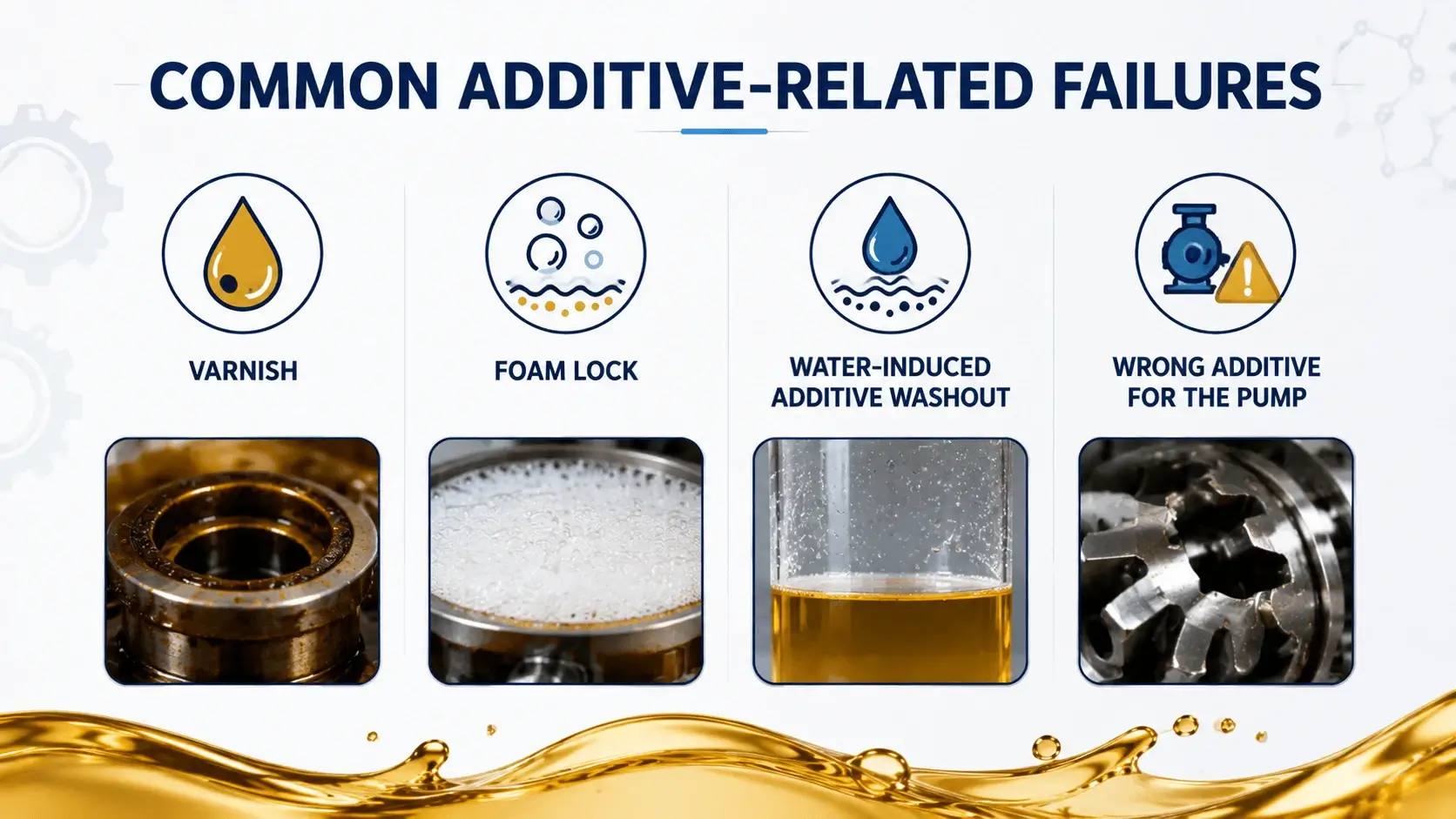
Varnish forms when antioxidants deplete and oxidation products polymerize onto hot metal surfaces. The deposits stick valve spools, clog orifices, and coat heat exchanger surfaces. Servo and proportional valves fail first because their clearances are tightest. Varnish is the most expensive additive-depletion failure in modern high-pressure systems.
Foam Lock
Excess antifoam or incompatible antifoam can invert and stabilize foam instead of breaking it. The reservoir turns to foam, the pump draws air, and pressure drops or surges. This failure appears suddenly after a top-up with a different product.
Water-Induced Additive Washout
Water does not just rust parts. It strips additives. ZDDP and some rust inhibitors partition into free water and leave the system when you drain the water. Systems with chronic water ingress lose additive protection faster than the oil change interval accounts for.
Wrong Additive for the Pump
Putting a zinc-free ashless oil into a pump that needs ZDDP film, or the reverse, shortens pump life. Always confirm the additive chemistry matches the pump manufacturer’s recommendation. The pump manual names the chemistry. The fluid datasheet should confirm it.
Selection Checklist
Start with the pump manual. It names the required additive chemistry, usually zinc or ashless. Match the anti-wear system to that requirement before anything else.
Next, confirm your operating temperature range. Check that the oxidation stability test results meet your duty cycle. Hot-running systems need stronger antioxidant packages than intermittent service.
List every water exposure source in the system. Condensation, cooler leaks, and washdown spray all count. Pick rust and demulsibility performance to match the worst case.
For outdoor or cold-start service, verify pour point and VI requirements. Cold oil that will not flow starves the pump on the first start of the day.
Request the full additive disclosure from the supplier. A datasheet that hides the chemistry behind generic terms is a warning sign. You need the active species and their treatment rates.
Finally, set oil analysis targets for the additives you track. For ZDDP fluids, watch zinc and phosphorus. Getting the package right at the specification stage prevents most fluid-related failures before they start. The cost of a better-formulated oil is small next to a varnish-related valve replacement or a pump rebuild.
FAQ
What do these additives actually do?
Each additive targets a specific failure mode. Anti-wear additives lay down sacrificial films on loaded metal. Antioxidants slow oil breakdown at high temperature. Rust inhibitors, antifoam agents, pour point depressants, and VI improvers each handle one threat the base oil cannot manage alone.
Can I add aftermarket additive supplements to my hydraulic oil?
Generally no. A finished oil already has a balanced additive package. Pouring in aftermarket supplements can unbalance that chemistry, cause additive dropout, or trigger foaming. The oil supplier already optimized the treat rates. Trust the formulation and change the oil on schedule instead.
How do I know if my additives are depleted?
Oil analysis is the only reliable method. The elemental panel tracks zinc, phosphorus, and other marker metals. Acid number, pH, and oxidation trending show antioxidant health. Compare results to the new-oil baseline. A 50 percent drop in a marker element warrants a changeout plan.
Are synthetic fluids better because of their additives?
Not exactly. Synthetic base stocks like PAO already resist oxidation better than mineral oil. The hydraulic fluid additive package in a synthetic oil still matters, but the base stock does more of the work. Additive treat rates can run lower in PAO fluids for the same performance.
What happens if I mix two anti-wear fluids with different chemistry?
You risk additive incompatibility. Zinc and ashless systems can interact. Performance drops below either parent fluid. Foam, demulsibility, and deposit formation are common symptoms. Drain and flush rather than mixing.
Conclusion
Base oil gets the fluid into the reservoir. The additive package keeps the system alive. Pick the chemistry that matches your pumps, your temperatures, and your water exposure. Track additive health through oil analysis. Replace the oil before the additives run out. Do those three things and you eliminate most fluid-related failures before they reach the maintenance budget.