Why Supplier Selection Matters More Than Price
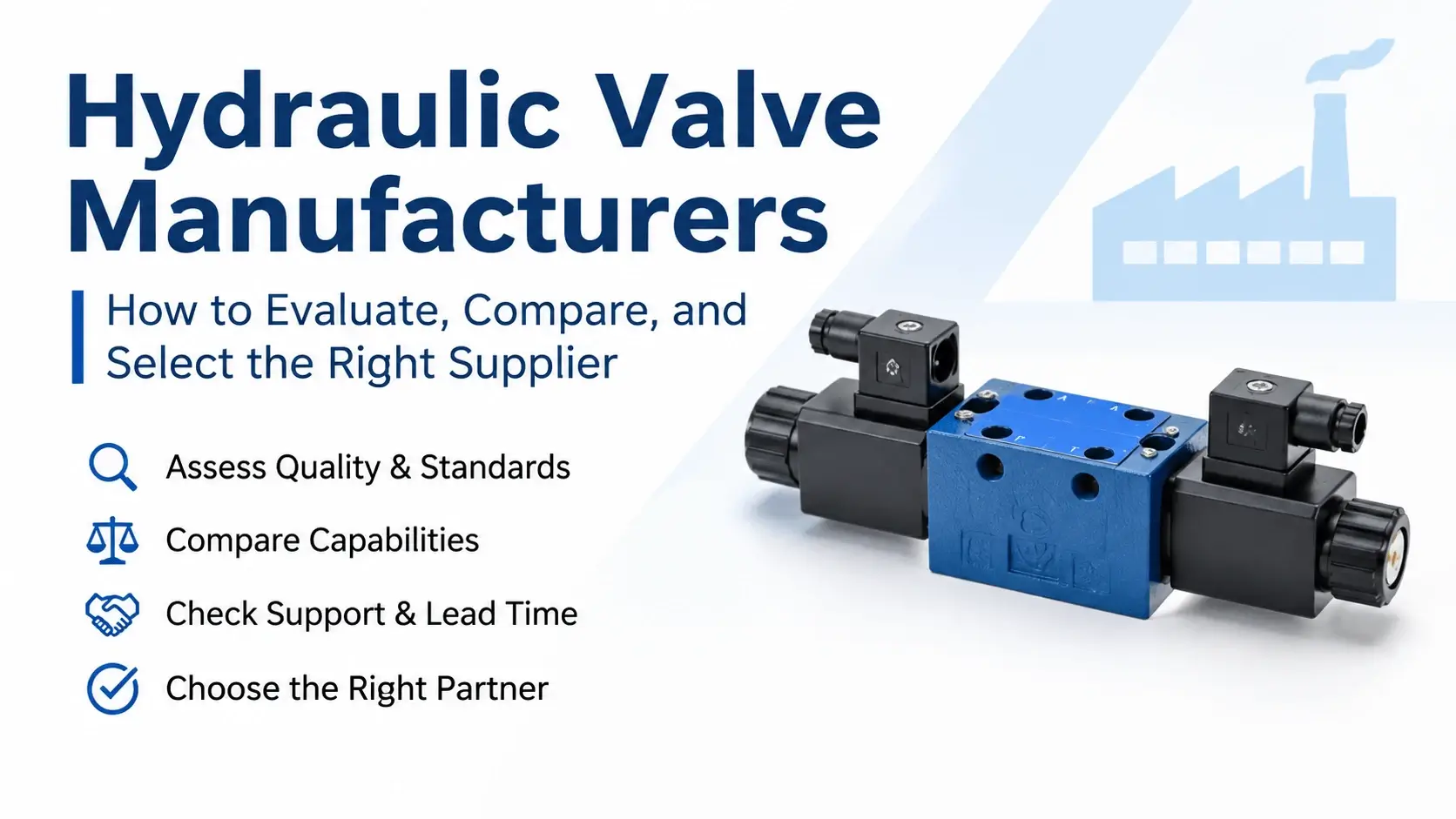
The cheapest quote from hydraulic valve manufacturers almost never represents the lowest total cost. A directional control valve that sticks after 500 cycles in the field costs far more in downtime, service calls, and reputation damage than the price difference between a bargain supplier and a competent one. Smart buyers know this. They evaluate suppliers on capability, not just unit price.
The Hidden Cost of Choosing on Price Alone
Consider a real scenario. A mobile equipment OEM sources 2,000 directional valves per year at 42 each from Factory A. Factory B quotes 58. After 18 months, Factory A’s valves show 7% premature failure from spool sticking. Field replacements average 380 each in labor and freight. Do the math. The “cheaper” supplier cost an extra 47,000+ in warranty exposure. This pattern repeats across industries where shops compete on price alone.
What Hydraulic Valve Manufacturers Actually Do
Hydraulic valve manufacturers take raw material, bar stock, castings, or forgings and turn them into precision flow-control devices. The process involves CNC machining of valve bodies and spools, heat treatment of critical wear surfaces, assembly of internal components, and rigorous testing before shipment. Not every shop does all of this in-house. Some machine bodies but buy spools from specialty vendors. Others assemble bought-out components with minimal value-add.
Where Quality Risks Hide in the Production Chain
Understanding what happens inside the factory matters because it reveals where quality risks hide. A supplier that outsources spool grinding cannot guarantee consistent lap conditions between spool lands and body bores. A factory that skips 100% pressure testing ships whatever comes off the assembly line. The best shops control their critical processes end-to-end.
Types of Hydraulic Valve Manufacturers and Their Specialties
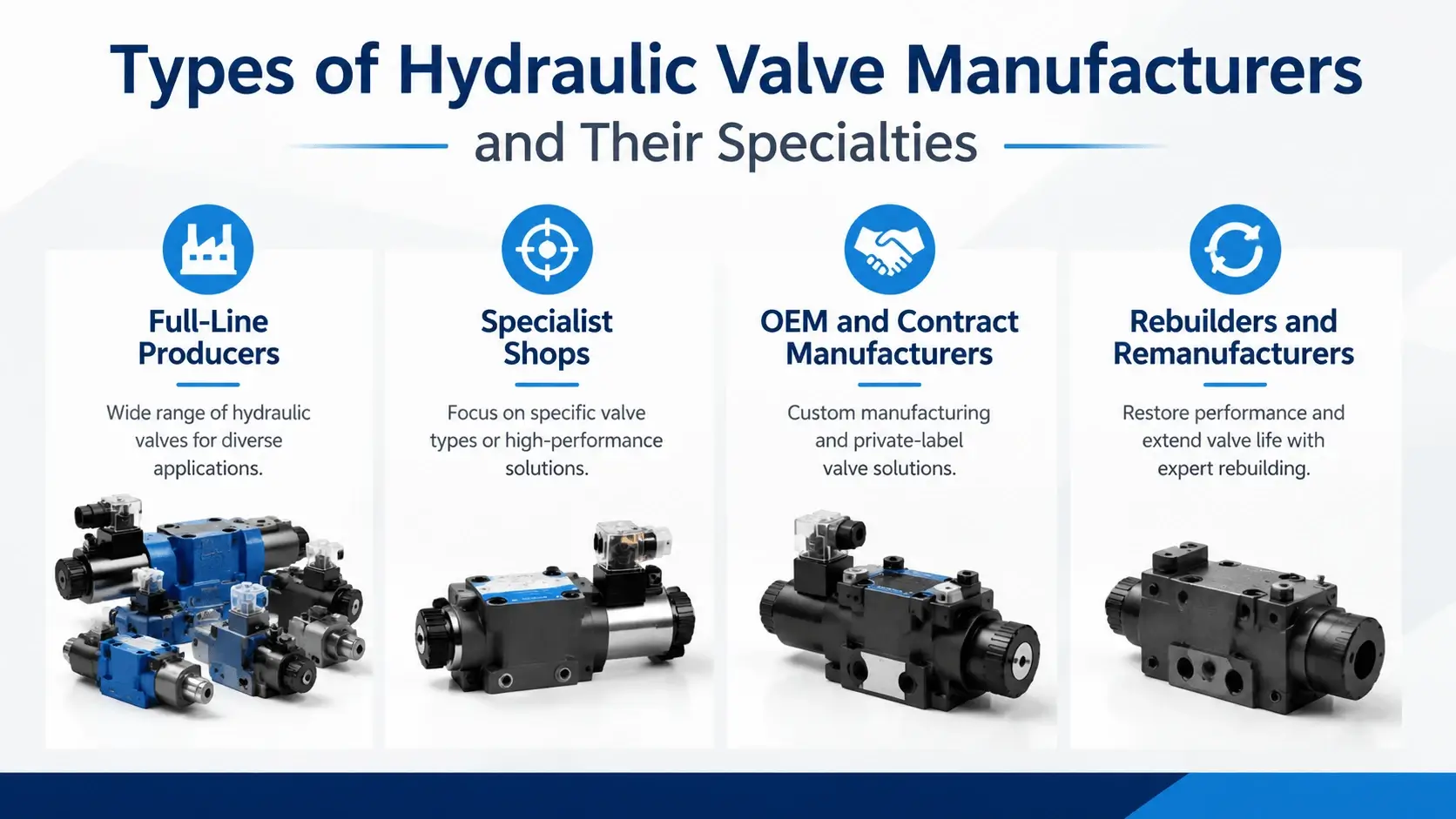
Not all hydraulic valve manufacturers cover the same ground. The industry splits into recognizable categories.
Full-Line Producers
Full-line producers offer directional, pressure, and flow control valves across multiple sizes and pressure classes. Companies like Danfoss, Parker, and Bosch Rexroth fit this model. They serve broad markets and maintain deep inventories. Smaller shops rarely match this range.
Specialist Shops
Specialist shops focus on one valve family. Some build only cartridge valves. Others produce only proportional or servo valves for motion control applications. These shops often achieve higher quality within their niche because every process, fixture, and inspection tool serves one product family.
OEM and Contract Manufacturers
OEM/contract manufacturers build valves to customer specifications under private label. Many in this category operate in China, Taiwan, and Korea. They produce valves that carry the buyer’s brand name. Quality varies enormously depending on the factory’s process discipline and the buyer’s oversight.
Rebuilders and Remanufacturers
Rebuilders and remanufacturers take worn valves and restore them to spec. This segment matters for high-value servo valves where replacement cost exceeds rebuild cost by a wide margin. Most in this space operate regionally due to core-exchange logistics.
Key Criteria for Evaluating Manufacturers
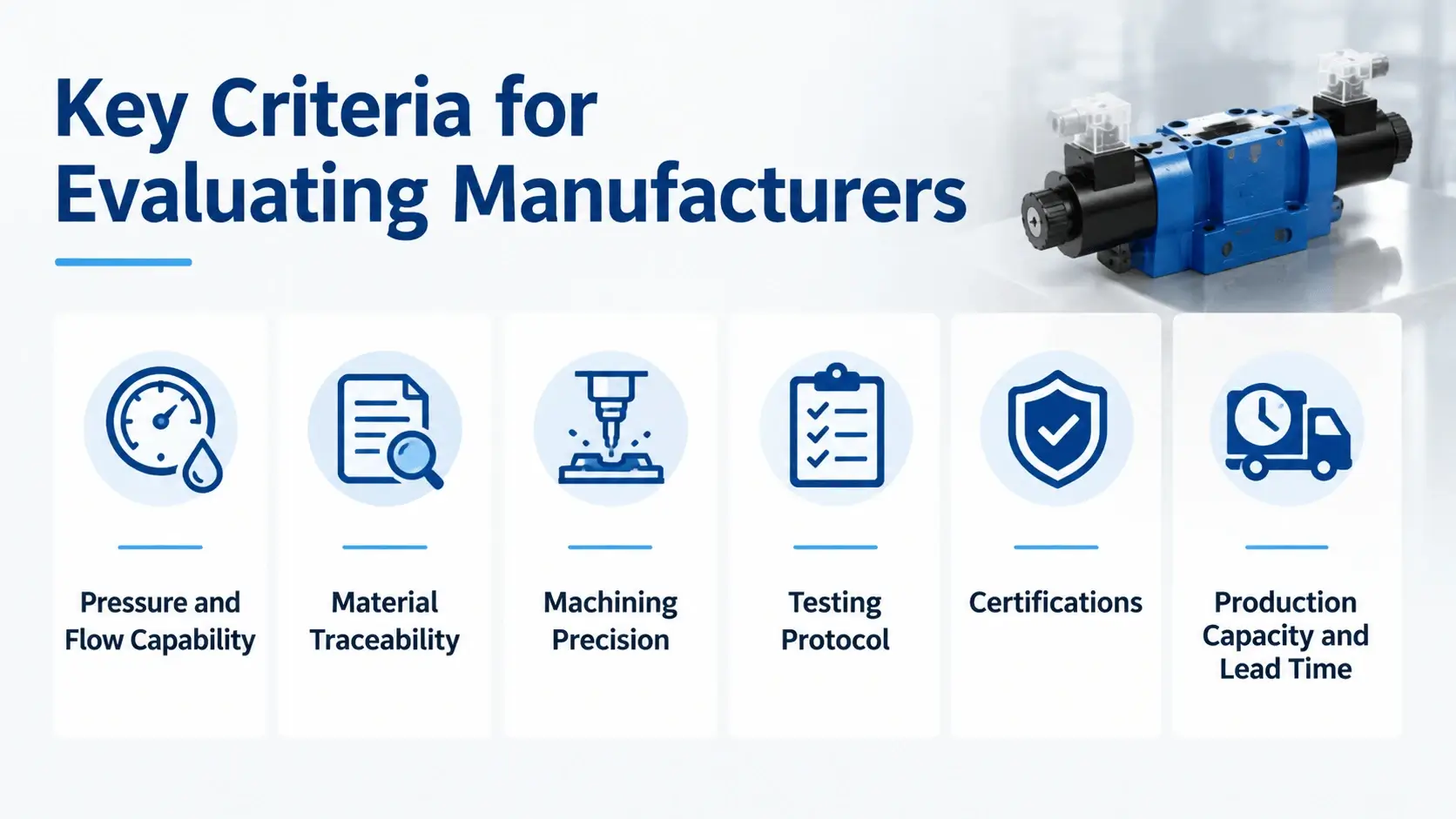
When you sit down to compare hydraulic valve manufacturers, run through this checklist. It covers the factors that actually predict field performance.
Pressure and Flow Capability
Can the shop produce valves rated for your operating range? A builder of 210-bar open-center directional valves may lack experience with 350-bar load-sense systems. Ask for standard pressure ratings and flow capacities. Legitimate suppliers publish these figures openly.
Material Traceability
Every valve body and spool should carry material certificates back to the mill. 1045 steel, ductile iron, and aluminum bronze each behave differently under cyclic loading. If a factory cannot produce a mill certificate on demand, walk away.
Machining Precision
Spool-to-bore clearance determines leakage, response, and stick-slip behavior. Tolerances below 10 microns require CNC grinding equipment and temperature-controlled inspection rooms. Ask about bore gauging methods and acceptance criteria.
Testing Protocol
Does every valve get pressure-tested? For how long? At what pressure? The minimum acceptable practice is 100% test at 1.5x rated pressure for 30 to 60 seconds with leak-down monitoring. Some test longer or cycle the valve during the hold period.
Certifications
ISO 9001 is table stakes. IATF 16949 indicates automotive-grade process control. API 624 or 6FA certification matters for oil and gas applications. CE marking is mandatory for European sales. Do not accept self-declared compliance without certificate numbers you can verify online.
Production Capacity and Lead Time
A factory running at 110% capacity will miss deliveries regardless of intentions. Ask about current utilization, typical queue times, and whether they buffer finished goods for common SKUs. Reliable shops give realistic delivery dates and communicate delays early.
Quality Systems That Separate Factories
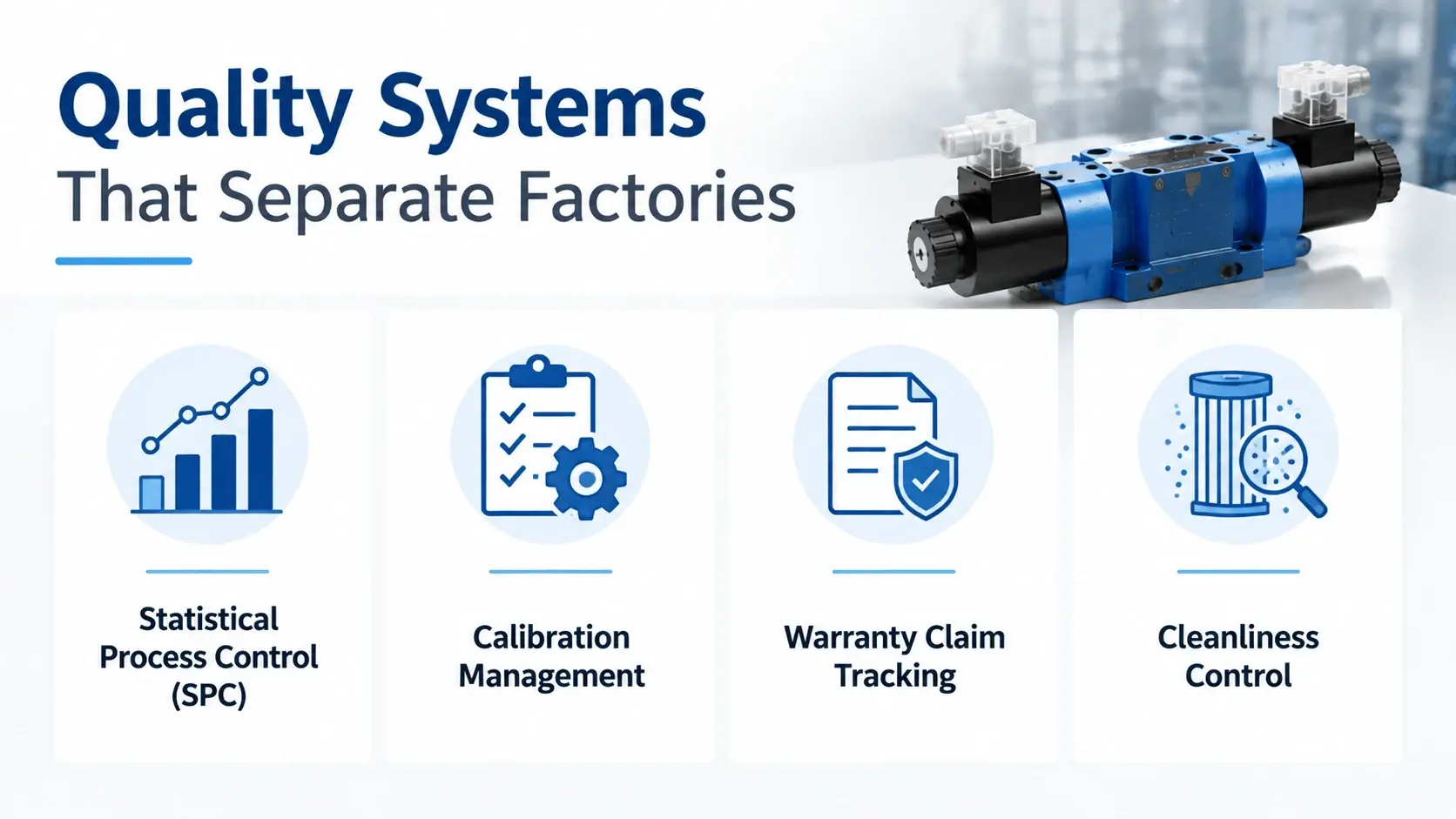
Two factories can both display an ISO 9001 certificate on their wall and produce radically different results. The difference shows up in execution, not documentation.
Statistical Process Control (SPC)
Statistical process control (SPC) separates serious suppliers from those going through motions. SPC means measuring critical dimensions on every shift, plotting the data, and reacting when trends drift toward tolerance limits. I have visited factories that track spool diameter Cpk values daily. I have also seen shops where inspectors measure one part per hundred and call it good. Guess which ones ship fewer defects.
Calibration Management
Calibration management sounds boring until an out-of-spec pressure gauge passes a bad valve. Top-tier shops calibrate test equipment on documented schedules and maintain calibration stickers on every gauge, transducer, and flow meter. Ask to see their calibration logs during an audit.
Warranty Claim Tracking
Warranty claim tracking tells you whether a factory learns from failures. A manufacturer that records every returned valve, performs root-cause analysis, and feeds corrections back into the process will improve over time. One that treats warranties as a cost of doing business will not. This distinction becomes obvious after speaking with their quality manager for twenty minutes.
Cleanliness Control
Cleanliness control affects valve life more than most buyers realize. Particulate contamination inside a new valve accelerates wear from day one. Best-practice shops assemble in clean-room or controlled environments, use filtered flushing fluid during pre-ship testing, and cap all ports before packaging.
Red Flags When Auditing a Supplier
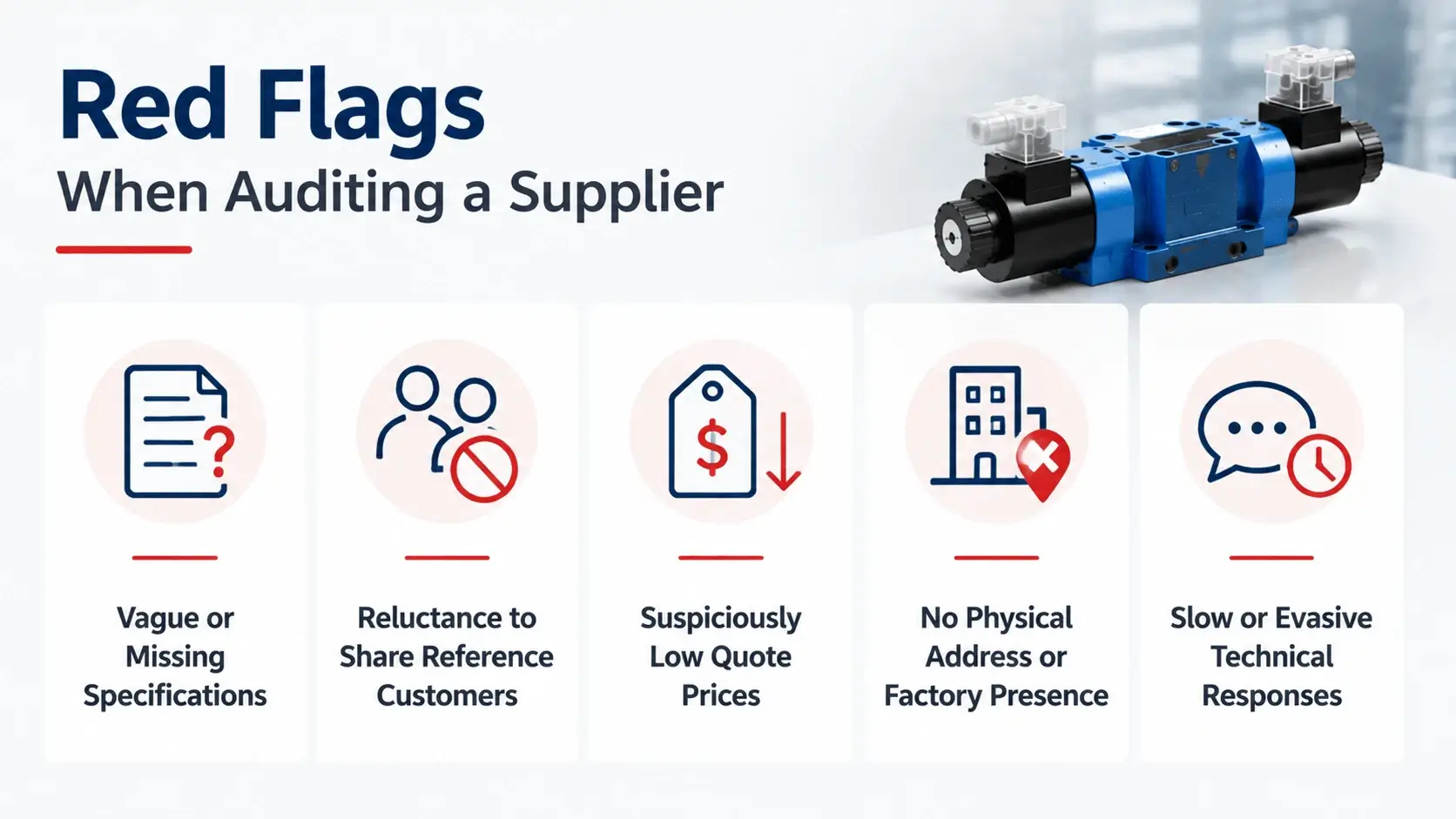
Some warning signs show up before you even visit the factory. Watch for these when evaluating suppliers.
Vague or Missing Specifications
Vague specifications on datasheets are a red flag. If a product sheet lists “high pressure” without stating the actual bar rating, or “long life” without hours data, the shop either lacks engineering rigor or hides something. Reputable firms publish specific numbers.
Reluctance to Share Reference Customers
Reluctance to share reference customers suggests problems. Every competent factory has three to five customers willing to confirm they receive acceptable product. Excuses like “our customers prefer confidentiality” usually mean the customer list is thin or unhappy.
Suspiciously Low Quote Prices
Quote prices that seem too low indicate corner-cutting somewhere. Material costs for a CETOP 3 directional valve body in ductile iron are well-known in the industry. If a quote comes in 30% below market, find out what material, process, or test step they omitted. Honest shops explain their cost structure. Suspicious ones deflect.
No Physical Address or Factory Presence
No physical address or only a P.O. box on their website signals a trading company, not a factory. Trading companies have a role in the supply chain, but you should know whether you are dealing with the actual producer or a middleman taking margin without adding value.
Slow or Evasive Technical Responses
Slow or evasive responses to technical questions reveal weak engineering. Send a specification sheet and ask how they would approach a custom modification. Strong suppliers respond with specific suggestions about porting, spring rates, or seal materials within days. Weak ones send generic acknowledgments or nothing at all.
Geographic Considerations: Domestic vs. Overseas
The debate over where to source hydraulic valves has shifted over the past decade. It is no longer simply “China equals cheap, domestic equals quality.” The reality is more nuanced.
Advantages of Domestic Sourcing
Domestic shops in North America and Europe offer advantages in communication speed, intellectual property protection, and rapid response to design changes. Lead times of four to six weeks are common for standard products. Custom modifications can move from print to sample in eight to twelve weeks. Freight costs are lower and inventory carrying costs drop when you can order smaller batches more frequently.
When Overseas Suppliers Make Sense
Overseas suppliers, primarily in China, Taiwan, and increasingly India, compete on scale and price. Large Chinese factories produce CETOP and NG6 cartridge valves in volumes that drive unit costs 30 to 50% below Western levels. The trade-off involves longer lead times, larger minimum order quantities typically starting at 50 to 100 pieces per SKU, and the logistical complexity of managing transoceanic shipments.
A Hybrid Sourcing Approach
Many successful buyers split their sourcing. They qualify two or three suppliers as approved sources, keep domestic shops for prototypes and low-volume custom work, and shift high-volume standard products to qualified overseas factories. This approach balances cost, risk, and flexibility better than putting all volume with one supplier regardless of location.
Requesting and Comparing Quotes
A proper request for quotation (RFQ) eliminates most ambiguity that leads to disputes later. When you contact hydraulic valve manufacturers, include these elements in your RFQ.
Essential RFQ Elements
Complete part number or drawing with material callouts, surface finish requirements, and any special treatments like nitriding or chrome plating. Annual estimated quantity broken down by forecast and firm order if possible. Required certifications and test documentation per piece or per lot. Packaging preferences, individual boxes or bulk, and labeling requirements. Delivery terms including Incoterm, destination, and any dock date constraints.
Normalizing Quotes for Fair Comparison
Send the identical RFQ to every supplier. Comparing quotes only works when each bidder prices the same scope. One supplier might exclude testing documentation. Another might quote shorter lead time but higher unit price. Normalize the quotes before deciding.
Building a Total-Cost Comparison Matrix
Build a comparison matrix. List unit price, tooling charge if applicable, lead time, payment terms, and warranty terms side by side. The lowest unit price rarely wins when you factor in all columns. I have seen purchasing managers select suppliers 15 to 20% above the bottom quote because their total-cost-of-ownership analysis favored reliability, communication quality, and warranty responsiveness.
Sample Approval Process
Never approve a supplier for production based on drawings and a phone call. Always require first-article samples inspected against your acceptance criteria.
Structured Workflow for First-Article Samples
The sample approval workflow should follow a structured sequence. The manufacturer produces a small batch, typically three to five pieces, using production tooling and processes. They perform their internal inspections and provide a dimensional report with actual measurements, not just pass/fail checkboxes. You receive the samples, perform your own incoming inspection, and ideally install at least one unit in a test circuit or pilot production run.
Inspection Checklist by Valve Type
What you check depends on the valve type. For directional valves, verify spool action force, center position accuracy, and port-to-port leakage at rated pressure. For relief valves, confirm cracking pressure, full-flow pressure, and reseat behavior across the adjustment range. For proportional valves, validate linearity, hysteresis, and null drift if the application demands precision motion control.
Document Everything for Dispute Protection
Document everything. Photographs of the sample, dimensional reports, and test results become the baseline for production acceptance. When suppliers ship production parts that deviate from the approved sample, you have objective evidence to support rejection. Without this documentation, disputes become he-said-she-said arguments that favor whoever holds the inventory.
FAQ
What certifications should hydraulic valve manufacturers hold?
ISO 9001 is the baseline. IATF 16949 adds automotive process controls. API certifications matter for oil and gas. CE marking is required for European Union sales. Demand certificate numbers and verify them through the issuing body’s database. Self-printed certificates carry no weight.
How do I verify a supplier’s quality without visiting?
Request a virtual factory tour via video call. Ask for photos of their test benches, calibration stickers on gauges, and sample SPC charts. Speak with their quality manager directly and ask specific questions about failure analysis on recent warranty claims. Weak shops struggle to answer detailed technical questions. Strong ones welcome the scrutiny.
What is a typical lead time from hydraulic valve manufacturers?
Standard products from domestic sources average four to six weeks. Overseas suppliers typically require eight to fourteen weeks including ocean transit. Custom or modified valves add four to ten weeks, depending on complexity. Build buffer into your schedule and ask explicitly whether the quoted lead time includes all operations or assumes raw material availability.
What MOQ should I expect from hydraulic valve manufacturers?
Domestic suppliers often accept orders as low as one to five pieces for standard items with a modest upcharge. Overseas factories usually set minimums at 50 to 100 pieces per SKU to justify setup and freight costs. Negotiate the MOQ down after establishing a purchase history. Many shops reduce minimums once they see consistent ordering patterns.
How do I compare quotes from different hydraulic valve manufacturers?
Build a matrix with unit price, tooling charges, lead time, payment terms, warranty coverage, and shipping costs. Calculate total landed cost, not just piece price. Factor in the cost of a single quality escape, because one bad batch erodes the savings from ten good ones. The cheapest bid often carries hidden risks that show up six months later.
Conclusion
Selecting the right hydraulic valve manufacturer takes work upfront but pays dividends over the lifecycle of your equipment. Price matters, but capability, quality systems, and communication matter more. Audit factories before committing. Require samples and test them yourself. Document everything. Build relationships with two or three qualified suppliers so you have options when volumes shift or problems arise.
The shops that earn long-term business are the ones that deliver consistent quality, communicate honestly about capabilities and limitations, and stand behind their product when something goes wrong. Everything else is noise.