
Introduction
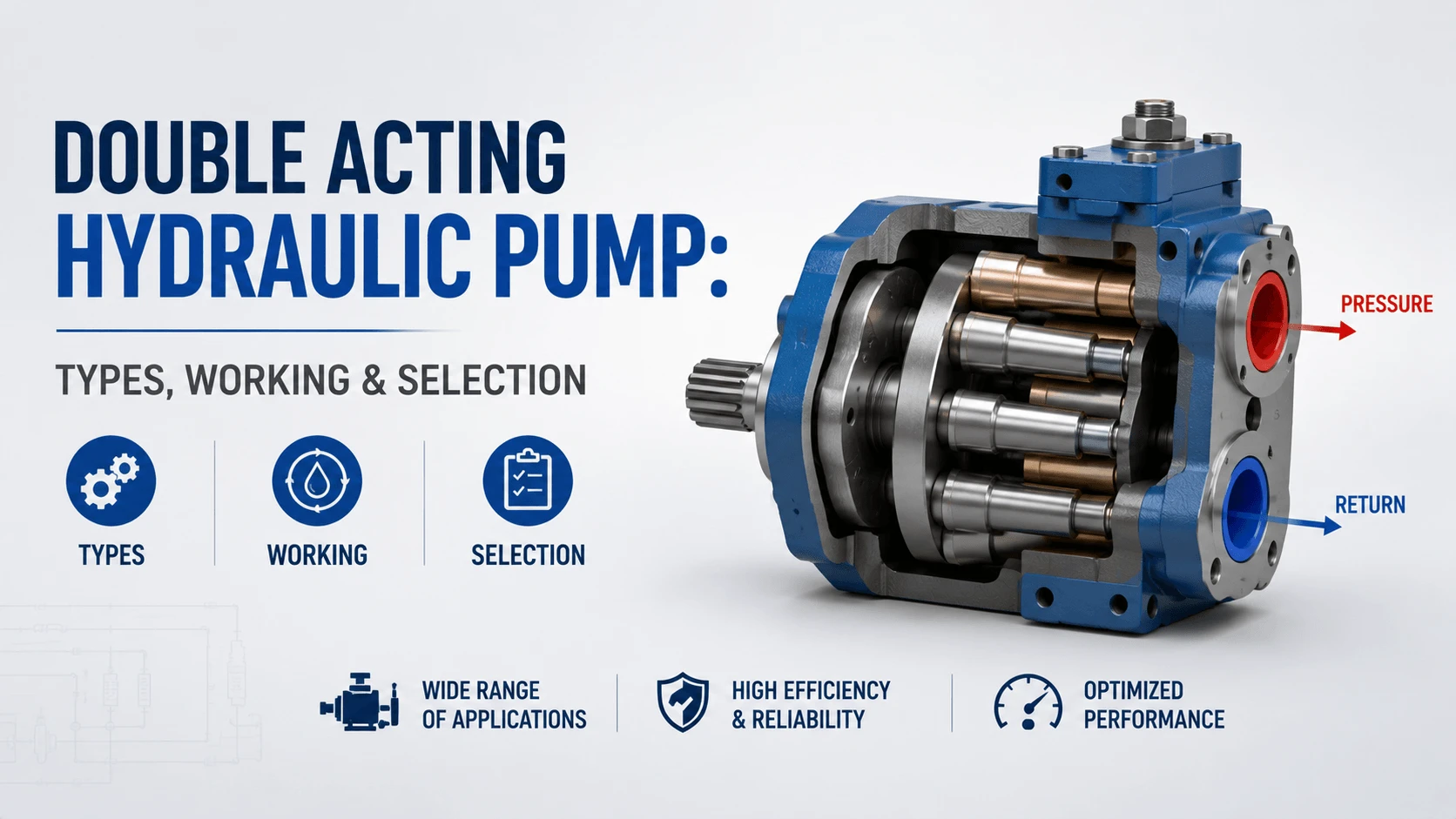
A double acting hydraulic pump moves fluid on both strokes of the piston. The forward stroke discharges fluid from one chamber. The return stroke discharges from the other. That gives you flow in both directions of travel, not just one.
Engineers pick this design when they need more output per cycle than a single-acting pump can deliver. Manual hand pumps for bolt tensioning and power-driven industrial pumps both use the principle. This guide covers the working mechanism, types, specs, and selection rules. Real pressure and flow numbers follow.
What is a Double Acting Hydraulic Pump
A double acting hydraulic pump is a reciprocating positive-displacement pump. A piston slides back and forth inside a cylinder. Suction and discharge check valves sit on both sides of the piston. Each chamber fills and empties twice per cycle.
The key trait sets it apart from a single-acting pump. A single-acting unit delivers fluid on one stroke and idles on the return. The double-acting version has no idle stroke. You get roughly twice the flow from the same bore and stroke length.
Do not confuse this with a double-acting vane pump. That term describes a rotary vane pump with two opposed pressure chambers per revolution. We cover that design separately in our hydraulic vane pump guide.
How a Double Acting Hydraulic Pump Works
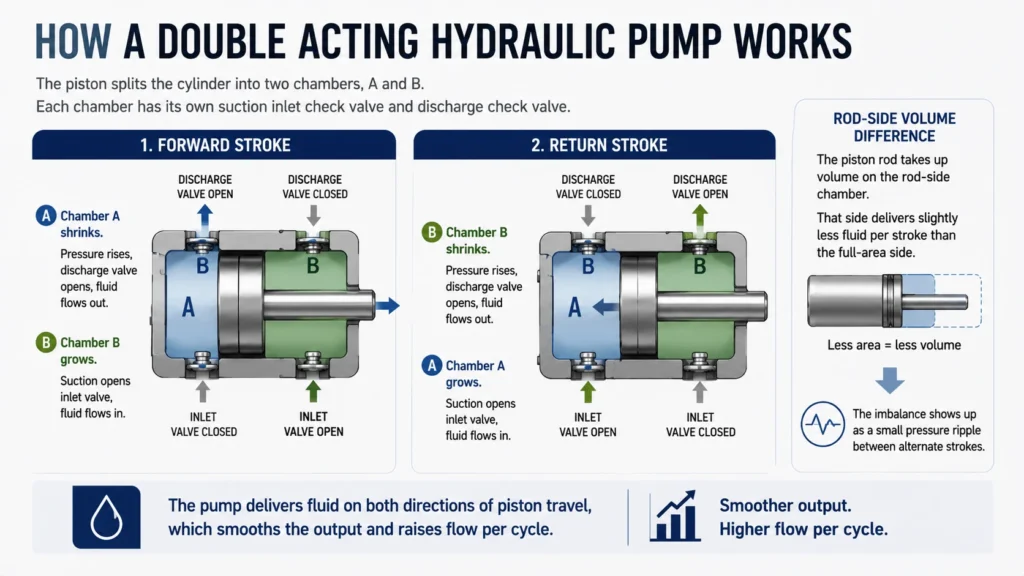
The piston splits the cylinder into two chambers, call them A and B. Each chamber has its own suction inlet check valve and discharge check valve. The valves open and close from pressure differences, with no timing mechanism required.
On the forward stroke, chamber A shrinks. Pressure rises in A, forces the discharge valve open, and pushes fluid out. At the same time chamber B grows. Suction opens the inlet valve, and fluid flows in.
The return stroke reverses the roles. Chamber B now shrinks and discharges. Chamber A grows and refills. The pump delivers fluid on both directions of piston travel, which smooths the output and raises flow per cycle.
One detail matters in practice. The piston rod takes up volume on the rod-side chamber. That side delivers slightly less fluid per stroke than the full-area side. The imbalance shows up as a small pressure ripple between alternate strokes.
Single Acting vs Double Acting Pump
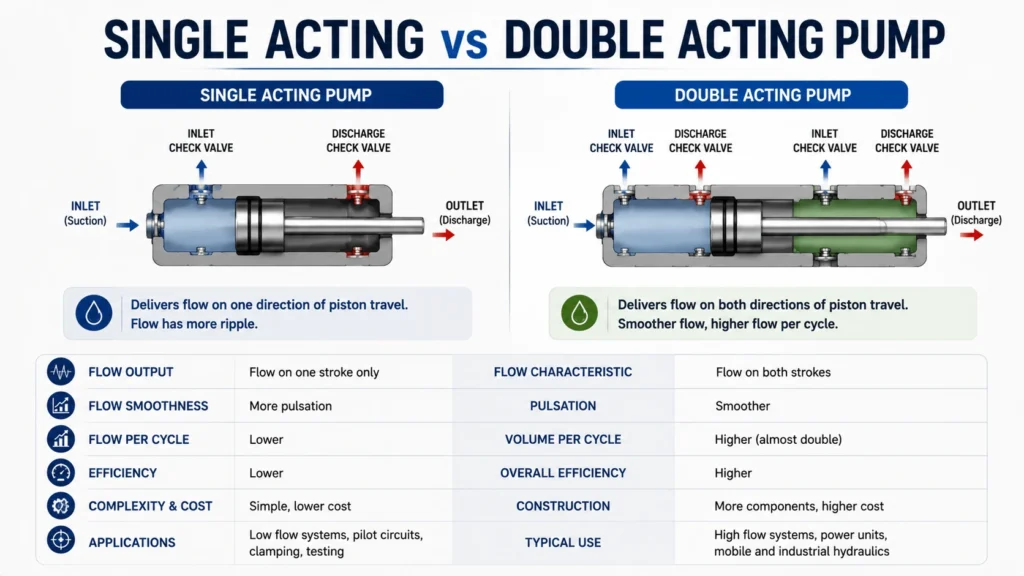
| Feature | Single acting | Double acting |
|---|---|---|
Delivery strokes |
One per cycle |
Two per cycle |
Check valves |
Two |
Four |
Flow per cycle |
Lower |
Roughly double |
Pulsation |
Higher |
Lower |
Complexity |
Simpler |
More complex |
Cost |
Lower |
Higher |
Best fit |
Intermittent, simple jobs |
Continuous duty, smooth flow |
Pick single-acting for simple manual jobs where cost matters most. Pick double-acting when you need smoother flow, higher output, or continuous duty.
Types of Double Acting Hydraulic Pumps
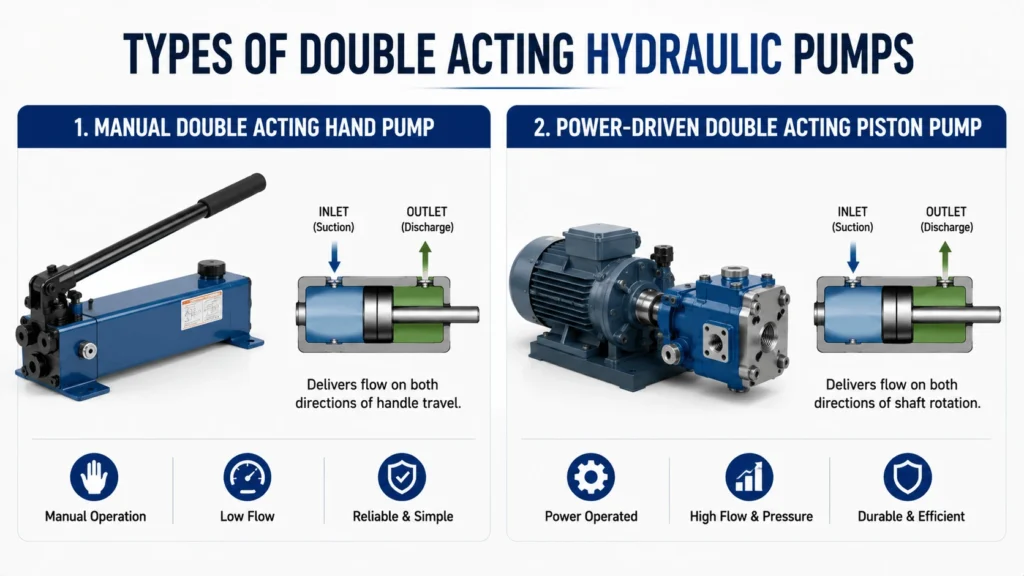
Manual Double Acting Hand Pump
A lever drives the piston by hand. These pumps serve field work where no power source exists. Bolt tensioning, flange spreading, and rescue tools run on them. Pressure ratings reach 350 to 700 bar at very low flow, often under 1 L/min.
Many hand pumps use a two-stage design. A high-volume low-pressure stage moves fluid fast until the load resists. A low-volume high-pressure stage then takes over to build force. This saves pumping effort at the cost of more internal valves.
Power-Driven Double Acting Piston Pump
An electric motor or engine turns a crank or cam that drives the piston. These pumps handle continuous duty at higher flow. You find them in hydrostatic testing, water jetting, chemical dosing, and oilfield service.
Pressure spans a wide band. Light service pumps run 70 to 210 bar. Heavy units reach 500 to 700 bar for high-pressure testing and injection. Flow ranges from 10 to 200 L/min depending on bore and speed.
Key Specifications
Match the pump to your pressure, flow, and duty first. Then check the speed range against your drive. Volumetric efficiency above 90 percent signals a healthy unit.
| Specification | Hand pump | Power-driven |
|---|---|---|
Pressure, continuous |
350 to 700 bar |
70 to 700 bar |
Flow |
under 1 L/min |
10 to 200 L/min |
Drive |
Manual lever |
Electric motor or engine |
Speed |
30 to 60 strokes/min |
300 to 1,800 rpm |
Volumetric efficiency |
90 to 95 percent |
92 to 96 percent |
Duty cycle |
Intermittent |
Continuous |
Advantages and Disadvantages
Advantages
- Flow on both strokes gives roughly double the output per cycle
- Smoother delivery with lower pulsation than single-acting
- No wasted return stroke, which suits continuous duty
- High pressure from a compact bore, especially in hand pumps
- Two-stage hand pumps cut operator effort at low pressure
Disadvantages
- Four check valves mean more leak paths and wear points
- Higher cost than a single-acting pump of the same bore
- Piston rod volume causes a slight flow imbalance between strokes
- More seal surfaces are leaking at the gland and chamber seats
- Sensitive to contamination that scores valve seats
Industrial Applications
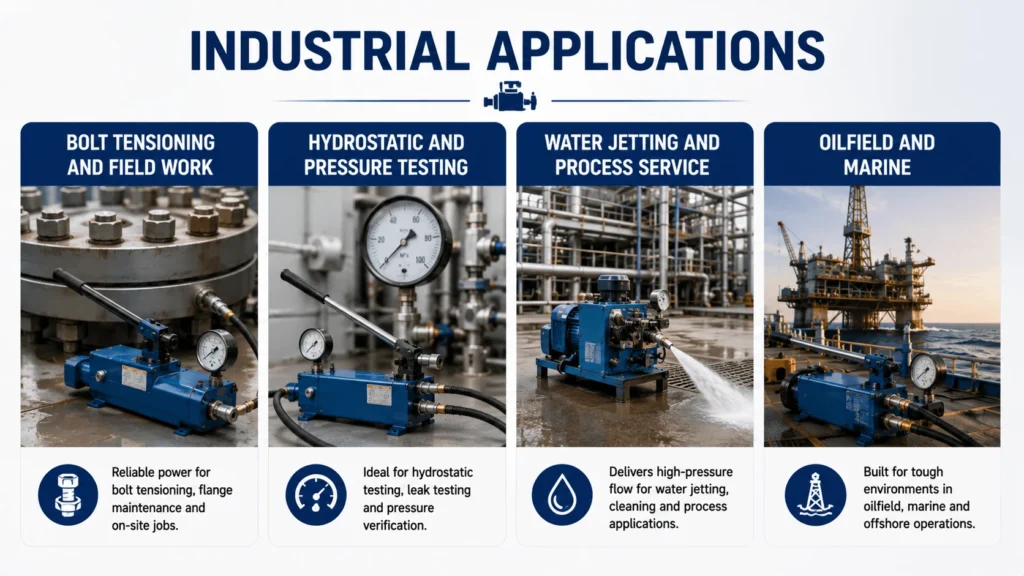
Bolt Tensioning and Field Work
Portable bolt tensioners run on double-acting hand pumps. The operator pumps to stretch a bolt, tightens the nut, then releases pressure. Double-acting delivery speeds the stretch cycle on large flanges. Pressures of 700 bar are common.
Hydrostatic and Pressure Testing
Power-driven double-acting piston pumps fill and pressurize pipes, vessels, and valves for proof testing. The smooth, high-pressure output suits long test holds. Many test rigs use water or glycol at 200 to 700 bar.
Water Jetting and Process Service
High-pressure water jetting pumps use multi-cylinder double-acting piston designs. Crankshafts drive several pistons in phase to smooth the flow. Cutting and cleaning jobs run at 700 to 2,000 bar in specialized builds.
Oilfield and Marine
Cementing, acidizing, and accumulator charging all use double-acting piston or plunger pumps. Marine steering and deck machinery use them for reliable high-pressure service. Durability matters more than peak efficiency in these roles.
Common Problems and Troubleshooting
| Symptom | Likely cause | Action |
|---|---|---|
Low or no flow |
Valve seat wear or debris |
Inspect and lap seats, clean oil |
Pressure drop under load |
Internal valve leakage |
Replace check valves, check seats |
Spongy or jerky output |
Air trapped in chambers |
Bleed air from both chambers |
Pulsation between strokes |
Rod-side volume imbalance |
Add a pulsation damper |
External leak at gland |
Packing wear |
Adjust or replace gland packing |
Overheating on fast stroking |
Cavitation or low inlet |
Slow stroke rate, enlarge suction line |
Selection Guide
Start with your required pressure and flow. Hand pumps fit pressures of 350 to 700 bar at low flow. Power-driven units cover the rest.
Choose manual when you work in the field without power, need portability, or run short intermittent cycles. Choose power-driven for continuous duty, high flow, or remote operation.
Check the fluid against the seals and valve materials. Water, oil, and glycol each need different elastomers. Add a pulsation damper if your downstream equipment cannot tolerate the rod-side ripple. Match the ports to your hoses, common options include NPT, BSPP, and ISO 16028 flat-face.
Installation and Maintenance Tips
Mount the pump close to the reservoir on powered units. Keep the suction line short and large to prevent cavitation. A flooded inlet helps cold starts and fast stroking.
Bleed air from both chambers before full-pressure work. Trapped air makes the output spongy and slows the build of pressure. Run the pump unloaded for the first few cycles.
Hold oil cleanliness to ISO 4406 19/17/14 for industrial service, tighter for high-pressure test pumps. Contaminant scores valve seats and causes internal leakage. Inspect check valves and lap the seats on a scheduled interval. Trend the flow and pressure ripple to catch wear early.
FAQ
What is a double acting hydraulic pump?
It is a reciprocating pump that delivers fluid on both the forward and return strokes of the piston. Four check valves, two suction and two discharge, control flow in and out of the two chambers. The result is roughly double the flow of a single-acting pump per cycle.
How does a double acting pump differ from a single acting pump?
A single-acting pump delivers on one stroke and idles on the return. A double-acting pump delivers on both. Double-acting units need four check valves instead of two and give smoother, higher flow at a higher cost and complexity.
Is a double acting vane pump the same thing?
No. A double-acting vane pump is a rotary pump with two opposed pressure chambers per revolution. These balance the radial load on the shaft. The double-acting piston pump in this guide is a reciprocating unit. See our hydraulic vane pump guide for the vane version.
What pressure can a double acting hand pump reach?
Most double-acting hand pumps run 350 to 700 bar. Two-stage designs switch from high flow to high pressure as the load builds. Flow stays low, often under 1 L/min, because the operator supplies the power.
Why does my double acting pump pulse between strokes?
The piston rod takes up volume on one side, so that chamber delivers slightly less fluid per stroke. The difference shows up as a pressure ripple between alternate strokes. A pulsation damper smooths the output if your process needs a steady flow.
Conclusion
A double acting hydraulic pump earns its place when you need flow on every stroke. Manual hand pumps give you 700 bar in the field without a power source. Power-driven units deliver smooth, high-pressure output for testing, jetting, and process duty.
Match the type to the job. Hand pumps fit portable, intermittent, high-pressure work. Power-driven pumps fit continuous flow and remote operation. Keep the oil clean, the valve seats lapped, and the inlet flooded. Done right, a double-acting pump runs hard and stays reliable for years.