
.webp)
What Is a Hydraulic Pump?
How Does a Hydraulic Pump Work?
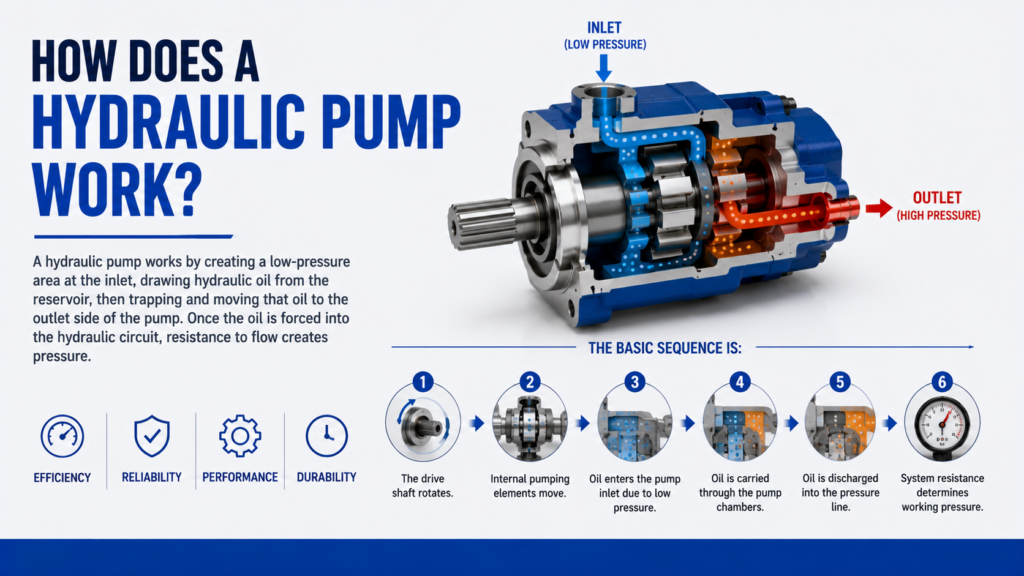
A hydraulic pump works by creating a low-pressure area at the inlet, drawing hydraulic oil from the reservoir, then trapping and moving that oil to the outlet side of the pump. Once the oil is forced into the hydraulic circuit, resistance to flow creates pressure.
The basic sequence is:
- The drive shaft rotates.
- Internal pumping elements move.
- Oil enters the pump inlet due to low pressure.
- Oil is carried through the pump chambers.
- Oil is discharged into the pressure line.
- System resistance determines working pressure.
For example, if a hydraulic cylinder is lifting a heavy load, the pump supplies flow to move the cylinder. The load resisting that movement causes system pressure to rise.
Main Components of a Hydraulic Pump
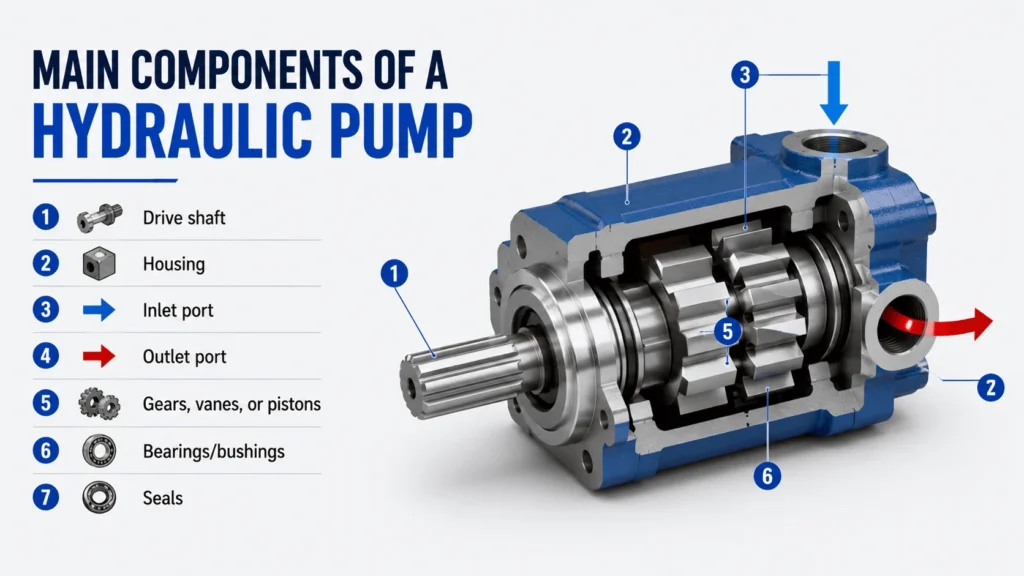
| Component | Function |
|---|---|
Drive shaft |
Transfers mechanical input power into the pump |
Housing |
Contains internal pressure and supports components |
Inlet port |
Allows oil to enter the pump |
Outlet port |
Sends pressurized flow into the system |
Gears, vanes, or pistons |
Move oil through the pump |
Bearings/bushings |
Support rotating components |
Seals |
Prevent internal and external leakage |
Common Types of Hydraulic Pumps
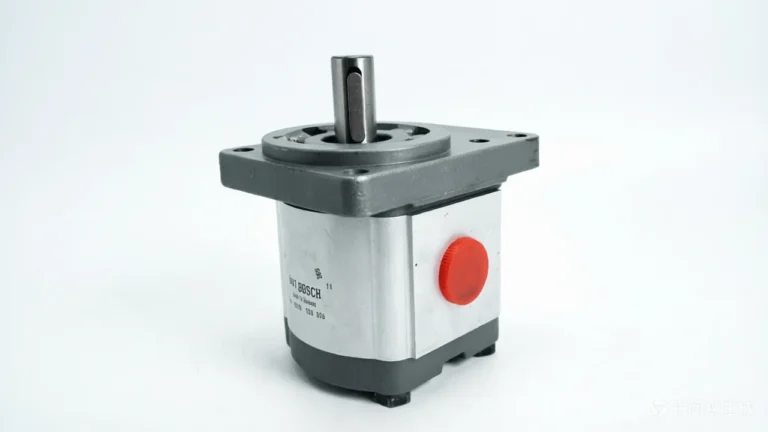
A gear pump uses meshing gears to carry oil from the inlet to the outlet. Gear pumps are simple, compact, and cost-effective.
Typical use: forklifts, tractors, dump trailers, lubrication systems, mobile equipment.
Advantages:
- Simple structure
- Lower cost
- Good contamination tolerance
- Easy maintenance
Limitations:
- Usually less efficient than piston pumps
- Fixed displacement in most designs
- Higher noise level at high pressure
A vane pump uses sliding vanes inside a rotor to move oil. It usually runs quieter than a gear pump and provides smoother flow.
Typical use: machine tools, injection molding machines, industrial power units.
Advantages:
- Quiet operation
- Smooth flow
- Good for medium-pressure systems
Limitations:
- More sensitive to contamination
- Not ideal for very high-pressure applications
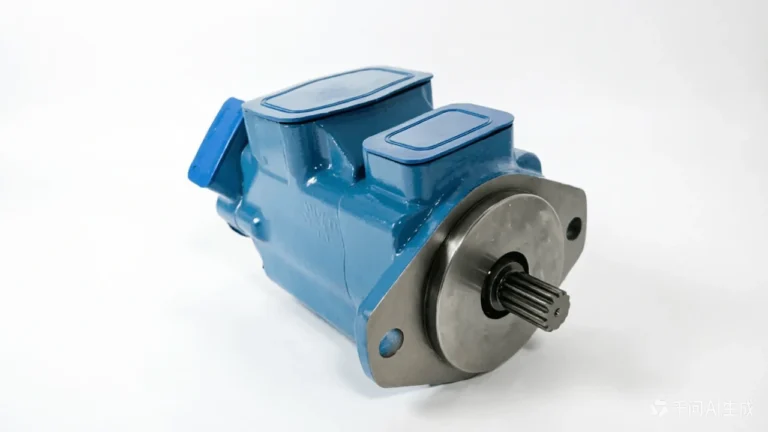
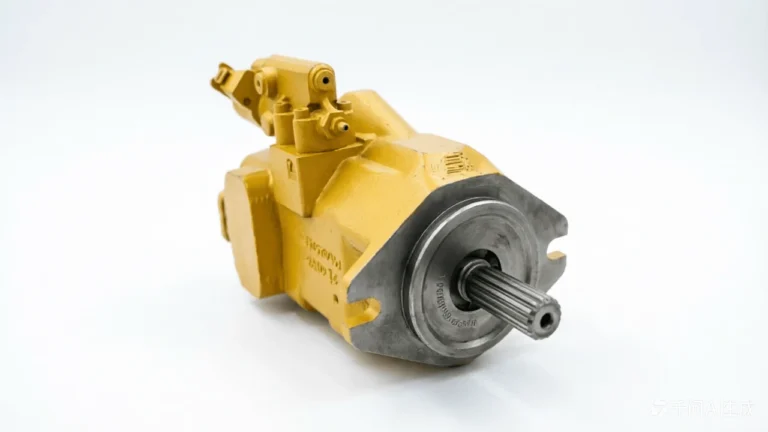
A piston pump uses reciprocating pistons to move oil. It is commonly used when high pressure, high efficiency, or variable displacement is required.
Typical use: excavators, presses, marine hydraulics, mining equipment, closed-loop hydrostatic drives.
Advantages:
- High-pressure capability
- High efficiency
- Variable displacement options
- Good for demanding duty cycles
Limitations:
- Higher cost
- More complex
- Requires cleaner oil and better maintenance
Pressure, Flow, and Efficiency
Common Hydraulic Pump Problems
| Problem | Likely Cause | Practical Check |
|---|---|---|
No flow |
Wrong rotation, empty reservoir, blocked inlet |
Check motor direction and oil level |
Low pressure |
Internal wear, relief valve stuck open, excessive leakage |
Test pressure and isolate relief valve |
Noise |
Cavitation, air ingress, misalignment |
Check suction line, oil level, inlet filter |
Overheating |
Excessive bypassing, wrong oil viscosity, high leakage |
Check oil temperature and system pressure |
Foamy oil |
Air entering suction side |
Inspect suction hose, clamps, shaft seal |
Slow actuator movement |
Low pump flow, worn pump, clogged filter |
Measure flow under load |
Selection Guide
When selecting a hydraulic pump, consider:
- Required flow rate
- Maximum operating pressure
- Duty cycle
- Fixed or variable displacement
- Open-loop or closed-loop circuit
- Oil viscosity and temperature range
- Contamination control
- Noise limits
- Mounting size and shaft type
- Replacement availability and lead time
For low-cost auxiliary functions, a gear pump may be enough. For high-pressure, high-efficiency, load-sensing, or variable-flow systems, a piston pump is usually the better choice.
Maintenance Tips
Good pump life depends heavily on oil condition and inlet conditions.
Key maintenance practices:
- Keep hydraulic oil clean and dry.
- Replace filters on schedule.
- Avoid suction restrictions.
- Use the correct oil viscosity.
- Prevent cavitation.
- Check pump noise changes early.
- Monitor case drain flow on piston pumps.
- Do not run the pump dry.
- Verify alignment between motor and pump.
Most pump failures are not random. They usually come from contamination, cavitation, overheating, incorrect oil, or long operation beyond wear limits.
FAQs
Does a hydraulic pump create pressure?
A hydraulic pump creates flow. Pressure is created when the flow meets resistance in the hydraulic system, such as a loaded cylinder, motor, valve, or restriction.
What is the difference between hydraulic flow and pressure?
Flow controls actuator speed. Pressure controls force or torque. A system can have high flow with low pressure, or low flow with high pressure, depending on the load.
Why is my hydraulic pump noisy?
Common causes include cavitation, air entering the suction line, low oil level, clogged inlet filtration, wrong oil viscosity, or shaft misalignment.
Which hydraulic pump is best?
It depends on the application. Gear pumps are economical and rugged. Vane pumps are quieter for medium-pressure systems. Piston pumps are best for high-pressure, high-efficiency, or variable-flow applications.
Authority Sources
Need help selecting or replacing a hydraulic pump? Contact your hydraulic engineering team with the required pressure, flow rate, oil type, duty cycle, and equipment model so they can recommend the correct pump type and specification.