

What is a Hydraulic Elevator?
How Does a Hydraulic Elevator Work?
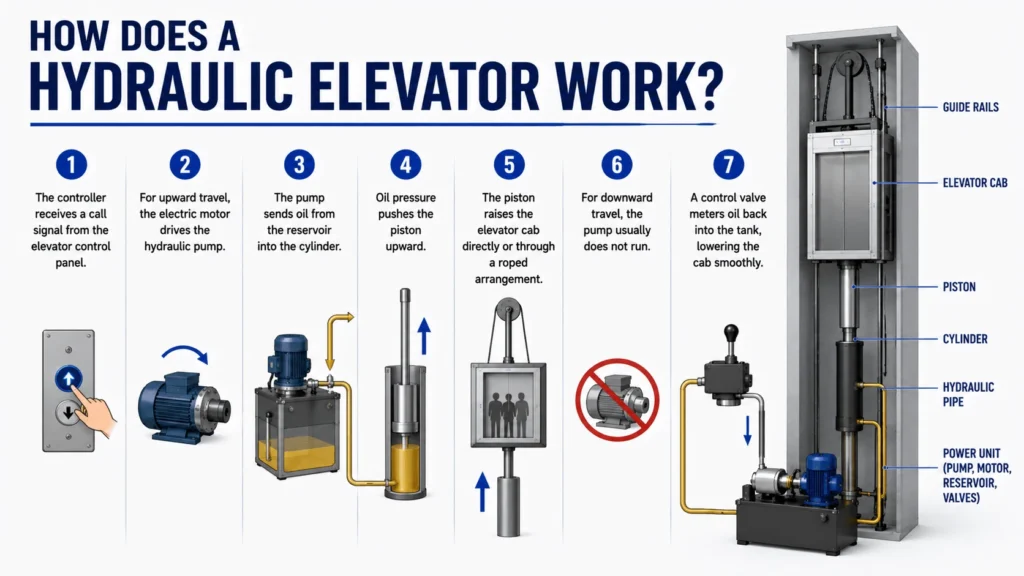
The basic operation is straightforward:
- The controller receives a call signal from the elevator control panel.
- For upward travel, the electric motor drives the hydraulic pump.
- The pump sends oil from the reservoir into the cylinder.
- Oil pressure pushes the piston upward.
- The piston raises the elevator cab directly or through a roped arrangement.
- For downward travel, the pump usually does not run.
- A control valve meters oil back into the tank, lowering the cab smoothly.
Typical hydraulic elevator systems may operate in pressure ranges of several hundred PSI, but exact pressure depends on cab weight, rated load, piston diameter, travel height, and safety factor. Freight elevators and heavy-duty industrial lifts may require higher system pressures and larger cylinders.
Main Components of a Hydraulic Elevator
| Component | Function |
|---|---|
Hydraulic pump |
Moves oil from the tank into the cylinder |
Electric motor |
Drives the pump |
Oil reservoir |
Stores hydraulic fluid |
Control valve |
Regulates flow direction, speed, and leveling |
Hydraulic cylinder |
Converts fluid pressure into lifting force |
Piston / plunger |
Moves vertically to raise the cab |
Controller |
Manages calls, doors, leveling, and safety logic |
Guide rails |
Keep the cab aligned during travel |
Safety devices |
Include rupture valves, buffers, door interlocks, and overspeed protection where required |
Types of Hydraulic Elevators
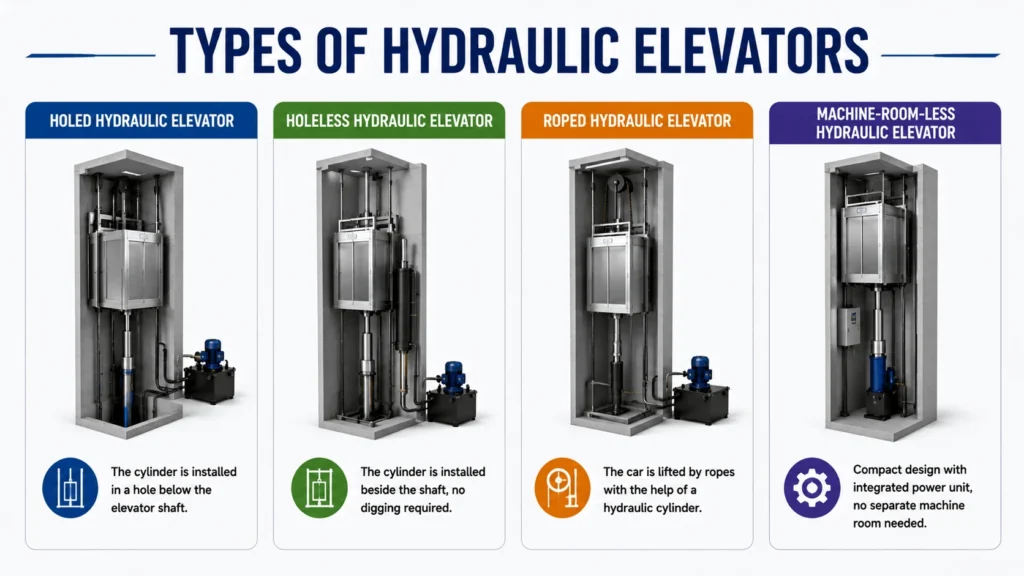
Holed Hydraulic Elevator
A holed hydraulic elevator uses a cylinder placed below the elevator cab, extending into a drilled hole beneath the shaft. It is mechanically simple and efficient for direct lifting, but site conditions, groundwater, and environmental regulations can make installation more complex.
Holeless Hydraulic Elevator
A holeless hydraulic elevator places cylinders beside the cab instead of below it. This avoids deep drilling and is common in low-rise buildings, but travel height may be more limited.
Roped Hydraulic Elevator
A roped hydraulic elevator combines hydraulic power with ropes and sheaves. This arrangement can provide greater travel than some holeless designs while still using a hydraulic power unit.
Machine-Room-Less Hydraulic Elevator
Some modern hydraulic elevators reduce or eliminate the traditional machine room by integrating equipment more compactly. Code acceptance varies by jurisdiction, so local elevator code review is essential before selection.
Advantages of Hydraulic Elevators
Hydraulic elevators remain popular because they offer practical benefits in the right application.
- Strong lifting capacity for passenger and freight use
- Lower initial cost than many traction systems in low-rise buildings
- Simpler mechanical arrangement
- Smooth lifting performance when properly maintained
- Good fit for heavy loads and short travel distances
- Less overhead space is required than some traction systems
For warehouses, workshops, service buildings, and low-rise commercial properties, hydraulic elevators can be a cost-effective solution when speed and travel height requirements are moderate.
Disadvantages of Hydraulic Elevators
Hydraulic elevators are not ideal for every building.
- Lower energy efficiency during upward travel compared with counterweighted traction systems
- Heat generation in high-cycle applications
- Hydraulic oil requires monitoring and maintenance
- Potential risk of oil leakage if seals, pipes, or cylinders fail
- Slower travel speeds than many traction elevators
- Usually less suitable for high-rise buildings
A common mistake is selecting a hydraulic elevator for a building with frequent traffic and long daily operating hours. In that case, energy consumption, oil temperature, and duty cycle should be reviewed carefully.
Hydraulic Elevator vs Traction Elevator
| Factor | Hydraulic Elevator | Traction Elevator |
|---|---|---|
Best use |
Low-rise buildings |
Mid-rise and high-rise buildings |
Lifting method |
Oil pressure and piston |
Ropes/belts and counterweight |
Machine room |
Often required, though compact options exist |
MRL options common |
Energy use |
Higher during upward travel |
Usually more efficient |
Load capacity |
Strong for heavy loads |
Good, depending on design |
Speed |
Generally slower |
Faster options available |
Maintenance focus |
Oil, seals, valves, pump unit |
Ropes/belts, sheaves, brake, machine |
For a 2- to 4-story freight application, hydraulic may be the better choice. For a busy office building with higher travel and frequent use, traction or MRL traction may be more suitable.
Industrial Applications
Hydraulic elevators are commonly used in:
- Low-rise commercial buildings
- Residential apartment buildings
- Schools and public buildings
- Hospitals and clinics
- Warehouses and logistics facilities
- Parking garages
- Freight and material handling elevators
- Industrial maintenance platforms
- Retail stores and service areas
In industrial environments, selection should consider rated load, platform size, duty cycle, oil temperature, landing accuracy, door type, and whether the elevator will handle pallet trucks, carts, or forklifts nearby.
Common Hydraulic Elevator Problems
| Problem | Possible Cause |
|---|---|
Elevator levels incorrectly |
Valve issue, oil temperature change, worn seals |
Slow upward travel |
Pump wear, low oil level, clogged strainer, motor issue |
Jerky movement |
Air in oil, valve contamination, guide rail friction |
Oil overheating |
High duty cycle, undersized reservoir, poor ventilation |
Cab drifts downward |
Internal leakage, valve leakage, cylinder seal wear |
Unusual noise |
Pump cavitation, motor bearing wear, loose mounting |
Oil leakage |
Damaged hose, worn seal, cylinder corrosion |
Hydraulic elevator problems should be handled by qualified elevator technicians. Elevator systems are regulated equipment, and unsafe adjustment can create serious risk.
Troubleshooting Guide
- Check operating symptoms. Note whether the issue happens during upward travel, downward travel, leveling, door operation, or after idle periods.
- Inspect oil condition. Dark, milky, contaminated, or overheated oil can point to maintenance issues.
- Verify oil level. Low oil can cause cavitation, noise, slow lifting, and inconsistent performance.
- Review valve performance. Many ride quality and leveling problems originate from valve contamination, wear, or incorrect adjustment.
- Check for leaks. Inspect visible hoses, fittings, tank area, and cylinder-related components.
- Monitor temperature. High oil temperature can reduce viscosity and cause leveling or performance changes.
- Call a licensed elevator contractor. Any safety-related fault, uncontrolled movement, door issue, or hydraulic pressure problem requires professional service.
Selection Guide: How to Choose a Hydraulic Elevator
Before specifying a hydraulic elevator, define these requirements:
| Selection Factor | Engineering Consideration |
|---|---|
Travel height |
Hydraulic is generally best for low-rise buildings |
Rated load |
Passenger, service, freight, or heavy-duty industrial use |
Speed |
Hydraulic systems are usually moderate-speed |
Duty cycle |
Frequent use may require thermal analysis |
Machine room space |
Confirm available layout and code requirements |
Pit and overhead |
Review shaft dimensions early |
Environmental risk |
Consider oil containment and cylinder protection |
Code compliance |
Follow local elevator code and inspection rules |
Maintenance access |
Ensure technicians can access power unit and valves safely |
The best specification usually starts with load, travel, speed, number of stops, operating frequency, available shaft dimensions, and local code requirements.
Maintenance Tips
Hydraulic elevator maintenance should include:
- Checking hydraulic oil level and condition
- Inspecting hoses, fittings, seals, and visible piping
- Monitoring pump and motor noise
- Testing leveling accuracy
- Checking valve operation
- Inspecting the cylinder and piston where accessible
- Monitoring oil temperature
- Keeping the machine room clean and ventilated
- Confirming door interlocks and safety devices function correctly
- Following required inspection intervals
Preventive maintenance is especially important because small hydraulic issues often become ride quality problems before they become complete failures.
FAQ
What is a hydraulic elevator?
A hydraulic elevator is an elevator that uses hydraulic oil pressure to move a piston, which raises and lowers the elevator cab. It is commonly used in low-rise buildings and heavy-load applications.
How does a hydraulic elevator go down?
Most hydraulic elevators descend by opening a control valve that allows oil to flow from the cylinder back into the reservoir. Gravity lowers the cab while the valve controls speed and smoothness.
Where are hydraulic elevators used?
They are commonly used in low-rise commercial buildings, apartments, schools, hospitals, warehouses, parking garages, and freight elevator applications.
Are hydraulic elevators energy efficient?
Hydraulic elevators are usually less energy efficient than traction elevators during upward travel because they lift the full cab load without a counterweight. However, they can still be cost-effective in low-rise, moderate-use buildings.
What is the main disadvantage of a hydraulic elevator?
The main disadvantages are limited travel height, lower energy efficiency for frequent use, heat generation, and the need to maintain hydraulic oil, seals, valves, and cylinders.
How long does a hydraulic elevator last?
Service life depends on usage, maintenance quality, environment, and modernization history. With proper maintenance, major components can operate for many years, but pumps, valves, seals, controls, and door equipment may require repair or replacement over time.
Authority Sources
- ASME A17 Elevators and Escalators Standards
- OSHA 1926.552: Material Hoists, Personnel Hoists, and Elevators
- National Elevator Industry, Inc.
- TK Elevator Hydraulic Elevators
Need help selecting a hydraulic elevator system or hydraulic components for a lift application? Contact our engineering team with your required load, travel height, speed, number of stops, and installation environment. We can help review the hydraulic power unit, cylinder sizing, valve configuration, and maintenance requirements for your project.