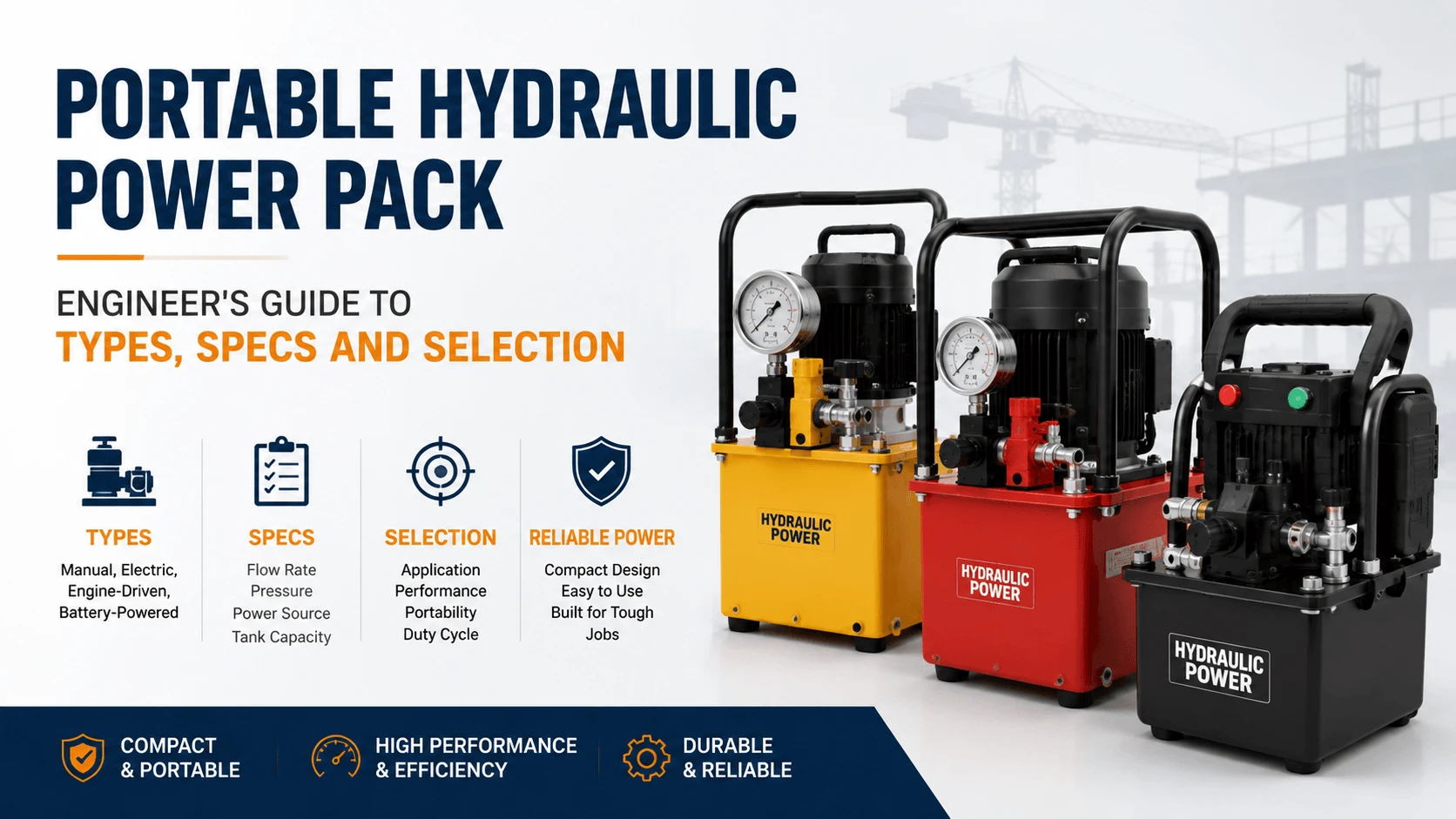
Portable Hydraulic Power Pack: Engineer’s Guide to Types, Specs and Selection

Portable Hydraulic Power Pack- Engineer's Guide to Types, Specs and Selection

Table of Contents

Introduction

A portable hydraulic power pack brings hydraulic force to locations with no installed power. You carry it to work. Field service crews use these units for bolt tensioning, flange spreading, cable jacking, and rescue extrication wherever wall power or vehicle mounts are absent.
 
Most buyers pick a unit by maximum pressure and call it done. That shortcut hides the spec that decides field success: power source fit. A 700-bar hand pump that takes 200 strokes to fill a tensioner is useless on a 40-bolt flange job. A petrol unit that weighs 25 kg is wrong for a roof-mounted repair. This guide walks through every component, rating, and trade-off you need to specify a portable power pack that works on the jobsite.

What is a Portable Hydraulic Power Pack?

A portable hydraulic power pack is a self-contained hydraulic package light enough for one person to carry. It combines a pump, reservoir, directional valve, and relief valve in one housing. The power source drives the pump, which pressurizes oil and feeds it to a hydraulic tool through a hose and coupler.
 
The key difference from a stationary or vehicle-mounted power unit is portability. Portable units trade flow and reservoir volume for weight and compact size. They run at high pressure and low flow, because most field tools need more force than speed.
 
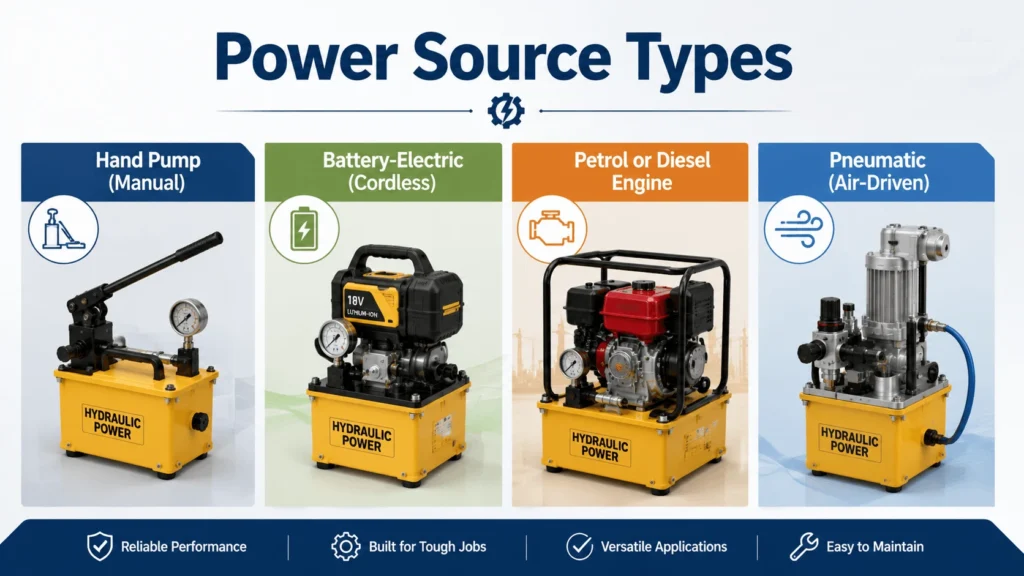
You will find three main power source families: manual hand pumps, battery-electric units, and small petrol or diesel engines. Each fits a different job profile based on runtime, weight, and available energy.

How a Portable Hydraulic Power Pack Works

The cycle starts when you activate the power source. On a hand pump, you work the lever. On a battery unit, you press a button. On a petrol unit, you pull the recoil cord and open the throttle.
 
The pump draws oil from a small reservoir through a suction strainer. Oil flows to the directional valve, which routes it to the tool’s pressure port. Return oil vents back to the reservoir. A relief valve caps maximum pressure to protect the pump, hose, and tool.
 
When you release the lever or button, a check valve holds the load. To retract, you shift the directional valve or open a manual release. Oil vents from the tool back to tank. The cycle repeats.
Most portable units run single-acting circuits because field tools like cylinders and tensioners often extend under pressure and retract by gravity or spring. Double-acting units add a retract port for tools that need powered return.

Power Source Types

 
Portable Hydraulic Power Pack Source Types

Hand Pump (Manual)

A hand pump uses your arm as the power source. You pull a lever that drives a small piston pump. Each stroke moves a fixed volume of oil, typically 2 to 12 cc per stroke. Pressure builds with each stroke until the tool reaches its working load or the relief valve opens.
 
Hand pumps suit low-frequency, high-pressure work. A typical unit produces 350 to 700 bar at full stroke. The trade-off is speed. Filling a 1 L tensioner at 8 cc per stroke takes 125 strokes. On a multi-bolt job, that adds up fast.
 
Weight runs 3 to 10 kg. Hand pumps need no fuel, no battery, and no maintenance beyond oil changes. They work in explosive atmospheres where electric sparks are unsafe. The limit is human endurance and cycle count.

Battery-Electric (Cordless)

Battery-electric units use a brushless DC motor driven by a lithium-ion battery pack. Common battery voltages run 18V, 36V, 48V, and 58V. The motor turns a small gear or piston pump at 0.5 to 4 L/min.
 
These units fill the gap between hand pumps and petrol units. They produce 350 to 700 bar at useful flow rates, so a bolt tensioner reaches pressure in 5 to 15 seconds instead of 125 strokes. A typical 4 Ah or 5 Ah battery delivers 50 to 150 full cycles per charge, depending on pressure and tool volume.
 
Weight runs 5 to 12 kg without the hose and tool. The battery adds 0.5 to 1.5 kg per pack. Brushless motors need no brush replacement, and lithium packs survive 500 to 1000 charge cycles before capacity drops below 80 percent.

Petrol or Diesel Engine

Petrol and diesel units use a small single-cylinder engine, typically 1.5 to 6 kW (2 to 8 HP). The engine drives a gear or piston pump through a direct coupling. Flow runs 2 to 12 L/min at pressures up to 350 or 700 bar, depending on pump type.
 
Engine-driven units deliver the highest flow and longest runtime of the portable families. They suit continuous-duty field work like cable tensioning, pipe bending, or running multiple cylinders. A 4-stroke petrol engine runs 1 to 2 hours on a liter of fuel.
 
Weight runs 15 to 35 kg. That limits single-person carry on some models. Noise and exhaust make petrol units unsuitable for indoor or confined-space work. Diesel versions suit mining and offshore sites, where regulations require diesel fuel.

Pneumatic (Air-Driven)

Pneumatic units use compressed air to drive an air motor, which turns the hydraulic pump. Plant air at 6 bar drives the motor, and the pump produces hydraulic pressure up to 700 bar. These units suit environments with an air supply but no electrical power.
 
Weight runs 8 to 18 kg. Pneumatic units are spark-free, so they work in explosive atmospheres. The limit is the air supply. You need a compressor or plant air line delivering 300 to 1000 L/min of free air. Without it, the unit stalls.

Main Components of Portable Hydraulic Power Pack
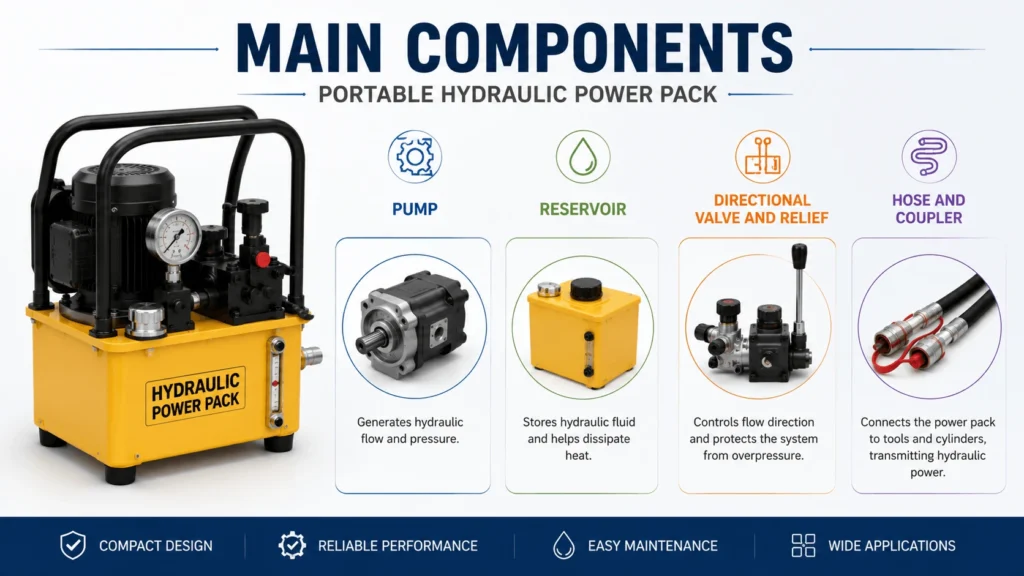
Main Components Portable Hydraulic Power Pack

Pump

Portable units use external gear pumps, radial piston pumps, or axial piston pumps. Gear pumps suit pressures up to 250 bar and offer low cost and contamination tolerance. Piston pumps reach 700 bar and suit bolt tensioning and high-force cylinder work.
 
Displacement runs 0.2 to 3 cc per rev on battery units, and 2 to 12 cc per stroke on hand pumps. The pump sets the flow rate at a given input speed, and the flow sets how fast your tool moves.

Reservoir

The reservoir holds 0.1 to 3 L of oil. It must fill the tool’s pressure volume plus room for thermal expansion. A reservoir too small for the tool causes cavitation, foaming, and slow operation.
Aluminum tanks cut weight. Steel tanks take threaded ports and resist damage. Both need a vented cap and a suction strainer at the pump inlet.

Directional Valve and Relief

The directional valve routes pump flow to extend, retract, or neutralize. Most portable units use a 4/3 manual valve or a solenoid valve on battery models. An integral relief valve sets maximum system pressure.
 
Common relief settings land at 350, 500, or 700 bar. The relief protects the pump, hose, and tool if the cylinder stalls. Some units add a pressure gauge so you can read actual working pressure.

Hose and Coupler

The hose connects the power pack to the tool. Portable units use 1/4 inch or 3/8 inch bore hose rated for 700 bar working pressure. Hose length runs 1 to 3 meters on most kits.
The coupler at the hose end connects to the tool. Most portable units use ISO 16028 flat-face quick couplers because they connect under residual pressure and minimize oil loss. Threaded couplers (NPT, BSPP) appear on older or budget units but require tools to connect.

Key Specifications

Spec Hand pump Battery Petrol
Max pressure
350 to 700 bar
350 to 700 bar
350 to 700 bar
Flow at pressure
2 to 12 cc/stroke
0.5 to 4 L/min
2 to 12 L/min
Reservoir
0.1 to 1 L
0.5 to 2 L
1 to 3 L
Weight
3 to 10 kg
5 to 12 kg
15 to 35 kg
Runtime
human endurance
50 to 150 cycles per charge
1 to 2 hours per liter
Noise
none
low
high
Indoor use
yes
yes
no
Explosive atmosphere
yes (no spark)
no (unless rated)
no
Read flow at the pressure you actually need. Flow drops as pressure rises, because internal pump leakage grows with pressure. A unit rated 4 L/min at zero pressure may deliver 2 L/min at 700 bar.

Power Source Comparison

Choose hand pump for low cycle count and high portability. Choose battery for medium cycle count and fast operation. Choose petrol for high cycle count and continuous flow.
Job profile Best power source Why
5 bolts, single tensioner
hand pump
light, simple, no fuel
40 bolts, repeat tensioning
battery
fast, repeatable, indoor safe
Cable tensioning, 2 hours
petrol
continuous flow, long runtime
Rescue extrication
battery
quiet, fast, no exhaust
Offshore flange work
hand pump or pneumatic
spark-safe, no battery fire risk
Indoor plant maintenance
battery or hand pump
no exhaust fumes
Weight budget matters as much as pressure. If the job needs 30 seconds of work at 700 bar, a 10 kg battery unit beats a 25 kg petrol unit. If the job needs 2 hours of flow, a 25 kg petrol unit beats a battery unit that dies after 30 minutes.

Sizing a Portable Hydraulic Power Pack

Sizing a portable unit means matching four things. Pressure must match the tool force. Flow must match the tool speed. The reservoir must match the tool volume. Power source must match cycle count.
Pressure equals force divided by area. For a bolt tensioner that needs 200 kN of force on a 4 square centimeter piston, you need 500 bar. Round up to the next standard relief setting.
Flow sets speed. Speed equals flow divided by area. A tensioner with 0.1 L extended volume filled at 2 L/min takes 3 seconds to reach full stroke. At 0.5 L/min, it takes 12 seconds.
 
The reservoir must exceed the tool volume. If the tool holds 0.5 L of oil at full extension, the reservoir needs at least 0.7 L. That covers tool volume plus expansion. Too small, and the pump cavitates.
Power source sets the cycle count. Count your cycles per job, then check the unit’s rated cycles per charge or per tank. Add a 20 percent margin for cold oil and voltage sag.

Quick-Connect Couplers and Port Standards

The coupler decides whether your tool connects at all. Portable units use two main families: flat-face quick couplers and threaded couplers.

ISO 16028 Flat-Face

ISO 16028 flat-face couplers are the standard on modern portable hydraulic tools. They connect by pushing two flat faces together and snapping a sleeve. They connect under residual pressure, which prevents oil loss and air entry. Sizes run 1/4 and 3/8 inch bore.
 
Use ISO 16028 on any unit that drives bolt tensioners, flange spreaders, or rescue tools. The flat face wipes clean before connection, which keeps dirt out of the hydraulic circuit.

Threaded Couplers

Threaded couplers (NPT, BSPP, or metric) screw together with a wrench. They hold well at 700 bar and cost less than flat-face couplers. The trade-off is connection time. You need a wrench, and you cannot connect under pressure.
 
Threaded couplers appear on older units, budget hand pumps, and some mining equipment. If your tool uses threaded fittings, match the thread standard exactly. NPT and BSPP do not interchange.

Port Standards

Pump ports follow SAE J1926, ISO 6149, or BSPP. Check the port standard before ordering hoses, because adapters add weight and leak paths. Buy hoses that match the pump port directly.

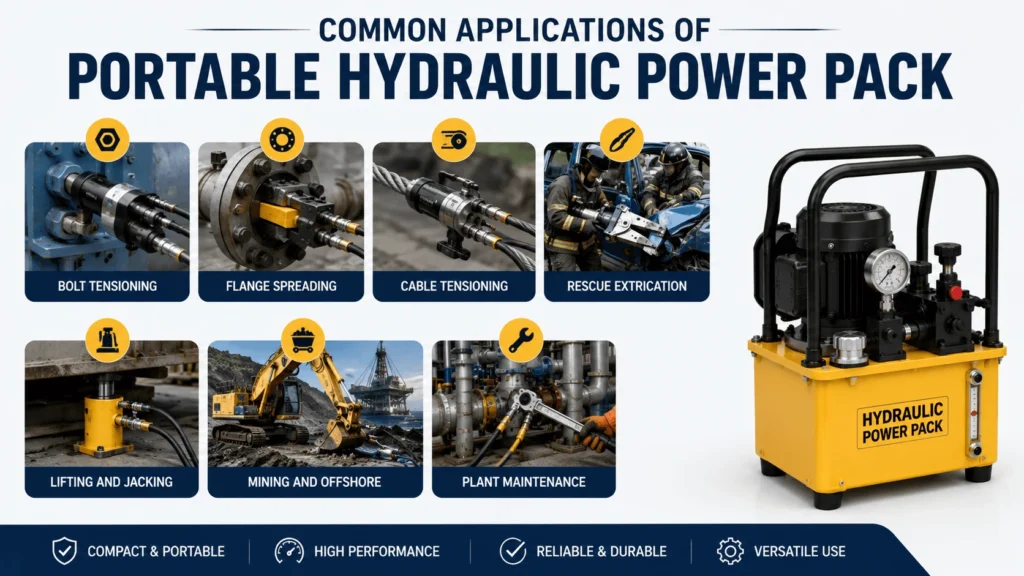
Common Applications

Common Applications of Portable Hydraulic Power Pack
  • Bolt tensioning: battery or hand pump units drive hydraulic tensioners on flange assemblies in oil, gas, and power generation.
  • Flange spreading: portable pumps drive spreader wedges that open pipe flanges for gasket replacement.
  • Cable tensioning: petrol units drive cable jacks for overhead line and bridge cable installation.
  • Rescue extrication: battery units, power spreaders, and cutters for vehicle rescue, where quiet operation and no exhaust matter.
  • Lifting and jacking: hand and battery pumps drive small hydraulic jacks for machinery alignment and structural lifting.
  • Mining and offshore: pneumatic or hand pump units suit explosive atmospheres where electric sparks are unsafe.
  • Plant maintenance: battery and hand pumps drive presses, pullers, and cylinder tools for in-plant repair without a stationary power unit.

Common Failures

Low Pressure or Slow Operation

The usual cause is internal pump leakage, a worn relief valve, or a clogged suction strainer. Check the relief setting first with a gauge. If pressure holds, check the flow at the tool. Low flow points to pump wear or a partial blockage.

Battery Unit Dies Quickly

Lithium packs lose capacity in cold weather. A 5 Ah pack that delivers 150 cycles at 20 degrees C may deliver 80 cycles at 5 degrees C. Check battery age too. Packs below 80 percent capacity need replacement.

Coupler Leaks

Flat-face couplers leak when the seal has a nick or when dirt sits on the face. Clean the face before connection, and replace the coupler if the seal has a cut. Threaded couplers leak when the thread seal wears out or the fitting works loose.

Oil Loss and Cavitation

Portable units lose oil through coupler disconnection and hose leaks. Low oil causes cavitation, foaming, and slow operation. Check oil level before each job, and top up with the correct grade.

Engine Failure (Petrol Units)

Petrol units fail on stale fuel, dirty carburetors, and fouled spark plugs. Run the engine dry if you store it for over a month. Use fresh fuel and check the air filter before long jobs.

Troubleshooting Guide

Symptom Likely cause Check
No pressure
relief valve stuck open
gauge reading, relief adjustment
Low pressure
pump wear or relief bypass
gauge at pump port, relief seat
Slow tool movement
low flow or wrong oil grade
flow at tool, oil viscosity
Battery dies fast
cold battery or aged pack
cycle count, temperature, pack age
Coupler leak
damaged seal or dirt on face
visual check, seal replacement
Pump noise
cavitation or low oil
oil level, suction strainer
Engine won’t start
stale fuel or fouled plug
fresh fuel, clean plug, air filter

Selection Checklist

  1. The tool force sets the required pressure.
  2. The tool volume sets required flow.
  3. Cycle count per job sets the power source.
  4. The tool volume sets the reservoir size
  5. The work environment sets an indoor or outdoor unit.
  6. Coupler standard sets hose compatibility.
  7. Weight budget sets hand, battery, or petrol.
  8. An explosive atmosphere sets hand or pneumatic.

Maintenance Best Practices

  • Check oil level before each job; top up with ISO VG 32 or 46 to the maker’s spec.
  • Replace the suction strainer every 500 hours or annually.
  • Sample oil for ISO 4406 cleanliness; target 20/18/15 or better.
  • Clean coupler faces before every connection; replace nicked seals.
  • Store batteries at 40 to 60 percent charge if unused for a month.
  • Run petrol engines dry before storage to prevent stale fuel.
  • Verify the relief setting with a gauge during annual service.
  • Inspect hoses for cuts and abrasion; replace at any sign of damage.

FAQ

What is a portable hydraulic power pack?

A portable hydraulic power pack is a self-contained pump, reservoir, valve, and relief package light enough for one person to carry. It drives hydraulic tools like bolt tensioners, flange spreaders, and cylinders at locations with no installed power source. Power sources include hand pumps, batteries, petrol engines, and pneumatic motors.

How does a portable hydraulic power pack work?

The power source drives a pump that pulls oil from a small reservoir and feeds it through a directional valve to the tool. The valve routes oil to extend or retract. A relief valve caps maximum pressure. A check valve holds the load when you stop pumping. Most portable units run single-acting circuits.

Hand pump or battery hydraulic power pack?

Choose a hand pump for low cycle count jobs where weight and simplicity matter most. Choose a battery unit for repeat work where speed saves time. A hand pump takes 125 strokes to fill a 1 L tool. A battery unit does it in 15 seconds. If your job has more than 10 cycles, go battery.

How much pressure can a portable hydraulic power pack produce?

Most portable units produce 350 to 700 bar. Hand pumps reach 700 bar at full stroke. Battery units reach 700 bar at 0.5 to 4 L/min. Petrol units reach 350 or 700 bar depending on pump type. Always match the pressure rating to your tool’s requirement.

What oil goes in a portable hydraulic power pack?

Use a clean hydraulic oil at ISO VG 32 for cold climates or VG 46 for warm climates. Keep cleanliness at ISO 4406 20/18/15 or better. Never mix grades. Never run with water-contaminated or foamy oil. Check oil level before each job, because portable reservoirs are small.

How long does a battery hydraulic power pack last per charge?

A typical 4 Ah or 5 Ah battery delivers 50 to 150 full cycles per charge, depending on pressure and tool volume. High-pressure work at 700 bar draws more current and reduces cycle count. Cold weather cuts capacity by 30 to 50 percent. Carry a spare battery for multi-hour jobs.

Which coupler standard should I use on a portable power pack?

Use ISO 16028 flat-face quick couplers for any modern portable tool. They connect under residual pressure, minimize oil loss, and wipe clean before connection. Threaded couplers suit older units or mining equipment. Match the coupler bore to your hose size, and never mix thread standards.

Conclusion

A portable hydraulic power pack trades flow and reservoir size for weight and carry-to-site convenience. Get the spec right, and the unit drives your tools all day in the field. Get it wrong, and you carry dead weight up three flights of stairs.

Before you buy, answer one question: how many cycles per job? That number sets your power source. Under 10 cycles, a hand pump wins. Between 10 and 150, a battery unit wins. Over 150 or longer than an hour, a petrol unit wins. Everything else follows from that choice.

Whether you are specifying a bolt tensioning pump, replacing a rescue tool power source, or building a field service kit, the ratings and sizing math above take you to a unit that fits the job.

Related Articles

Scroll to Top
Shoot Us An Email

Professional Manufacturer