Single Acting Hydraulic Cylinder: Types, Uses & Guide

Single Acting Hydraulic Cylinder- Types, Uses & Guide

Table of Contents

A single acting hydraulic cylinder moves a load in one direction under hydraulic pressure. Gravity, a spring, or an external force returns the rod. This simplicity suits lifting, clamping, and holding jobs where you skip the retract force.
 
Designers pick single-acting when the load itself does the return stroke. Dump trailers, scissor lifts, and bolt tensioners all rely on this principle. The hydraulic circuit pressurizes only one side, which halves the valving and simplifies plumbing.

What is a Single Acting Hydraulic Cylinder?

A single acting hydraulic cylinder has one hydraulic pressure port. That port sits on the cap end, the side opposite the rod. Fluid pressure pushes the piston outward during the extension stroke. The rod end stays open to the tank or atmosphere.
 
The retract stroke uses no hydraulic pressure. Instead, the load weight, a built-in return spring, or an external mechanical force pulls the rod back. That is the defining difference from a double acting cylinder, which pressurizes both sides.
Most single-acting cylinders work in the 50 to 210 bar range. Spring-return types cap near 160 bar because the spring must hold against reseat pressure. Gravity-return units reach 300 bar in heavy lift service.

How a Single Acting Hydraulic Cylinder Works

The extended cycle starts when the directional valve shifts to send pressurized oil to the cap-end port. Oil fills the cap-end chamber. Pressure builds against the full piston area. The output force equals pressure times piston area.
 
That force overcomes the load plus friction. The rod extends at a speed that the pump flow and bore area set together. A check valve or closed-center valve holds the load when the pump stops.
Retract works differently. The valve opens the cap-end port to the tank. Gravity pulls the load down, or the return spring pushes the piston back. Oil exits the cap end and drains to the reservoir. The rod end never sees pressure.

Single Acting vs Double Acting Cylinder
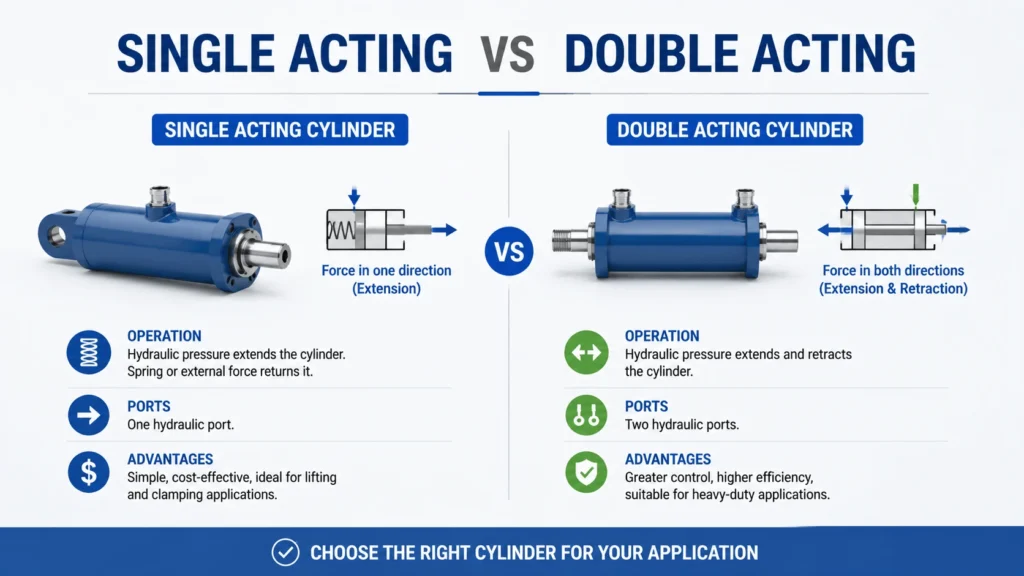
Single Acting vs Double Acting Cylinder
Feature Single acting Double acting
Pressure ports
One (cap end)
Two (cap + rod end)
Retract force
None hydraulic
Hydraulic
Directional valve
3-way, 2-position
4-way, 3-position
Hose count
One pressure line
Two pressure lines
Stroke control
Extend only
Both directions
Typical cost
Lower
Higher
Best fit
Lift/lower, clamp
Push-pull, mid-stroke hold
A single-acting cylinder wins on cost and simplicity when the load returns itself. A double-acting cylinder wins when you need powered retract, mid-stroke holding, or precise position control.

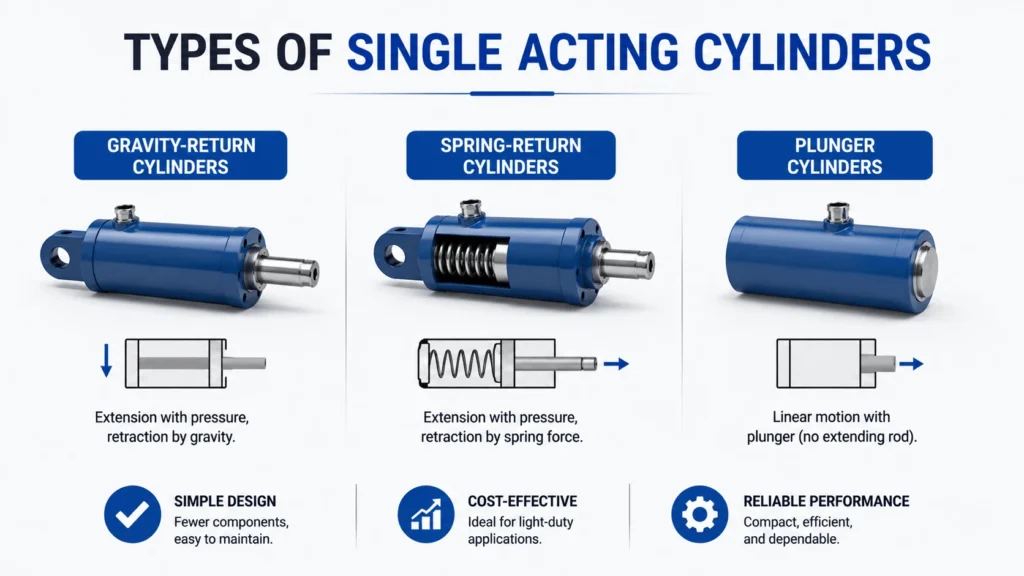
Types of Single Acting Cylinders

Types of Single Acting Cylinders

Gravity-Return Cylinders

The load weight retracts the rod. These cylinders lift platforms, dump bodies, and lift gates. They need the load to always push down. The cap-end port opens to tank for retract.
Gravity-return suits long strokes up to several meters on telescopic hoists. Pressure ratings reach 210 to 300 bar for heavy truck hoists.

Spring-Return Cylinders

A coil spring inside the barrel pushes the piston back when pressure releases. These fit clamping, braking, and short-stroke actuation. The spring adds a counter-force during extend, which lowers usable output force.
Spring-return limits stroke length. Most stay under 500 mm before coil bind becomes a problem. Pressure tops out near 160 bar. Common uses include machine tool clamps and fail-safe brake actuators.

Plunger Cylinders

A plunger cylinder has no piston seal. The rod itself acts as the piston. The barrel has no internal honing. These lift loads straight up and rely fully on gravity to retract.
Plungers work in car lifts and stage lifts. They handle 70 to 210 bar. The simple bore keeps cost low.

Key Components

Single-acting cylinders share most parts with double-acting units. The cap end has a piston seal, barrel, end cap, and pressure port. The rod end has a wiper seal and rod bearing, but no pressure seal.

The return spring, when fitted, sits between the piston and the rod-end head. Spring material is music wire or chrome-silicon alloy for fatigue life.

For a full parts breakdown, see the guide on parts of a hydraulic cylinder.

Force and Speed Calculations

The extend force follows one formula. Force in newtons equals pressure in pascals times piston area in square meters. In practical shop units, force in kN equals pressure in bar times bore area in cm² divided by 10.

Worked example: a 100 mm bore cylinder at 160 bar gives 12.6 kN extension force. The math is 160 times 78.5 cm² divided by 10.

Retract force comes from the spring or gravity, not hydraulics. Spring force drops as the rod extends, so design for the minimum spring force at full extension.

The extended speed depends on the pump flow. Speed in mm/s equals flow in L/min times 1000, divided by bore area in cm² times 60. Double the flow, and you double the speed.

Advantages

  • Lower cost than double-acting, with one port, a simpler valve, and one hose
  • Simpler hydraulic circuit, using a 3-way valve instead of a 4-way valve
  • Fewer leak paths, with a single pressure seal at the cap end
  • Lower oil volume, since the rod-end side vents to the tank
  • Natural fail-safe on pressure loss, as gravity or a spring retracts the rod
  • Easier to plumb on mobile equipment with moving joints

Limitations

  • No powered retract, so the load must self-return
  • No mid-stroke position holding without an external pilot check valve
  • Spring-return strokes cap around 500 mm before coil bind
  • Spring force subtracts from extend force, lowering usable output
  • Rod-end side leaks oil if the wiper fails
  • Slower retraction than a powered double-acting unit

Industrial Applications of Single Acting Hydraulic Cylinder
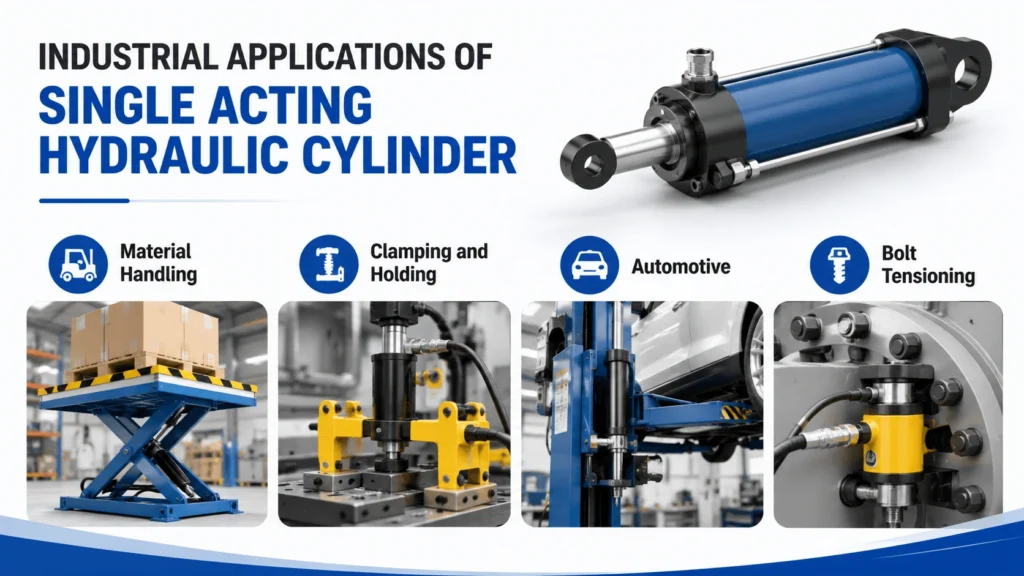
Industrial Applications of Single Acting Hydraulic Cylinder

Material Handling

Dump trailers, lift gates, and scissor lifts use gravity-return single-acting cylinders. The load always pushes down. A telescopic single-acting hoist lifts dump truck beds up to 9 meters stroke.

Clamping and Holding

Machine tool fixtures use spring-return cylinders to clamp parts. Releasing pressure unclamps the part automatically. This gives a clean fail-safe if air or hydraulic power drops.

Automotive

Hydraulic jacks, car lifts, and bus door actuators use plunger or spring-return cylinders. The simple bore and one-port plumbing keep costs down. Brake calipers use single-acting pistons at each wheel.

Bolt Tensioning

Portable bolt tensioners use single-acting cylinders to stretch large bolts. The operator dials in pressure, tightens the nut, then releases pressure. A return spring retracts the tool.

Selection Guide

Choose single-acting when all of these apply. The load returns itself by gravity or external force. You do not need a powered retract. Stroke length fits the return method, under 500 mm for spring and unlimited for gravity. Cost and plumbing simplicity matter.
 
Switch to double-acting when any of these apply. You need force in both directions. You need precise retract speed control. You must hold a position mid-stroke under varying loads. The load does not self-return.
 
Check the bore against the required force at your pressure limit. Add a 20% margin for friction and wear. Verify the return method handles the load mass in the retract.

Installation and Maintenance Tips

Mount gravity-return cylinders rod-up so the load pulls down. Spring-return units can mount in any orientation, but verify that the spring can push the load back.
 
Plumb one pressure line from the directional valve to the cap-end port. Route the rod-end vent to a low-point drain or back to the tank. Never plug the rod end, or trapped air will stall the cylinder.
 
Hold oil cleanliness to ISO 4406 18/16/13. Contaminant in the cap-end seal groove causes the most failures. Inspect the rod chrome for scoring every 500 hours. Replace the wiper at the first sign of oil misting past the rod.

Common Problems and Troubleshooting

Slow or no extension. Check pump pressure and flow. Verify the directional valve shifts fully. Look for a blocked cap-end port or a kinked hose.
 
Rod will not retract. On gravity return, check that the load actually pulls down and the valve opens to the tank. On spring return, the spring may be fatigued or broken. Measure free length against spec.
 
Spongy extend. Air trapped in the cap-end chamber. Bleed the port at the top of the stroke. Refill to clear air pockets.
 
External oil leak at the rod. Wiper or rod seal worn. Inspect the rod surface for scoring. Replace both seals as a set.
 
Spring fatigue. Extend force rises, and the retract gets sluggish. Spring-return cylinders need spring replacement every 1 to 3 million cycles, depending on duty.

FAQ

When should I use a single acting vs double acting cylinder?

Use single-acting when the load returns itself by gravity or external force, and you need no powered retraction. Use double-acting when you need force in both directions, mid-stroke holding, or precise retract control.

How does a single acting cylinder retract?

The retract stroke uses no hydraulic pressure. Gravity pulls the load down, a return spring pushes the piston back, or an external force pulls the rod. The cap-end port opens to tank so oil drains out.

How far can a spring-return cylinder stroke?

Most spring-return single-acting cylinders stay under 500 mm stroke. Longer strokes need a spring long enough to avoid coil bind, which raises cost and lowers force.

What pressure do single acting cylinders run?

Most run 50 to 210 bar. Spring-return types cap near 160 bar because the spring must hold against pressure. Gravity-return hoists reach 300 bar for heavy truck and industrial lift duty.

Can a single acting cylinder hold a load mid-stroke?

Only with an external pilot-operated check valve. The cylinder itself has no hydraulic lock. When the valve opens to tank, the load drops. A pilot check valve locks oil in the cap end when pressure drops.

Do single acting cylinders use the same seals as double acting?

The cap-end piston seal matches. Single-acting units do not need a rod-end pressure seal, only a wiper and rod bearing. Seal kit part numbers differ, so confirm with the OEM.

Conclusion

A single acting hydraulic cylinder earns its place wherever the load does the return work. Gravity, a spring, or an external force pulls the rod back. That removes the need for a second pressure port, a second hose, and a 4-way valve. The result is lower cost and simpler plumbing.
 
Match the return method to the job. Gravity-return handles long-stroke lifts. Spring-return fits short-stroke clamps and brakes. Plunger cylinders serve simple vertical lifts. Pick single-acting when the load self-returns, and switch to double-acting the moment you need powered retract or mid-stroke control.
 

Related Articles

Scroll to Top
Shoot Us An Email

Professional Manufacturer