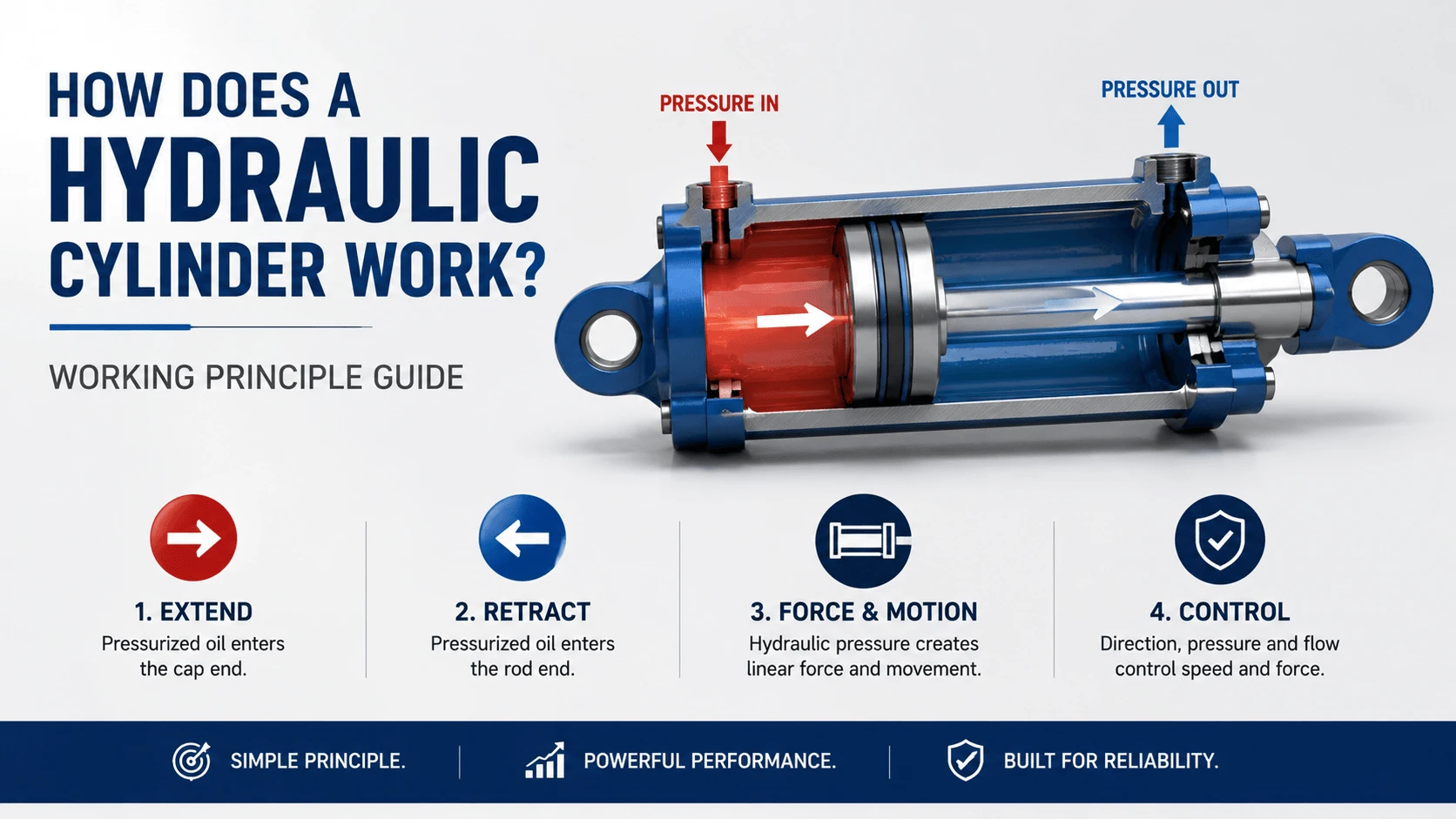
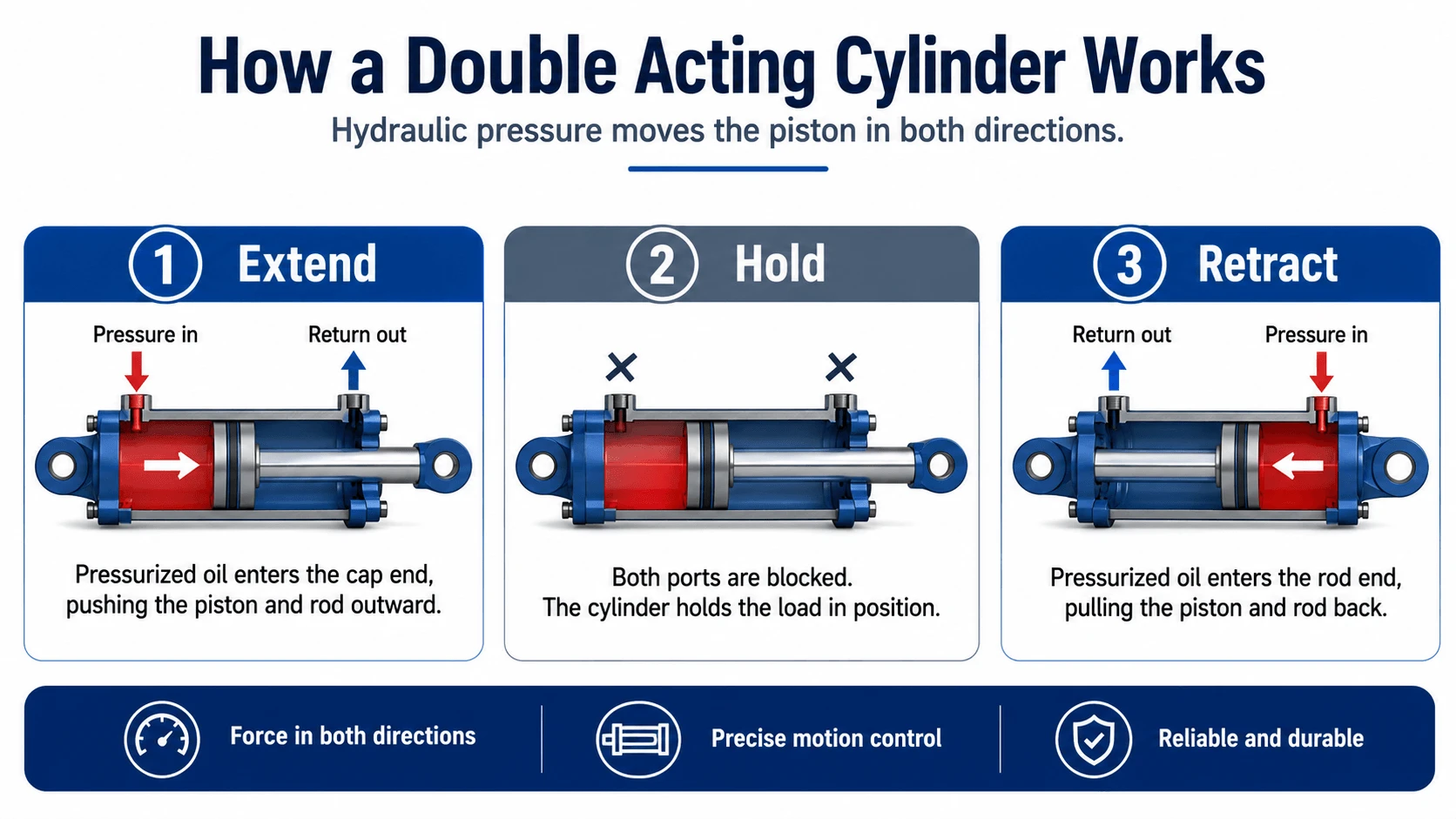
A double acting cylinder works in three states: extend, hold, and retract. The directional control valve decides which state the cylinder is in.
Extend
The valve sends pump flow to the cap-end port. Oil fills the cap-end chamber, and pressure builds against the full piston face. When pressure times area exceeds load plus friction, the piston moves. Rod-end oil exits through the rod-end port and returns to the tank.
The extended speed depends on pump flow and piston area. The extent of force depends on system pressure and the same area. The cylinder pushes at full bore force for the whole stroke.
Hold
The valve returns to center. Both ports close on a closed-center valve. Oil stays trapped on both sides of the piston, and the load stops where it is. For a tighter hold, a pilot-operated check valve locks the cap-end line directly at the cylinder.
Holding has limits. A worn piston seal lets oil slip from the cap end to the rod end. The cylinder then drifts under load even with both ports closed.
Retract
The valve sends pump flow to the rod-end port. Pressure acts on the annulus, the ring-shaped piston face around the rod. Cap-end oil flows back to the tank. The piston pulls the rod in.
Retract force is lower than the extension force because the rod eats part of the piston area. Retract speed is higher for the same reason. A smaller area fills faster at the same flow.
Why Extend and Retract Differ
The rod creates the asymmetry. The extended pressure acts on the full bore area. Retract pressure acts on the bore area minus the rod area. That ring-shaped remainder is the annulus area.
Take a 100 mm bore with a 56 mm rod. The bore area is 78.5 cm². The rod area is 24.6 cm². The annulus area is 53.9 cm², about 69% of the bore.
The consequences show up in both force and speed:
How a Single Acting Cylinder Works
A single-acting cylinder has one pressure port at the cap end. Pressure extends the rod exactly as it does on a double-acting unit. The difference is the return stroke. Nothing hydraulic pulls the rod back.
Gravity, a return spring, or an external load does the retract work. The valve opens the cap-end port to the tank. The load pushes oil out of the chamber as the rod comes back. The rod end stays vented to the atmosphere.
This suits lifts, clamps, and jacks where the load always pushes back. The circuit needs one hose and a simpler 3-way valve. Our single acting hydraulic cylinder guide covers return methods, stroke limits, and force trade-offs in detail.
Force and Speed Calculations
Two formulas predict almost everything a cylinder does.
Force in kN equals pressure in bar times area in cm² divided by 10. Speed in m/s equals flow in L/min divided by area in cm² times 6.
Worked example for the 100 mm bore, 56 mm rod cylinder at 210 bar and 60 L/min:
- Extend force: 210 × 78.5 ÷ 10 = 1649 kN ÷ 10, so about 165 kN
- Retract force: 210 × 53.9 ÷ 10, so about 113 kN
- Extend speed: 60 ÷ 78.5 ÷ 6, so about 0.127 m/s
- Retract speed: 60 ÷ 53.9 ÷ 6, so about 0.185 m/s
Two practical rules follow. Raising pressure raises force. Raising flow raises speed. If a cylinder feels weak, check the pressure. If it feels slow, check the flow. Most field complaints trace back to one of those two numbers.
Size the bore with a 20 to 25% force margin above the calculated load. That margin covers seal friction, guide wear, and pressure drops through valves and hoses.
Regeneration Circuits
A regeneration circuit makes a double-acting cylinder extend faster without a bigger pump. The valve routes rod-end oil back into the cap end instead of sending it to the tank. Both sides of the piston see the same pressure.
The forces do not cancel. Pressure on the full bore area beats pressure on the annulus area, so the net force still extends the rod. The net force equals pressure times the rod area alone.
Speed rises because the pump flow only needs to fill the rod-area volume. The rod-end flow adds to the pump flow at the cap end. Extend speed can double or better, at the cost of most of the extend force.
Machine tools use regeneration for fast approach, then switch to full-force mode for the working stroke. It is a cheap way to get two speeds from one pump.
Cushioning: Slowing the Piston at Stroke End
A piston moving at speed carries real kinetic energy. Let it slam the end cap at full flow and the shock spikes pressure, hammers mounts, and shortens seal life. Cushions solve this at each end of the stroke.
As the piston nears the end, a cushion spear closes off the main exhaust port. The trapped oil escapes through a small adjustable orifice. The restriction builds back pressure and decelerates the piston smoothly over the last 15 to 25 mm.
Cushions matter once piston speed passes about 0.1 m/s or the moving mass gets heavy. High-cycle machines with fast strokes almost always need them. A needle valve at each end cap tunes the deceleration rate.
The Cylinder in the System
A cylinder never works alone. Four components around it decide how it behaves.
The pump sets the available flow, which sets the speed. The relief valve caps the system pressure, which caps the force. The directional valve routes flow for extend, hold, and retract. Load-holding valves, such as pilot-operated checks or counterbalance valves, keep a suspended load from dropping.
Counterbalance valves deserve a note on vertical loads. They add back pressure on the rod end so a hanging load cannot run away during retract. Without one, a boom or platform can drop faster than the pump can feed the cap end. The cylinder then cavitates, and the load falls uncontrolled.
Oil condition drives working life. Hold cleanliness to ISO 4406 18/16/13 for general industrial cylinders and 16/14/11 for servo-controlled positioners. Dirty oil scores rods and grinds seals, and then the working principle stops mattering because the cylinder leaks past itself.
Common Working Problems
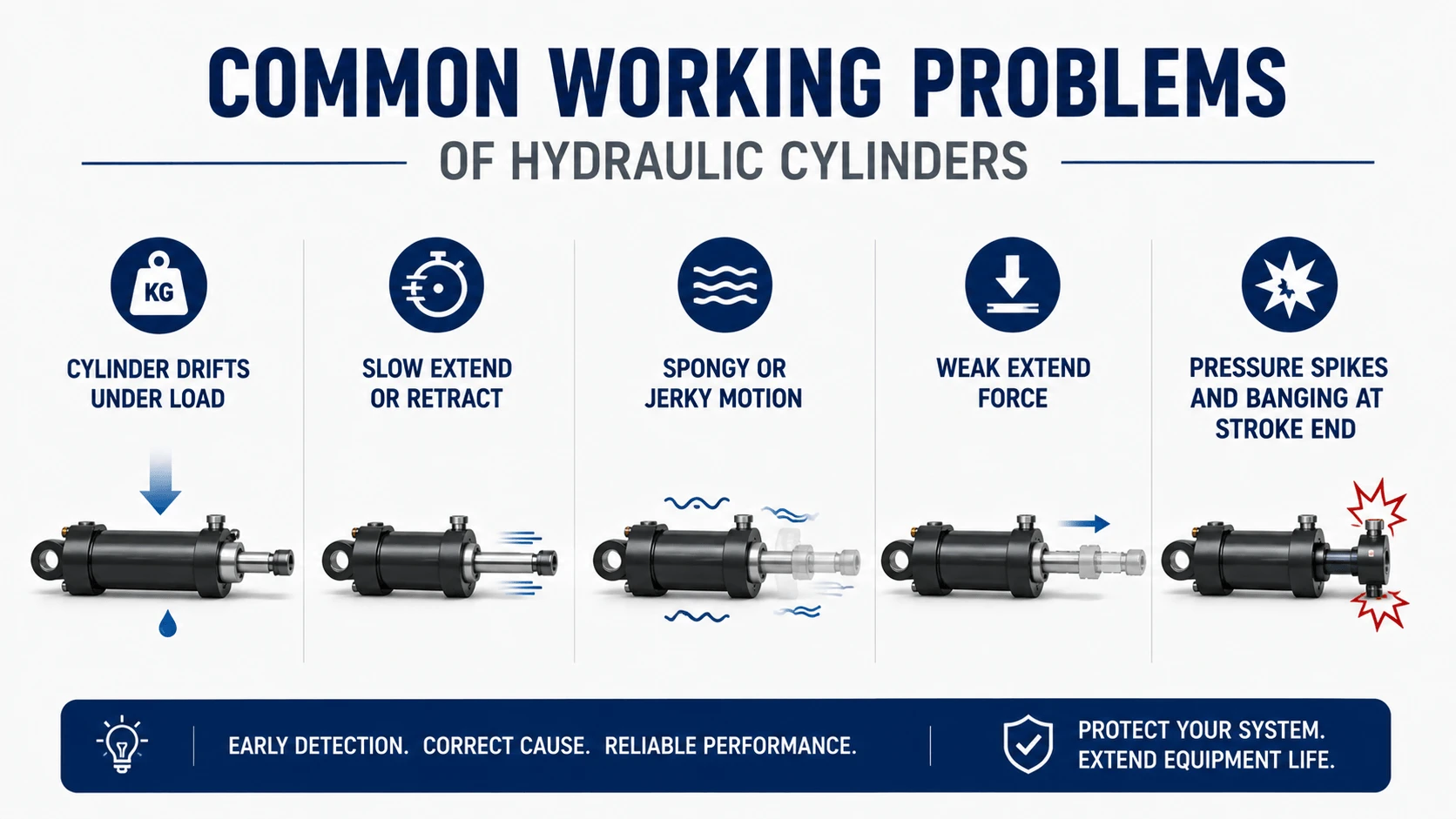
Cylinder drifts under load
Oil slips past the piston seal into the rod end, or the holding valve leaks. Isolate the cylinder ports and watch for movement. Movement with sealed ports means piston seal bypass. No movement points to the valve.
Slow extend or retract
Flow has dropped. Look for a worn pump, a clogged suction strainer, or a relief valve passing oil back to tank. Heat across the relief valve confirms bypass flow.
Spongy or jerky motion
Air sits in the oil. Cycle the cylinder end to end at low pressure to purge it. Check suction line fittings for air leaks if the problem returns.
Weak extend force
Pressure at the cap port reads low, or the piston seal bypasses and caps effective pressure. Gauge the cap port first, then run the drift test.
Pressure spikes and banging at stroke end
Cushions are missing, worn, or closed too tight. Back the cushion needle out a quarter turn and retest.
FAQ
What makes a hydraulic cylinder move?
Pressurized oil acting on the piston area. Force equals pressure times area, so pressure on the full bore face drives the rod out. The directional valve decides which chamber gets pump flow and which drains to tank.
Why is retract force lower than extend force?
The rod occupies part of the piston face on the rod-end side. Retract pressure acts on the annulus area only, which is the bore area minus the rod area. Less area at the same pressure means less force.
Why does a cylinder retract faster than it extends?
The rod-end chamber holds less oil than the cap-end chamber because the rod takes up volume. The same pump flow fills that smaller volume faster. Speed difference typically runs 30 to 50% depending on rod diameter.
How does a hydraulic cylinder hold a load in place?
A closed-center valve or pilot-operated check valve traps oil in the chambers. The incompressible oil column locks the piston. A worn piston seal defeats this by letting oil bypass internally, which causes drift.
What is a regeneration circuit on a cylinder?
A valve connection that routes rod-end oil back into the cap end during extend. Both sides see equal pressure, and the net force equals pressure times rod area. Extend speed rises sharply, but force drops to a fraction of normal.
What pressure do hydraulic cylinders run at?
Mobile equipment cylinders typically run 210 to 350 bar. Industrial press and mill cylinders run 160 to 315 bar per ISO 6020 and ISO 6022 ratings. Heavy-duty and jacking cylinders reach 700 bar.
Conclusion
A hydraulic cylinder works because confined fluid transmits pressure, and pressure on a piston area creates force. The extend stroke pushes with the full bore area. The retract stroke pulls with the smaller annulus area, so it runs faster but weaker. The valve decides which chamber fills and which drains.
From there, the details shape performance. Regeneration trades force for speed. Cushions absorb end-of-stroke energy. Load-holding valves keep suspended loads safe. Clean oil keeps the whole cycle working for years instead of months. Understand pressure, area, and flow, and you can predict exactly what any cylinder will do.