
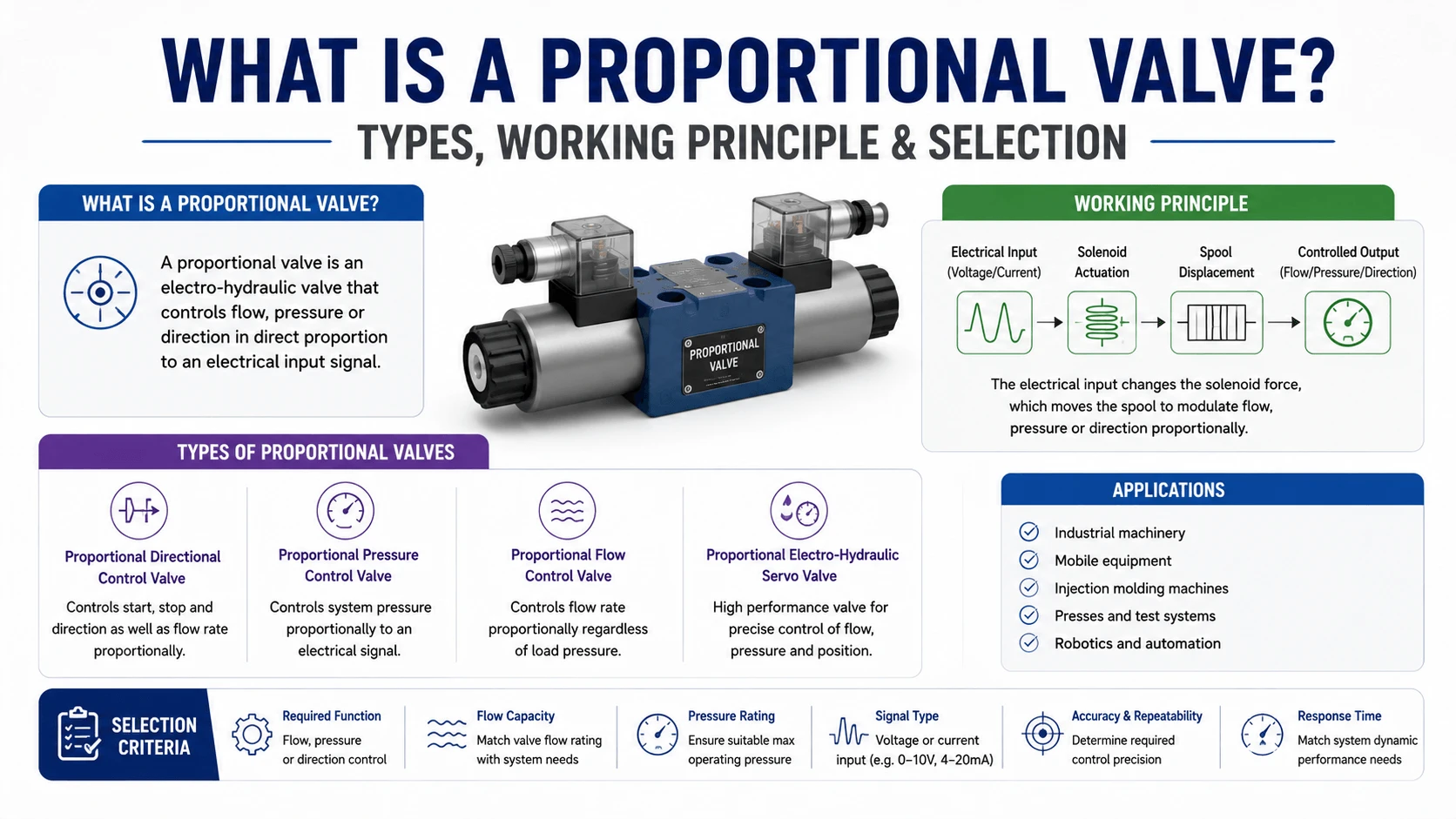
Introduction
A buyer who specs an on/off solenoid valve can shop almost blind. Two suppliers quoting the same NG6 CETOP pattern and 24 V coil will usually ship a working part. Sourcing a hydraulic proportional valve does not work that way. Two factories can quote identical rated flow and pressure, then deliver valves that perform nothing alike.
The gap hides in the spool machining, the solenoid force curve, the electronics, and the test coverage. A datasheet alone will not expose it. This guide covers what to verify on the datasheet and how to qualify a supplier. It targets buyers who need a hydraulic proportional valve at production volume. For the physics, hysteresis, and dead-band theory, read our proportional valve engineering guide first.
Why Hydraulic Proportional Valve is Hard to Source
An on/off directional valve has two states. The factory machines a spool with positive overlap, drops in a switching solenoid, and the valve either flows or blocks. Tolerances matter, but the binary job forgives a lot. A hydraulic proportional valve asks the spool to hold any position between two stops. Flow forces push back through the whole stroke. The solenoid must produce a force proportional to current across that range.
That demands a controlled magnetic circuit in the solenoid. It needs a precision-ground spool with machined notches. A driver converts a 0 to 10 V or 4 to 20 mA command into a stable PWM current. Add an LVDT for closed-loop feedback, and the valve becomes an electro-hydraulic control system, not a plumbing part.
Two factories can buy the same steel and solenoid wire and still build very different valves. The difference lies in grinding tolerance, coil winding consistency, and amplifier tuning. A datasheet lists the result. It does not show the process behind it.
Spec Sheet Verification: What to Check Before You Quote
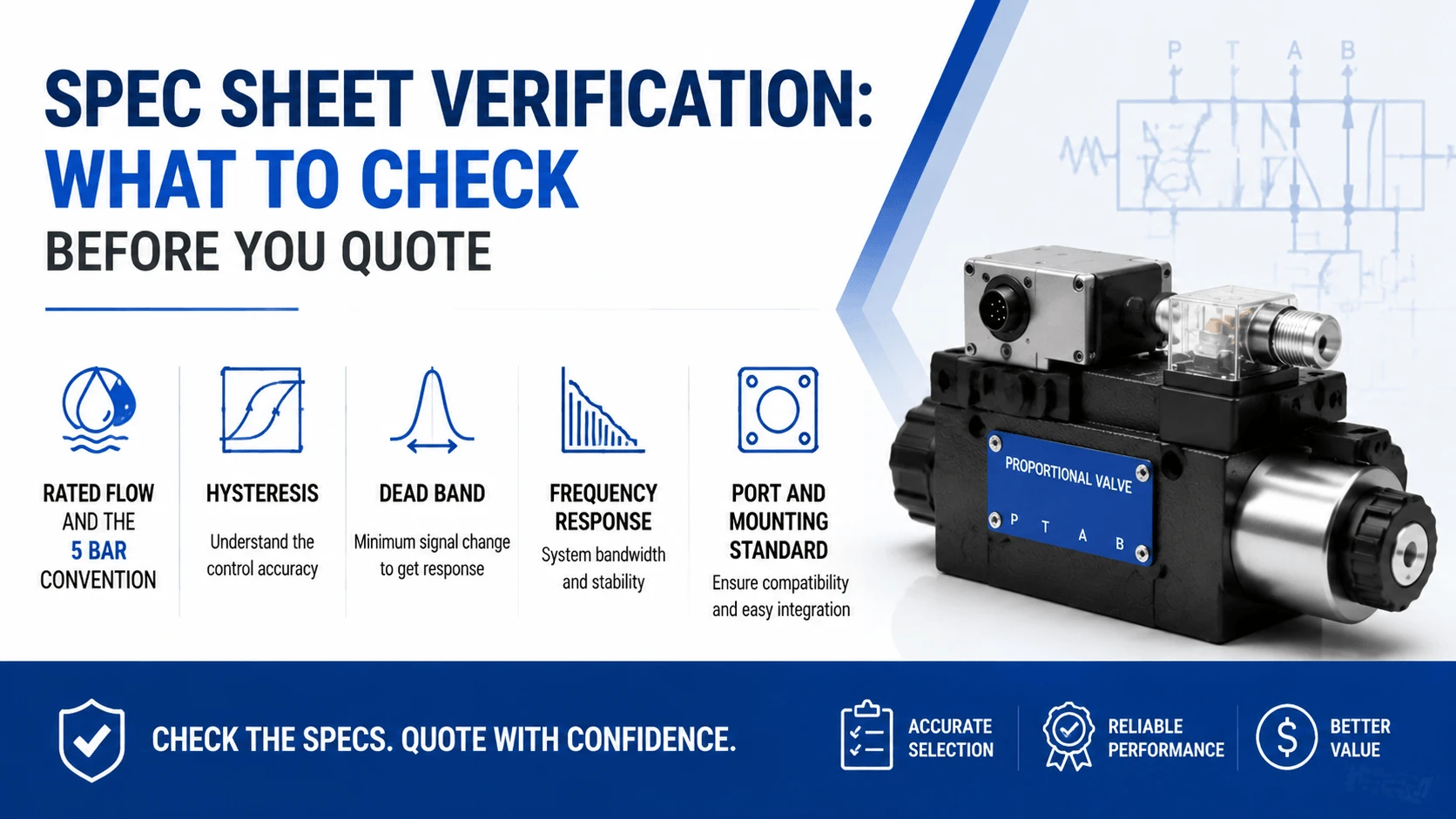
The datasheet is where most sourcing mistakes happen. Suppliers know buyers compare rated flow, pressure, and hysteresis, so those numbers get optimized.
Rated Flow and the 5 Bar Convention
Manufacturers rate proportional directional valves at 5 bar pressure drop per control edge, not at system pressure. A valve rated 80 L/min at 5 bar per edge flows far less at 210 bar system pressure. When you compare two hydraulic proportional valve datasheets, confirm both quote flow at 5 bar per edge. If one quotes nominal flow at 10 bar, the number is not comparable, and the valve is likely undersized.
Hysteresis
Open-loop valves run 1 to 6 percent hysteresis. Closed-loop valves with LVDT feedback run under 0.3 percent. If a datasheet claims under 0.3 percent with no position feedback, treat the number as copied, not measured. Demand the test method.
Dead Band
Open-loop proportional valves carry a 10 to 20 percent dead band around center because of spool overlap. The amplifier jumps over it. Closed-loop valves nearly eliminate it. A datasheet that quotes zero dead band on an open-loop valve is lying.
Frequency Response
Proportional valves quote a -3 dB frequency response between 5 and 30 Hz. High-response versions reach 60 Hz. If the number looks high for the size, ask for the amplitude-sweep test curve, not the headline.
Port and Mounting Standard
ISO 4401 / CETOP patterns in NG6, NG10, NG16, and NG25 are the industry default. Ports should follow ISO 6149 or SAE J1926. A supplier that lists threaded ports without an ISO or SAE number leaves you guessing on tooling.
Valve Types You Will Be Asked to Source
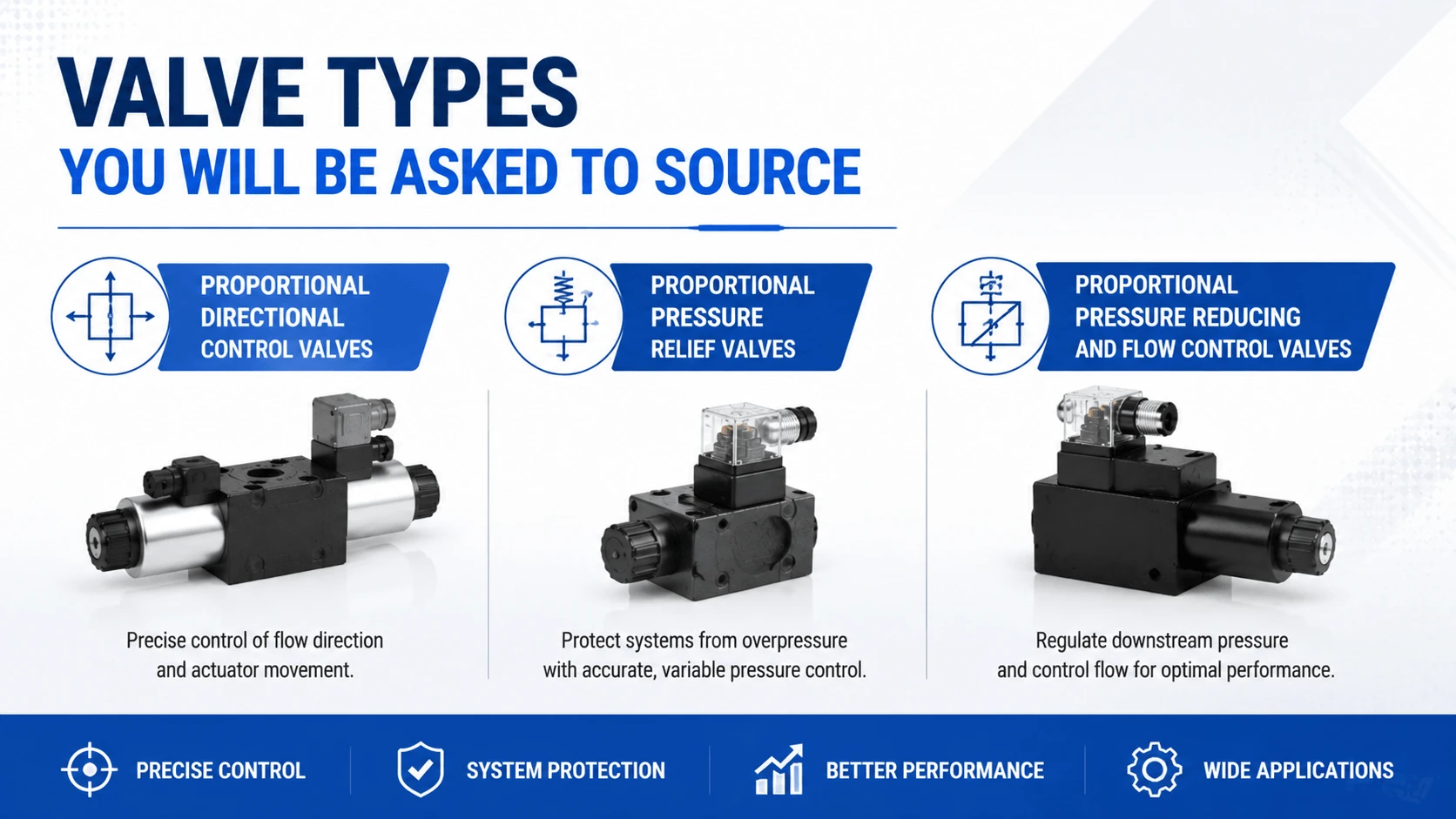
Most buyers source four proportional valve families. The engineering differences matter less than the sourcing differences here. Each type has a different supplier base and counterfeit risk profile.
Proportional Directional Control Valves
Proportional directional control valves dominate the volume. They replace a directional valve plus a flow control valve in one body. The valve controls actuator speed and direction under electronic command. NG6 and NG10 cover most industrial duties. This is the type most often relabeled or faked, because the exterior looks identical to an on/off valve.
Proportional Pressure Relief Valves
Proportional pressure relief valves let a PLC program system pressure across a machine cycle. Direct-operated versions handle pilot and low-flow duty to 350 bar. Pilot-operated versions handle main system pressure on presses and injection machines. The supplier base here is smaller because the pilot stage demands precision grinding.
Proportional Pressure Reducing and Flow Control Valves
Proportional pressure-reducing valves branch a lower-pressure circuit off a high-pressure main. They need a drain line back to the tank, and buyers miss that detail on the datasheet. Proportional flow control valves meter flow independent of load pressure, using a pressure compensator.
For the full physics, working principle, and type comparison, read our proportional valve engineering guide. This sourcing guide focuses on how to buy them.
NG Size to Flow Mapping (Sourcing Reference)
The NG size sets the flow range and the price bracket. Suppliers quote rated flow at 5 bar per control edge. The mapping below covers proportional directional valves from reputable makers. Use it to sanity-check a datasheet before you request a quote.
| NG size | Mounting standard | Typical rated flow (L/min) | Common pressure (bar) | Typical use |
|---|---|---|---|---|
NG6 (NG06) |
ISO 4401 / CETOP P4.4 |
40-80 |
up to 350 |
Small cylinders, test stands, mobile auxiliary |
NG10 |
ISO 4401 / CETOP P7.2 |
80-300 |
up to 350 |
Mid-size presses, injection molding, machine tools |
NG16 |
ISO 4401 / CETOP P8.2 |
300-700 |
up to 350 |
Large presses, steel mills, marine |
NG25 |
ISO 4401 / CETOP |
700-1000 |
up to 315 |
Heavy mobile, mining, energy |
NG32 |
ISO 4401 / CETOP |
1000-1500+ |
up to 315 |
Very large industrial presses |
If a supplier quotes an NG6 hydraulic proportional valve at 150 L/min, the number is wrong. The test pressure is likely not 5 bar per edge. An NG6 body physically cannot meter 150 L/min at the rated pressure drop without choking. This table is the single fastest way to catch an inflated datasheet.
Certifications and Standards to Require
A proportional valve crosses mechanical, electrical, and fluid-power standards. Require these on every quote, and reject suppliers who cannot produce the certificates.
| Standard | What it covers | Why it matters for sourcing |
|---|---|---|
ISO 9001 |
Quality management system |
Proves the factory runs documented processes, not ad-hoc assembly |
CE marking |
EU conformity (machinery, EMC) |
Required for shipment into the EU; covers the amplifier electronics |
ISO 4401 / CETOP |
Valve mounting pattern |
Guarantees the valve drops into your manifold without re-machining |
ISO 6149 / SAE J1926 |
Port thread and o-ring boss |
Confirms the port matches your fittings and torque spec |
ISO 4406 |
Fluid cleanliness code |
Sets the target oil cleanliness the valve needs to survive |
Material certificate (3.1) |
Steel grade and heat treatment traceability |
Proves the spool and body steel match the spec, not a substitute grade |
A supplier without ISO 9001 runs an undocumented shop. A supplier without a 3.1 material certificate cannot prove the spool steel. A supplier that cannot quote ISO 4406 cleanliness targets does not understand the product. These gaps predict field failure.
Factory Testing: What a Qualified Supplier Does
The test report separates a real manufacturer from an assembler. A qualified supplier tests every hydraulic proportional valve before shipment. It logs the result against the serial number and includes the report in the box. A loose supplier batch-tests one in ten and cannot produce a per-unit record.
Ask for a sample test report with your quote request. A real report includes four measurements.
| Test | What it measures | Pass criterion |
|---|---|---|
Hysteresis curve |
Spool position vs input signal, up and down |
Within datasheet spec (open-loop <6%, closed-loop <0.3%) |
Step response |
Time to reach commanded position from step input |
Within datasheet spec (typically 10-60 ms) |
Frequency response |
-3 dB point under sinusoidal input |
Within datasheet spec (5-30 Hz, high-response to 60 Hz) |
Internal leakage |
Flow from pressure port to tank at neutral |
Below datasheet limit |
Cleanliness flush |
Final ISO 4406 code of the valve |
Meets target (18/16/13 or better for proportional) |
A factory that cannot produce these curves does not own a test bench. A factory that produces them for every serial number treats the valve as a control product, not a commodity. That distinction predicts whether your second order matches your first.
OEM, ODM, and Custom Manufacturing
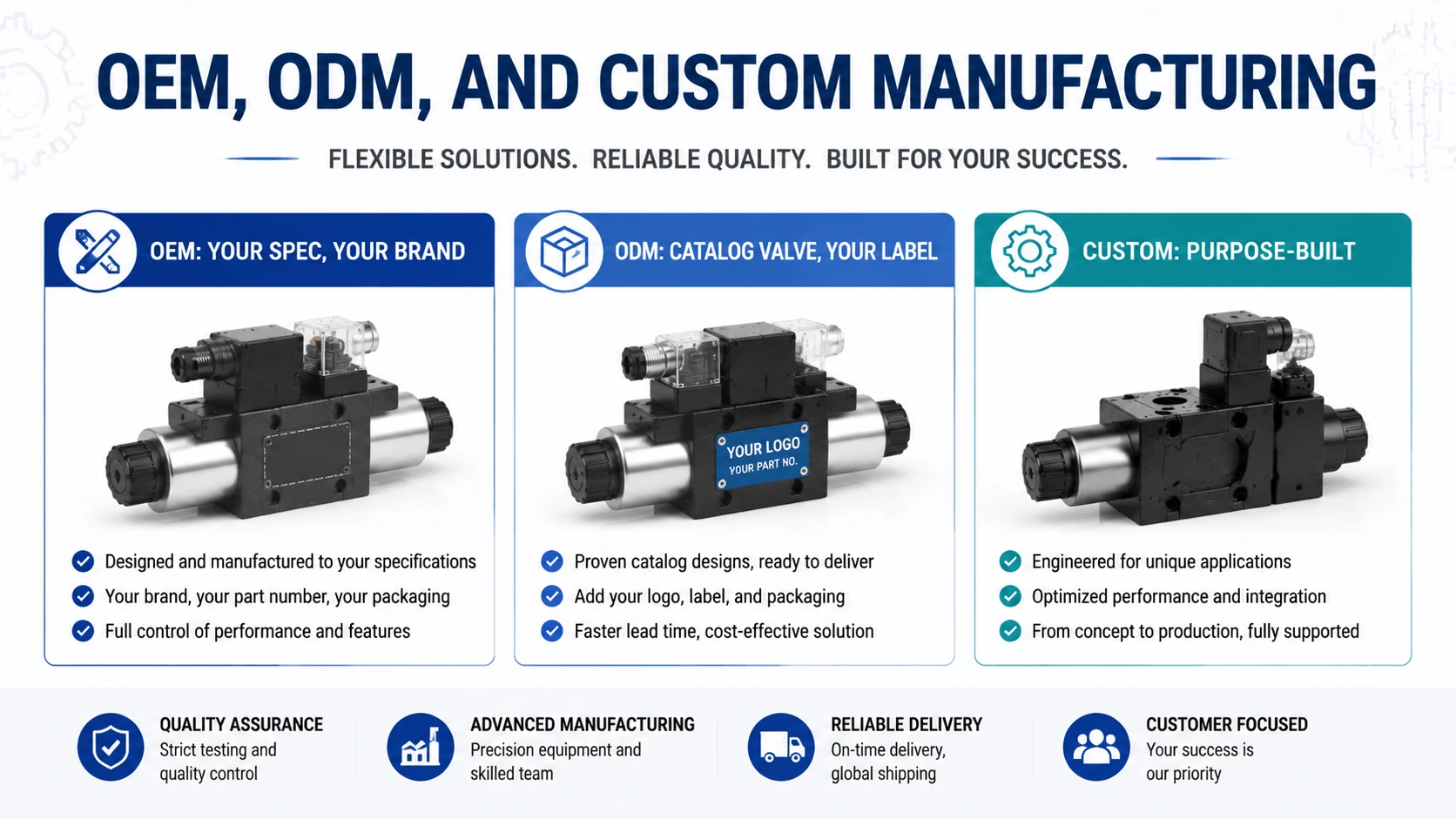
Three buying models exist, and they set your cost, lead time, and brand control. Most buyers pick the wrong one because the names blur.
OEM: Your Spec, Your Brand
OEM means the supplier builds a valve to your full specification and stamps your part number. You own the design data. The factory commits to a production line and a tooling setup. This model fits high-volume buyers who want brand control and repeatable supply.
ODM: Catalog Valve, Your Label
ODM means the supplier builds its own existing design and lets you relabel it. You pick from a catalog, apply your logo, and skip design cost. This model fits distributors and mid-volume buyers who need a working valve fast without engineering investment.
Custom: Purpose-Built
Custom means the supplier develops a valve to your requirements that does not exist in any catalog. This covers non-standard NG sizes, integrated electronics, special porting, or unique spool notches. Custom runs carry an NRE charge and a longer lead time, but they solve problems no catalog valve can.
For a standard NG6 or NG10 hydraulic proportional valve, choose ODM and save the engineering cost. For a valve that must fit a proprietary manifold or meet a unique response curve, choose OEM or custom.
MOQ, Lead Time, and Pricing Structure
MOQ and lead time depend on the buying model and the channel. A trading company ships one unit from stock. A real factory sets a minimum and runs a production batch.
| Channel / model | Typical MOQ | Lead time | Price tier |
|---|---|---|---|
Trading company (stock) |
1 unit |
1-2 weeks |
Highest per unit |
Factory ODM (catalog) |
10-50 units |
4-8 weeks |
Mid |
Factory OEM (your spec) |
50-100 units |
8-12 weeks |
Lower at volume |
Custom development |
50-100 units |
12-20 weeks |
NRE + per-unit |
Standard NG6 and NG10 catalog valves run four to eight weeks from the factory. OEM runs add a setup and tooling phase. Custom runs stretch to twelve to twenty weeks because the supplier machines fixtures, winds prototype solenoids, and tunes the amplifier. A supplier quoting two weeks on a custom hydraulic proportional valve is lying or cutting corners.
Pricing tracks the NG size, the feedback type, and the electronics. An open-loop NG6 valve costs a fraction of a closed-loop NG25 valve. The electronics often cost more than the hydraulic body on high-response versions. China-source valves run 30 to 60 percent below European equivalents. Supplier variance is wider, so the qualification step matters more.
Supplier Red Flags and Counterfeit Risk
Counterfeit proportional valves cost more than counterfeit on/off valves. The failure hides until the load needs stepless control. A relabeled on/off directional valve looks identical on the outside. It fails the first time the circuit demands a proportional metering ramp.
Common Red Flags
Watch for these red flags. A datasheet that copies hysteresis and frequency-response numbers from a premium brand verbatim. A supplier that cannot produce a per-unit test report. A price 70 percent below the market with no explanation. A valve stamped with a famous brand but sold through an unofficial channel. A supplier that refuses a sample order or an audit.
The Safest Sourcing Path
The safest path runs through an authorized distributor or a factory-direct relationship. A brand stamp proves nothing. A test report against a serial number proves everything. If a supplier cannot tie a serial number to a logged hysteresis curve, walk away.
How to Qualify a New Supplier
Qualification protects the buyer from the variance that defines proportional valve sourcing. Run a four-step process on every new supplier before the first production order.
Step 1: Request a Paid Sample
Request a sample against your spec. Pay for it. A real factory accepts a paid sample order. A trading company resists, because it cannot control production.
Step 2: Audit the Factory
Audit the factory or send a third-party inspector. Walk the test bench. Ask to see a hysteresis curve logged against a serial number. If the bench exists and the staff can run it, the factory builds valves. If not, it assembles them.
Step 3: First Article Inspection
Run a PPAP-style first article inspection. Lock the spool drawing, the solenoid spec, the amplifier tuning, and the test limits. The first article must match the spec on every measurable point.
Step 4: Small Production Order
Place a small production order and track the consistency. Measure hysteresis and step response across the batch. If the variance exceeds the datasheet tolerance, the factory cannot hold the process. Stop before the volume order.
Cost Drivers and Where the Money Goes
A buyer who understands cost drivers negotiates better and specs smarter. The price of a proportional valve splits across four cost centers, and the split shifts with the valve type.
| Cost center | Share of cost | What drives it |
|---|---|---|
Spool and body machining |
25-35% |
Grinding tolerance, notch geometry, steel grade |
Proportional solenoid |
20-30% |
Magnetic circuit design, coil winding consistency |
Electronics and amplifier |
15-35% |
Open-loop driver vs closed-loop LVDT controller |
Assembly and testing |
10-20% |
Per-unit test coverage vs batch sampling |
Certifications and overhead |
5-10% |
ISO 9001, CE, material certs, documentation |
Where the Cost Shifts by Valve Type
The electronics share climbs sharply on closed-loop and high-response valves. A closed-loop NG10 valve can cost 1.5 to 2.5 times the open-loop version. Most of that gap lives in the LVDT and the amplifier. The machining share dominates on large NG25 and NG32 bodies, where the steel and grinding time set the price.
The Open-Loop Price Trap
A supplier that quotes a closed-loop valve at open-loop prices is cutting the electronics, the testing, or both. The valve arrives, runs for a week, and drifts. Pay for the cost center that matters to your application.
Sourcing Checklist
Use this checklist on every quote before you commit. It catches the mistakes that cost the most later.
| Check | Pass criterion |
|---|---|
Rated flow quoted at 5 bar per control edge |
Yes, with test pressure stated |
Hysteresis matches feedback type |
Open-loop 1-6%, closed-loop <0.3% |
Dead band stated |
Open-loop 10-20%, closed-loop near zero |
Frequency response curve available |
-3 dB point with amplitude sweep |
NG size matches flow claim |
Per the NG-to-flow table |
Port and mounting standard specified |
ISO 4401/CETOP, ISO 6149 or SAE J1926 |
ISO 9001 and material cert 3.1 provided |
Current certificates on file |
Per-unit test report with serial number |
Hysteresis curve + step response |
Sample order accepted |
Paid sample against your spec |
MOQ and lead time realistic |
Per the channel table |
A quote that fails three or more rows is not a deal. It is a risk. Walk through every row before you place the order.
FAQ
How do I find a reliable proportional valve supplier?
Start with the test report. A supplier that logs a hysteresis curve against every serial number builds real valves. One that cannot is an assembler or a trader. Ask for a sample report with your first quote.
What specs must I verify before buying?
Verify the rated flow convention at 5 bar per control edge. Check hysteresis against the feedback type, dead band, the frequency-response curve, and the port standard. Confirm the NG size matches the flow claim per the mapping table.
What is a realistic MOQ for proportional valves?
A trading company ships one unit. A factory ODM catalog order runs 10 to 50 units. An OEM order runs 50 to 100. Custom development runs 50 to 100 plus an NRE charge.
How long does production take?
Standard catalog valves run four to eight weeks. OEM runs add a setup phase and reach eight to twelve weeks. Custom runs stretch to twelve to twenty weeks for fixture machining and amplifier tuning.
What factory testing should I demand?
Demand a per-unit report with a hysteresis curve, a step response, a frequency-response sweep, and a leakage check. All four must log against the serial number. Batch testing one in ten is not enough for a control valve.
Are Chinese proportional valve suppliers reliable?
The better Chinese factories have closed much of the engineering gap and run 30 to 60 percent below European prices. Supplier variance is wider, so the qualification process matters more. Audit the test bench before the volume order.
How do I spot a fake proportional valve?
A relabeled on/off directional valve looks identical outside and fails on the first proportional ramp. Demand the per-unit hysteresis curve. If the supplier cannot tie a serial number to a logged curve, the valve is not what the label claims.
Conclusion
Sourcing a proportional valve comes down to one question: can the supplier prove what it builds? A datasheet full of clean numbers proves nothing without a per-unit test report behind it. The rated-flow convention, the hysteresis curve, and the factory test bench separate a real maker from an assembler.
Specify the valve, verify the datasheet, demand the test report, and qualify the supplier before the volume order. Skip these steps, and you get a valve that drifts and a second order that matches nothing. Run the process and you get repeatable control at the right price.