Hydraulic Radial Piston Pump: 700 Bar High-Pressure Guide

Hydraulic Radial Piston Pump- 700 Bar High-Pressure Guide

Table of Contents

Introduction

Some hydraulic jobs demand more pressure than any gear or vane pump can deliver. Press clamping, accumulator charging, bolt tensioning, and test-bench work all push past 350 bar. That is where the hydraulic radial piston pump earns its place.

This guide covers working principles, the two architectures, pressure and flow ranges, and selection. We wrote it for engineers who specify and maintain high-pressure circuits. Real numbers follow: pressure bands, flow limits, efficiency targets, and cleanliness rules.


What is a Hydraulic Radial Piston Pump

A hydraulic radial piston pump is a positive-displacement pump. Its pistons sit radially around the drive shaft, like the spokes of a wheel. Each piston rides in its own cylinder bore.
 
An eccentric element converts shaft rotation into piston stroke. The pistons draw fluid in on one half turn and push it out on the other. Output scales with piston size, number, and stroke.
Radial piston pumps lead the pressure field. Most designs run 400 to 700 bar continuous. Specialized units reach 1000 bar peak for test and clamping duty.

How a Hydraulic Radial Piston Pump Works

The drive shaft turns an eccentric journal or eccentric ring. Pistons bear against this eccentric surface through shoes or rollers. As the shaft rotates, the eccentricity pushes each piston in and pulls it out.
 
On the outward stroke, the piston uncovers a suction port or opens a suction check valve. Fluid fills the expanding cylinder. On the inward stroke, the suction closes and the discharge check valve opens.
 
Check valves in each cylinder give radial pumps their high-pressure tightness. They seal better than the port-plate timing of axial pumps. That seal integrity lets radial pumps hold 700 bar without internal slip.

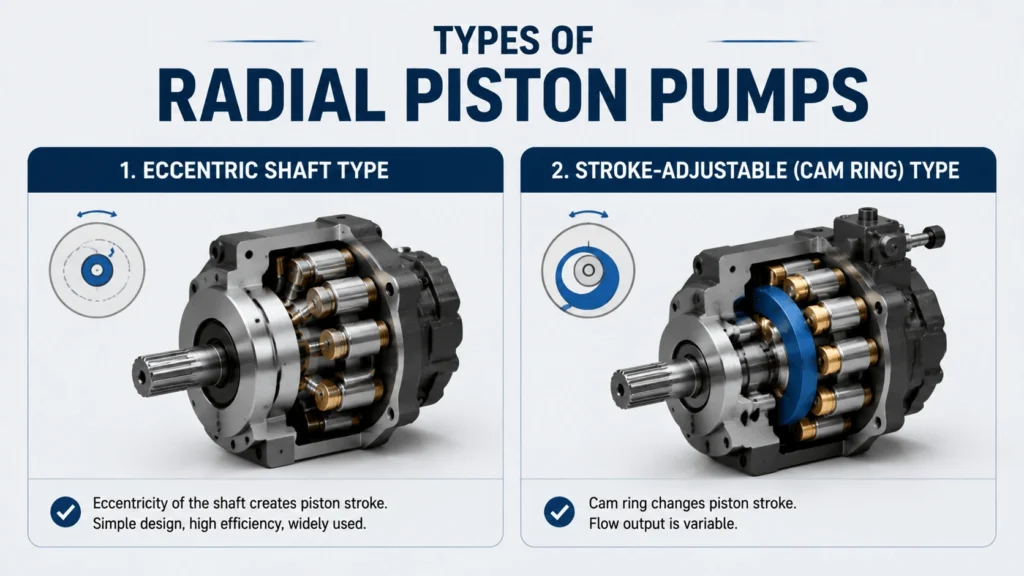
Types of Radial Piston Pumps

Types of Radial Piston Pumps

Eccentric Shaft Type

The eccentric shaft design uses a simple offset journal. Pistons sit in a fixed cylinder block around the shaft. The shaft eccentricity sets the stroke, and stroke equals twice the offset.
This type runs fixed displacement only. It trades adjustability for simplicity and strength. Press builders and accumulator chargers favor it for steady high-pressure duty.

Stroke-Adjustable (Cam Ring) Type

The cam ring type places pistons between an inner shaft and an outer reaction ring. Shifting the ring eccentricity changes the piston stroke. Zero eccentricity means zero flow.
This design gives true variable displacement. Bosch Rexroth and several European builders offer it for press circuits. It saves energy when hold pressure dominates the cycle.

Key Specifications of Hydraulic Radial Piston Pump
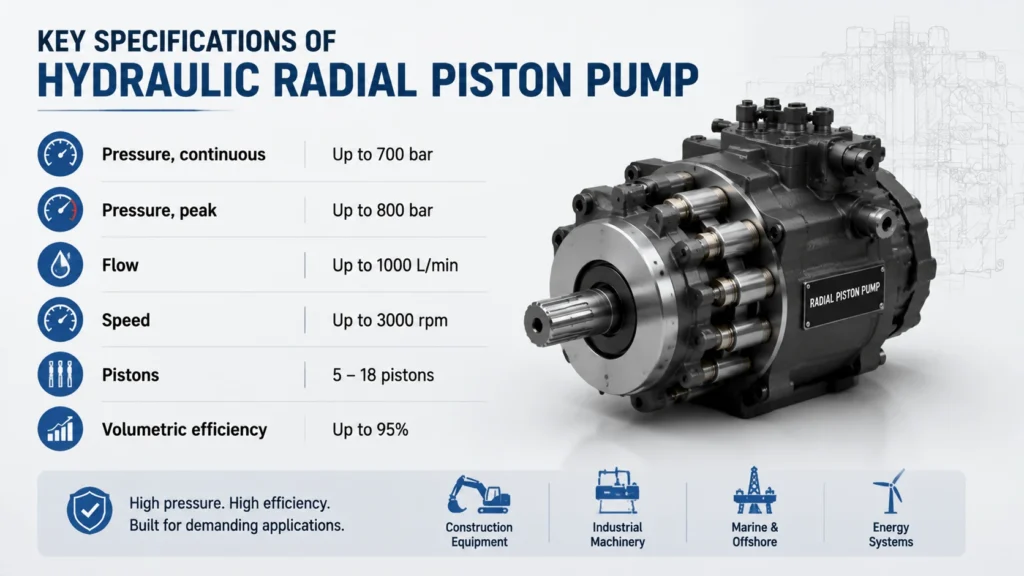
Key Specifications of Hydraulic Radial Piston Pump
Match the pump to your circuit pressure first. Radial pumps shine at 400 to 700 bar, far above vane or gear limits. Flow stays modest because high pressure and small pistons go together.
Specification Typical range Notes
Pressure, continuous
400 to 700 bar
Some reach 1000 bar
Pressure, peak
800 to 1000 bar
Short-duration clamping
Flow
0.5 to 100 L/min
High pressure, low flow
Speed
1000 to 2000 rpm
Lower than axial pumps
Pistons
5, 7, or 9
Odd count cuts pulsation
Volumetric efficiency
95 to 98 percent
Best of all pump types
Volumetric efficiency above 95 percent is normal. The check-valve sealing loses almost no fluid. That efficiency holds even at 700 bar.

Radial vs Axial Piston Pump

Engineers often choose between radial and axial piston pumps. The split comes down to pressure versus flow. Axial pumps deliver more flow at lower pressure. Radial pumps deliver less flow at higher pressure.
Feature Radial piston Axial piston
Max pressure
700 to 1000 bar
350 to 450 bar
Max flow
to 100 L/min
to 500+ L/min
Speed
1000 to 2000 rpm
1500 to 3000 rpm
Weight per kW
High
Low
Variable displacement
Some designs
Most designs
Contamination tolerance
Medium
Low

Pick axial pumps for excavator travel and high-flow mobile circuits. Pick radial pumps when your circuit needs 500 bar or more. A 1000-bar test bench has no use for an axial pump.

Advantages and Disadvantages

Advantages

  • Highest pressure rating of any hydraulic pump type
  • Volumetric efficiency up to 98 percent
  • Long service life under continuous high load
  • Check-valve sealing holds pressure with minimal slip
  • Compact footprint relative to pressure output
  • Low pulsation with 7 or 9 pistons

Disadvantages

  • Heavy and bulky for a given flow
  • Speed capped near 2000 rpm by check-valve inertia
  • Higher cost than gear or vane pumps
  • Variable displacement is less common than axial
  • The limited flow range restricts mobile use

Industrial Applications

Radial piston pumps own the high-pressure niche. Hydraulic presses use them for clamping and holding pressure. The pump holds 500 bar on a clamp for hours with little heat.

Steel mills run them for hydraulic screw-down and roll balance circuits. The high pressure and durability suit 24-hour continuous duty. Test benches use radial pumps to calibrate relief valves and burst-test pipe.

Accumulator charging favors the eccentric shaft type. The pump tops off a nitrogen-charged bottle at 600 bar and sits idle until pressure drops. Bolt tensioning and flange spreading tools run portable radial pumps in the field.

Common Problems and Troubleshooting

Symptom Likely cause Action
No flow at startup
Suction check valve stuck
Clean valve, check oil cleanliness
Pressure drop under load
Discharge valve seat wear
Lap or replace valve seat
Loud knocking
Piston or roller wear
Inspect piston shoes and ring
Overheating
Contaminated oil or low level
Sample oil, top up reservoir
Erratic pressure
Air trapped in cylinders
Bleed at high point, check suction
Case drain flow rising
Internal wear
Trend drain flow, plan rebuild
Check-valve pumps fail differently than port-plate pumps. A stuck suction valve starves the cylinder. A worn discharge seat leaks pressure back. Listen for knocking and trend the case drain.

Selection Guide

Start with your required pressure. Below 350 bar, choose axial, vane, or gear pumps instead. Radial pumps only make sense when you need 400 bar or more.
Then size the flow. Radial pumps top out near 100 L/min. If you need both high pressure and high flow, run two pumps in parallel. Or split your press and clamp circuits.
Pick fixed displacement for accumulator charging or steady clamping. Pick stroke-adjustable variable type when your cycle alternates high flow and hold pressure. Match the port to your manifold: SAE 4-bolt flanges handle the high pressure best.

Installation and Maintenance Tips

Mount the pump below reservoir level to flood the suction. High-pressure radial pumps dislike inlet vacuum. A flooded inlet prevents cavitation at the suction check valves.
Fill the case with filtered oil before startup. Dry starts score the piston bores within seconds. Run the pump unloaded for the first few minutes to bleed air.
Keep the oil clean. ISO 4406 18/16/13 protects the check valves and piston bores. Replace filters before the bypass indicator trips. Trend case drain flow every month. A drain flow above 5 percent of nominal signals wear.

FAQ

What is a hydraulic radial piston pump used for?

Engineers use radial piston pumps for high-pressure circuits above 400 bar. They run hydraulic presses, test benches, accumulator chargers, and clamping systems. The pump holds high pressure with minimal internal slip.

How does a radial piston pump work?

Pistons sit radially around an eccentric shaft or ring. The eccentricity drives each piston in and out once per revolution. Suction and discharge check valves control flow direction in each cylinder.

What pressure can a radial piston pump reach?

Most radial pumps run 400 to 700 bar continuous. Specialized clamping and test units reach 800 to 1000 bar peak. That pressure range exceeds every other hydraulic pump type.

Radial or axial piston pump?

Choose axial for high flow at 250 to 400 bar. Choose radial when you need 500 bar or more. Radial pumps cost more and flow less, but no other type reaches their pressure.

Can a radial piston pump be variable displacement?

Yes, in the cam-ring or stroke-adjustable design. Shifting the reaction ring changes piston stroke. Zero eccentricity stops flow while the pump holds pressure.

Why does my radial pump knock?

Knocking usually means piston or roller wear. Check the case drain flow trend first. A rising drain flow confirms internal wear before the knock gets loud.

Conclusion

The radial piston pump owns the top of the hydraulic pressure range. No other pump type matches its 700 to 1000 bar capability. For presses, test benches, and clamping circuits, it has no real substitute.
Size it for pressure first, then accept the modest flow. Keep the oil clean and the suction flooded. Trend the case drain flow. A well-maintained radial pump runs decades in continuous high-pressure duty.

Related Articles

Scroll to Top
Shoot Us An Email

Professional Manufacturer